The Winter auction will feature Southern antiques, fine art, silver, and jewelry from the estates of Dr. Thomas Courtenay of Shelbyville, KY; Tony Marion of Blountville, TN; Marilyn S. Bullock of Knoxville; William Dullea of Nashville; Robert Thomson of Nashville; Dorothy Wellford of Memphis; and other Southern institutions and collections.
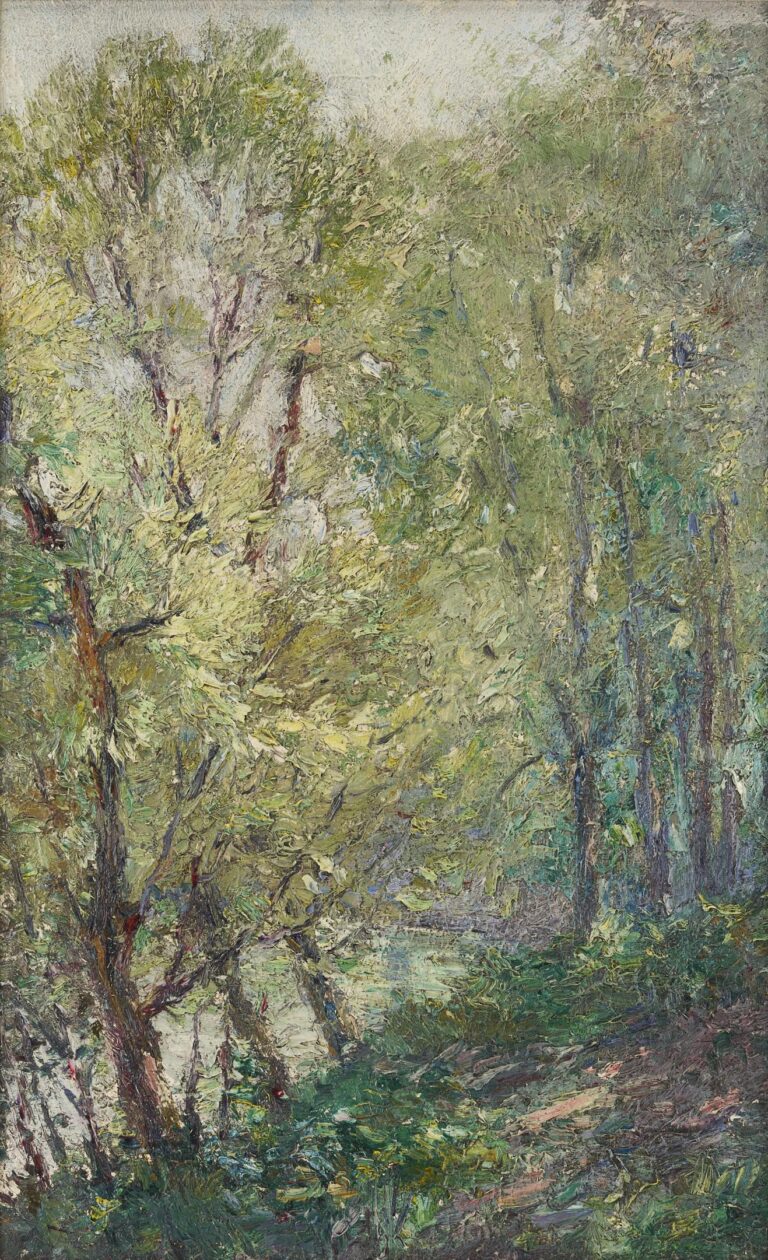
Anna Catherine Wiley (Tennessee, 1879-1958) oil on canvas painting that depicts a wooded hillside with a shady path in the foreground and river or other body of water visible through tall trees. Sunlight illuminates the water’s surface and branches of the trees while it casts dappled highlights onto the forest floor. Rendered in gustural impasto. Unsigned. Housed in a giltwood frame with textile liner. Sight: 23 3/8 in. H x 14 3.8 in. W. Canvas: 24 in. H x 15 in. W. Framed: 29 3/4 in. H x 20 3/4 in. W. Note: According to a written statement provided by Marliyn S. Bullock, Ernest Wiley, brother of the artist, presented three Catherine Wiley paintings to Knoxville’s Dulin Gallery for purchase in 1972. The Dulin Gallery selected one of these paintings, “Morning,” now in the collection of the Knoxville Museum of Art. As the Dulin Gallery chose not to purchase the remaining two paintings, Bullock, then the Executive Director of the Dulin Gallery, purchased the present painting from Ernest Wiley for her private collection.
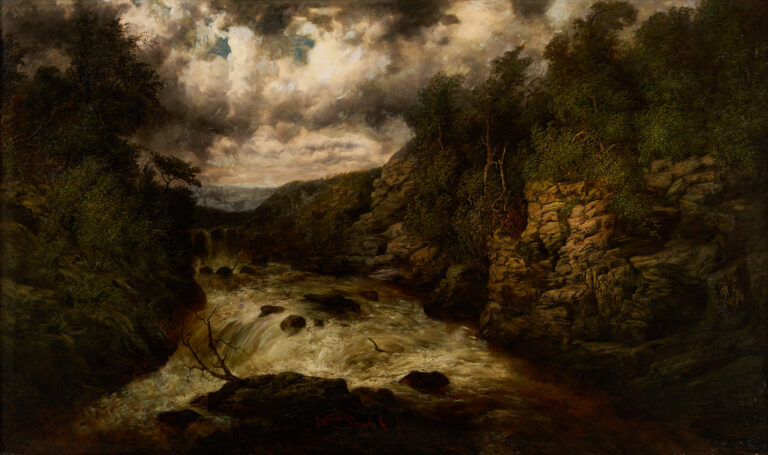
William Charles Anthony Frerichs (Belgian/American, 1829-1905) North Carolina oil on canvas wilderness river scene. Signed WCA Frerichs lower center, and dated 1885. Original giltwood molded frame with floral banding. Stretcher: 36 in. H x 60 in. W. Frame: 41 1/2 in. H x 65 1/2 in.
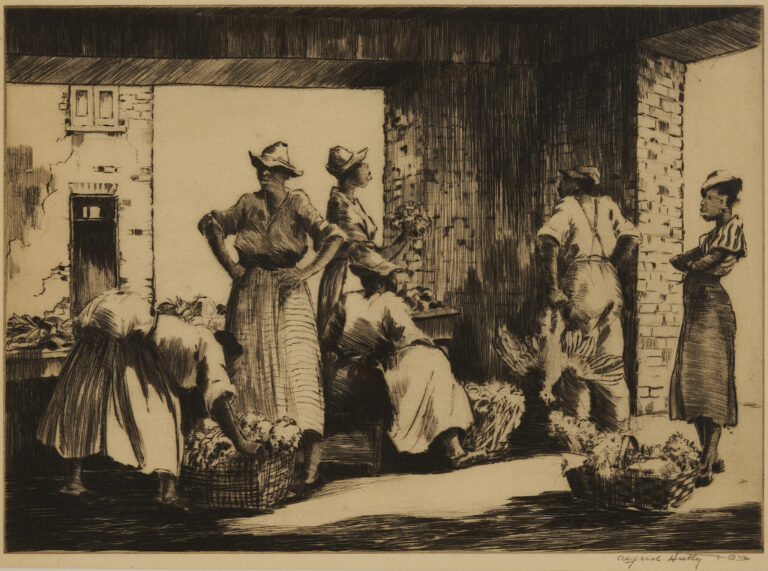
Alfred Heber Hutty (South Carolina, 1877-1954) drypoint entitled “Charleston Market. A group of African American women sell flowers from a stall in Charleston, SC. A man at right holds a chicken by the feet and a well-dressed woman stands in the doorway with arms folded. From the edition of 75. Signed in pencil along with snail cypher, lower right. Housed under glass in a distressed giltwood frame with cream mat. Sheet: 8 1/8 in. H x 10 5/8 in. W. Sight: 6 7/8 in. H x 9 7/16 in. W. Framed: 14 1/8 in. H x 16 5/8 in. W. 1938. Note: Listed as no. 158 and illustrated p. 151 in The Life and Art of Alfred Hutty: Woodstock to Charleston, edited by Sara C. Arnold and Stephen G. Hoffius, with Catalog of Known Prints by Edith Howle, The University of South Carolina Press, 2012. An example of this print is in the collection of the Gibbes Museum of Art / Carolina Art Association.
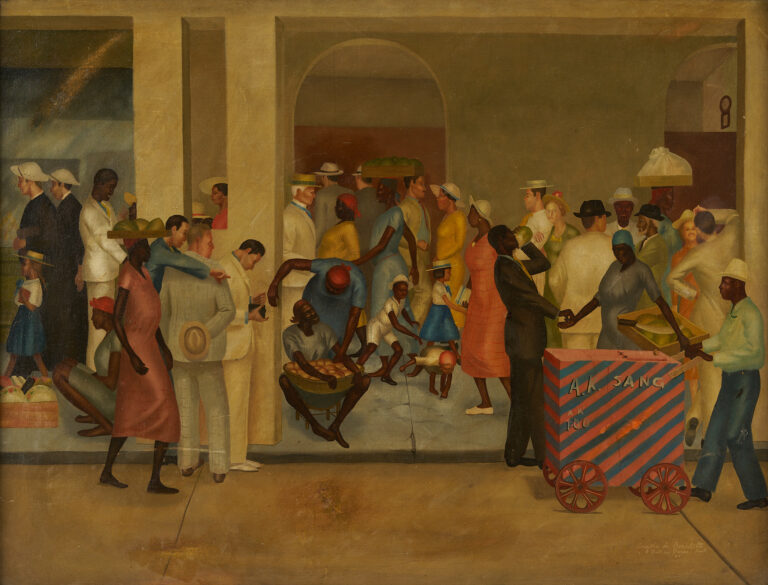
Angelo Benedetto (American, 1913-1992) oil on canvas, “Port au Prince, Haiti, 1939.” The Social Realist street scene portrays a bustling crowd of more than 34 individual figures, moving through a covered section of a train station and engaged in various activities. The scene includes street vendors, monks, uniformed schoolgirls, women carrying fruit atop their heads, children playing, and businessmen and ladies of diverse nationalities attired in fashionable white suits and hats. Signed, dated and titled lower right. Period carved giltwood frame with card for Elsie Anderson, Nashville (possibly a framer). Sight: 33 1/2 in. H x 25 1/2 in. W. Frame: 36 1/2 in. W x 28 1/2 in. H.
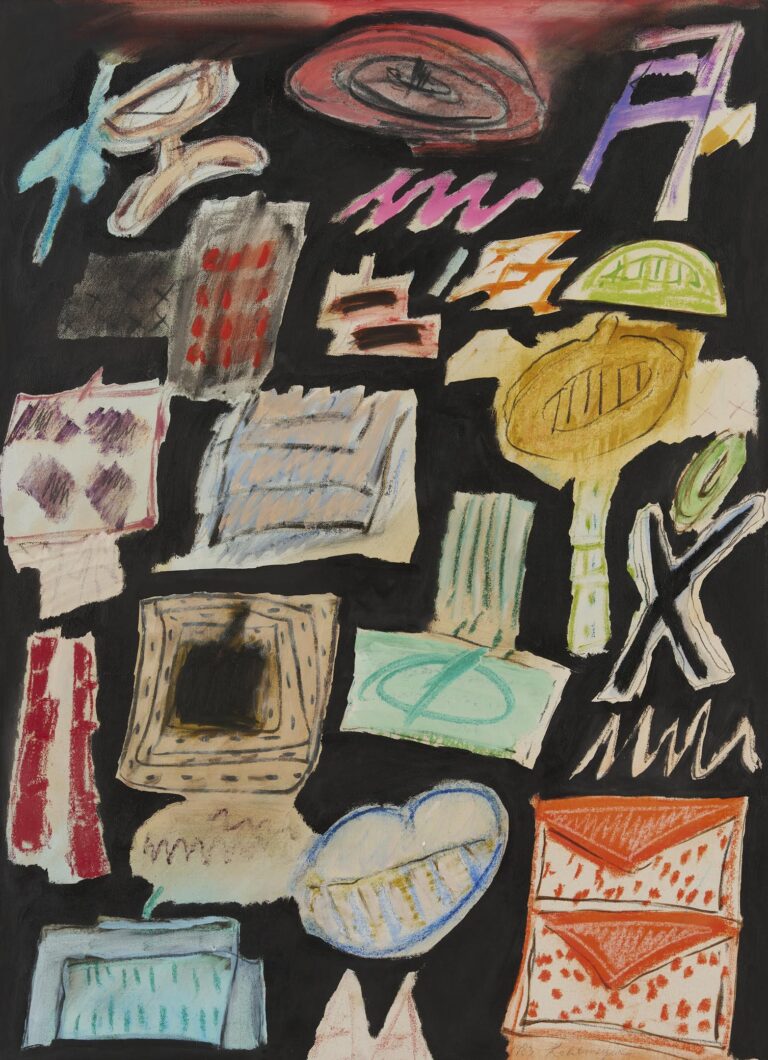
Ida Rittenberg Kohlmeyer (Louisiana/Georgia, 1912-1997) oil and oil stick on canvas abstract painting with various brightly colored forms arranged within a black field. Signed and dated 1983 in pencil, lower right. Housed in a modern metallic and wood frame. Canvas: 32 3/4 in. H x 24 in. W. Framed: 33 1/2 in. H x 24 3/4 in. W. 1983.
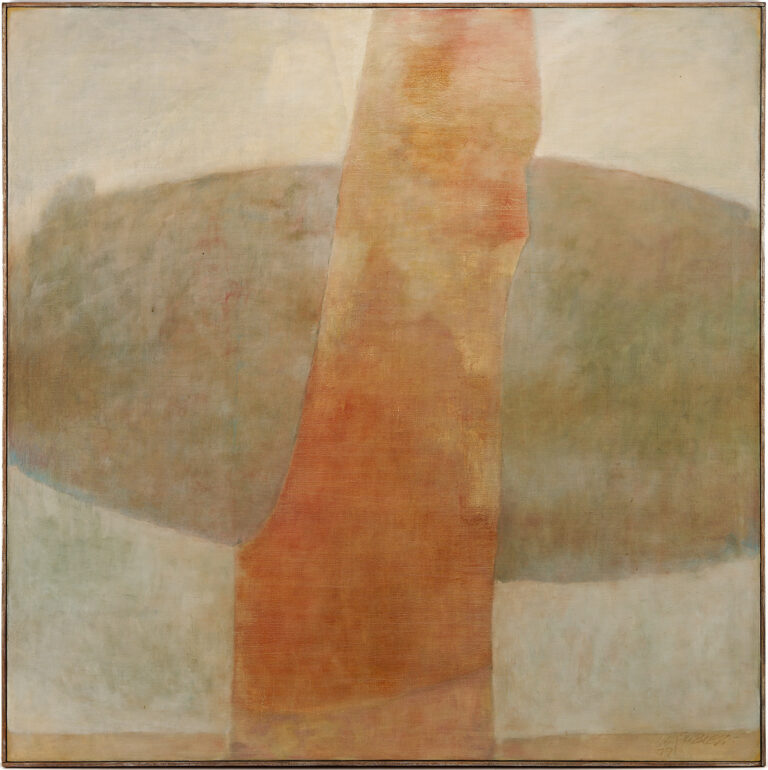
Carl Sublett (Tennessee, 1919-2008) oil on canvas abstract expressionist painting entitled “Mountain Forms.” A central rust-colored form divides the canvas vertically while elements rendered in shades of gray surround it. Signed and dated lower right. Additionally signed en verso. Artist’s label with date and title affixed to stretcher. Housed in a simple painted wood frame. Canvas: 48 in. H x 48 in. W. Framed: 48 3/4 in. H x 48 3/4 in. W. 1966-79.

Joanna Higgs Ross (Tennessee, 1934-2025) acrylic on canvas modernist East Tennessee landscape painting, “Cades Cove No. 7.” A snowy valley divided by a crossroads lies at the foot of a dark blue, hazy mountain. Signed, titled, and dated to back of stretcher. Housed in the artist’s own simple wood frame with metallic tape silvering. Canvas: 61 3/8 in. H x 72 in. W. Framed: 62 1/8 in. H x 72 3/4 in. W. 1985.
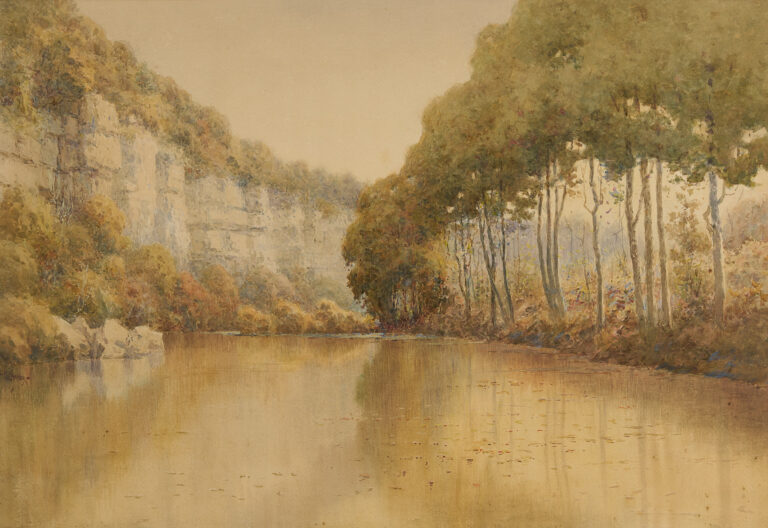
Paul Sawyier (Kentucky/American, 1865-1917) watercolor on paper Impressionist Kentucky River landscape painting depicting the cliffs of the Kentucky River Palisades at left and a row of thin trees at right. Blue and red highlights describe shadows and fall foliage, and leaves float on the surface of the water at lower right. Signed to center-left. Housed under UV-resistant glass in a giltwood frame with tan mat. Sight: 20 in. H x 29 1/8 in. W. Framed: 32 in. H x 42 in. W.
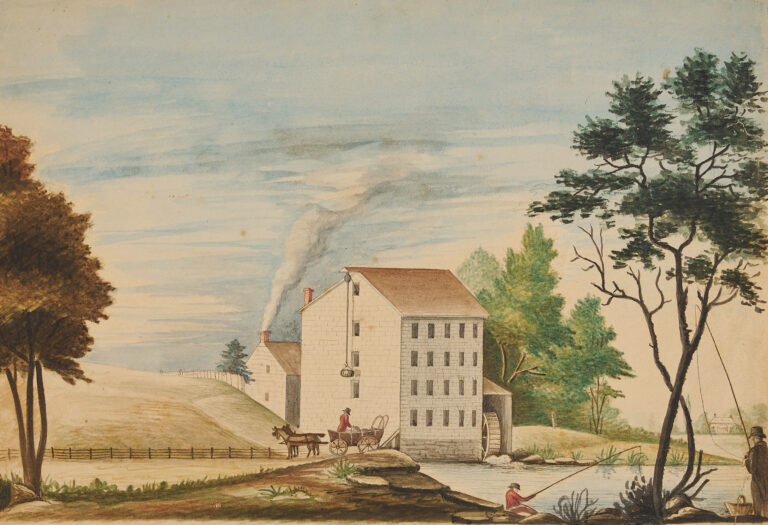
Watercolor painting depicting the former Elijah Craig distillery and Peyton Short Plantation in Woodford, Kentucky, with a prominent mill in the middle ground. A man loads barrels in a horse-drawn wagon beside the mill while two others fish in the foreground. The Short family home, Greenfield, stands in the distance at lower right. Attributed by oral history to Dr. Charles Wilkins Short (Kentucky, 1794-1863), son of Peyton Short. Unframed. 8 11/16 in. H x 11 in. W. Circa 1808. Note: The depicted mill was likely previously owned and operated by distiller Elijah Craig (1738-1808). Craig advertised the sale of the property in The Kentucky Gazette, April 23, 1791: “Land for Sale / Between five and six hundred acres of land of the first quality for sale part of the old military, capt Robert Sanders lives on, on cane run, in Woodford County, in parcels or altogether, for cash only, apply to / Elijah Craig.” The copy of this newspaper in the collection of the Lexington Public Library is inscribed “Peyton Short” to upper left. According to oral history the watercolor was painted by a young Charles Wilkins Short circa 1808.
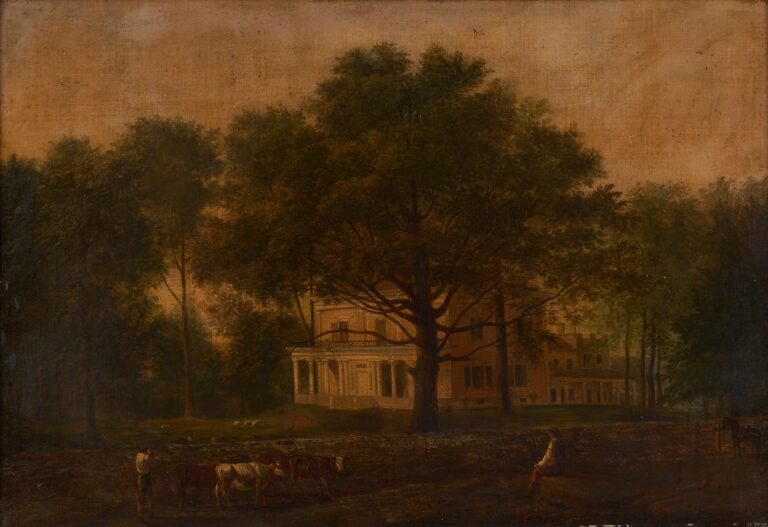
Oil on canvas Kentucky landscape painting that depicts Hayfield, near Louisville, in Jefferson County, Kentucky. The Greek Revival mansion stands among tall oak trees, with sheep that graze in the yard and cattle accompanied by two men in the foreground before the now-destroyed stone wall. A third figure walks down a dirt path, away from the viewer, in the central distance, while a tethered horse waits by the roadside at far right. Unsigned. Housed in a giltwood frame. Sight: 20 in. H x 29 in. W. Framed: 24 in. H x 33 in. W. Circa 1850. Exhibition History: “Collecting Kentucky 1790-1860”; Headley-Whitney Museum of Art, Lexington, KY; September-November, 2014. Literature: Illustrated in Genevieve Baird Lacer and Libby Turner Howard, “Collecting Kentucky 1790-1860” (Cherry Valley Publications, 2013), p. 37. Note: The 1868 obituary notice of Dr. Charles Wilkins Short published by the American Philosophical Society says of the home, “A beautiful and charming residence five miles from the city. A more lovely spot than this could hardly be imagined. The dwelling, the former abode of a gentleman of taste and refinement, was an elegant mansion, with all the conveniences of a city house. It was furnished in the best Kentucky style, and overlooked a rich lawn of almost perpetual verdure, such as might have charmed Calypso and her nymphs. It was surrounded by stately elm trees; close by was an immense spring of the coldest and most limpid water; the rear was skirted by a beautiful piece of woodland; and at one side was an ample garden, set out in shrubbery and plants, native and exotic, many of them set out by Dr. Short’s own hands.” (Obituary Notice of Charles Wilkins Short, M.D. Proceedings of the American Philosophical Society, Vol. 10, No. 78, January 1868, p. 169).
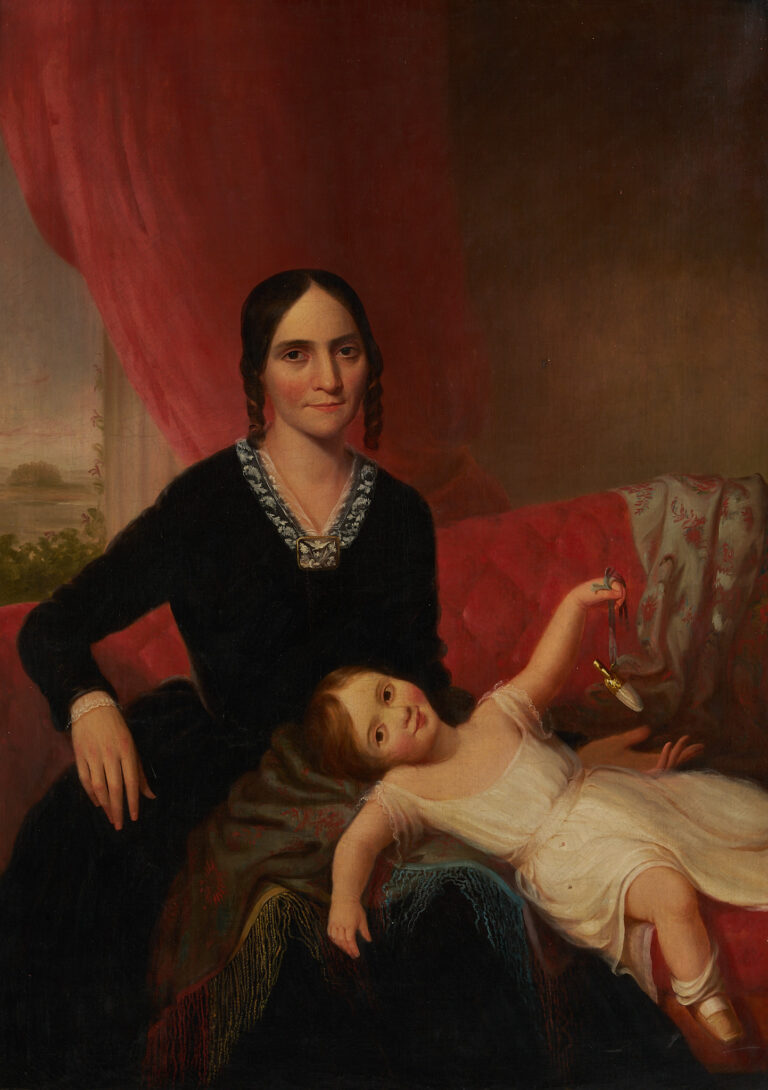
Oil on canvas double-portrait that depicts Almira Shelton Parker (1808-1878) and her daughter Melville ‘Mellie” Moxley Parker (1845-1925) on a red sofa in a domestic interior. Possibly by Theodore Sydney Moise (South Carolina/Louisiana, 1808-1885) or George Peter Alexander Healy (Massachusetts/Illinois, 1813-1894). Almira wears a black dress with a lace collar and brooch with a hand-grasping-what-and-dove motif, while Mellie reclines on her lap and dangles a gold and mother-of-pearl rattle whistle over her mother’s open left hand. Both sitters direct their attention toward to the viewer. At left, a red curtain has been pulled aside to reveal a vista outside of a window. Old typewritten labels affixed to back of frame read “Almira Shelton Parker / with Mellie Parker (Spalding) / 1808-1878 / Attributed to G.P.A. Healy / circa 1847” and “The child is Mellie (Melville) who was later a Mrs Spalding and lived in Cincinnati. She had a nephew Melville Parker who was named for her.” Housed in a giltwood frame. Sight: 53 1/2 in. H x 38 1.2 in. W. Framed: 63 1/4 in. H x 48 1/4 in. W. Circa 1847. Note: Almira Shelton Parker was born in Fairfield County, Connecticut in 1808 and married Amos Pillsbury Parker (1797-1880) of New Hampshire. The couple lived in Louisville, Kentucky, and are buried at Cave Hill Cemetery. Their daughter, Melville “Mellie” Parker married William Davis Spalding (1841-1923) of Maysville, Kentucky, in 1864. The Spaldings made their home in Cincinnati, where William worked as a manager at the Cincinnati Leaf Department of the American Tobacco Company. William’s father, Daniel Spalding (b. 1811), had been involved in tobacco interests in antebellum Kentucky and Ohio.
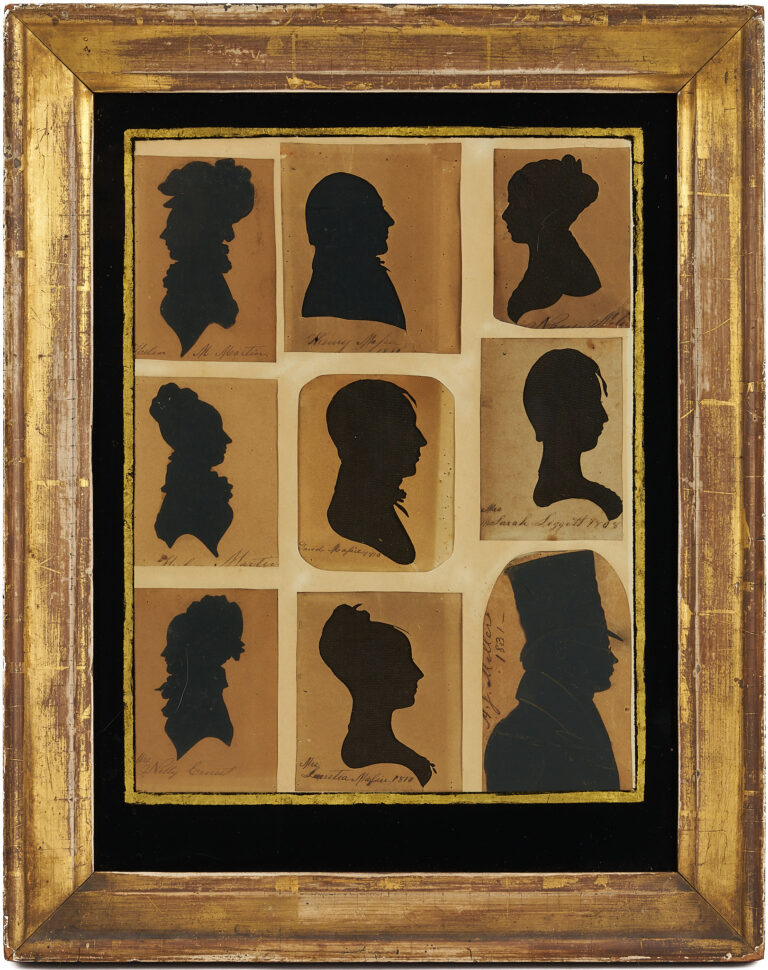
Grouping of nine (9) hollow cut silhouettes on silk depicting the Henry Massie family, Louisville, KY. Contemporary paper backing en verso with handwritten descriptions of Massie Family Silhouettes, with names and notes, including “cut with scissors” and “she couldn’t decide whether she looked better with or without hat.” Additionally noted: “According to Aunt Jane Courtenay (Tyler) she spent the day with her grandmother (Annie Christian Courtenay) who was to teach her to sew (circa 1885-6). They gathered these silhouettes and sewed them into this frame. Aunt Jane & Uncle Henry moved to Florida in 1946. About 1965 they moved into a retirement place and sold the orange grove to Disney. While talking to their son T. Courtenay Tyler I asked about the Paul Saruzier [sp] and the silhouettes. He thought they were still in the attic of the house. I paid him to go get them just before it was bulldozed. They were in bad condition. I pieced the fragile paper together and added the black and gold “mat” as the ribbon had disentegrated. T. A. Courtenay.” Housed behind reverse painted period glass with gold leaf frame. c. 1808-1831. Sight: 7 3/4 in. L x 10 1/8 in. H. Framed: 11 3/4 in. L x 14 3/4 in. H.
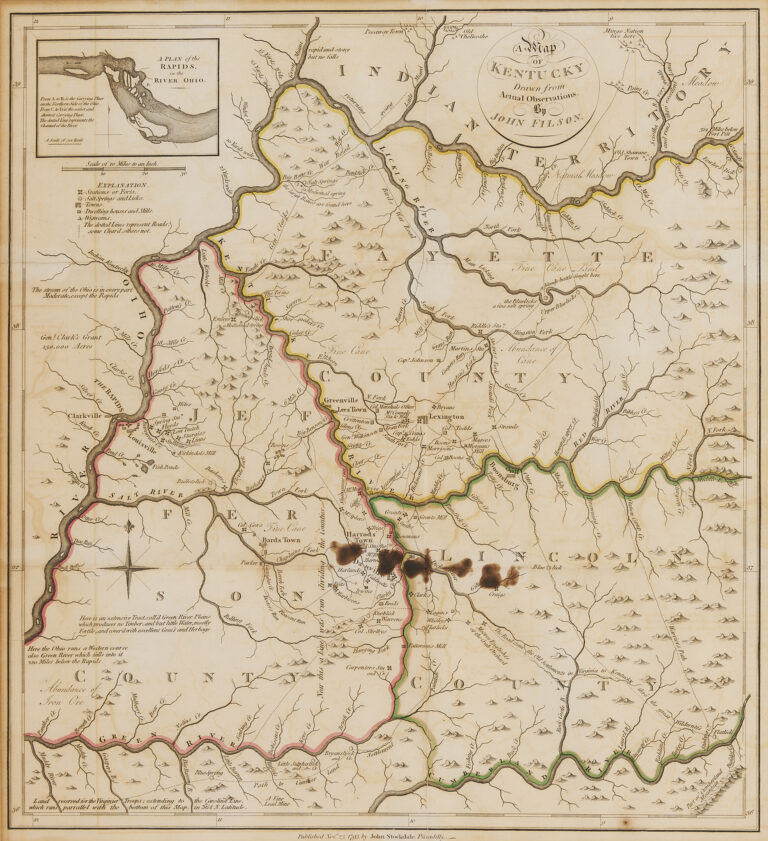
John Filson’s (American, 1747-c. 1788) “A Map of Kentucky Drawn From Actual Observations” engraved map with hand coloring. Published by John Stockdale, London, and originally included in Stockdale’s 1793 edition of Filson’s “The Discovery, Settlement and Present State of Kentucke.” 1793.
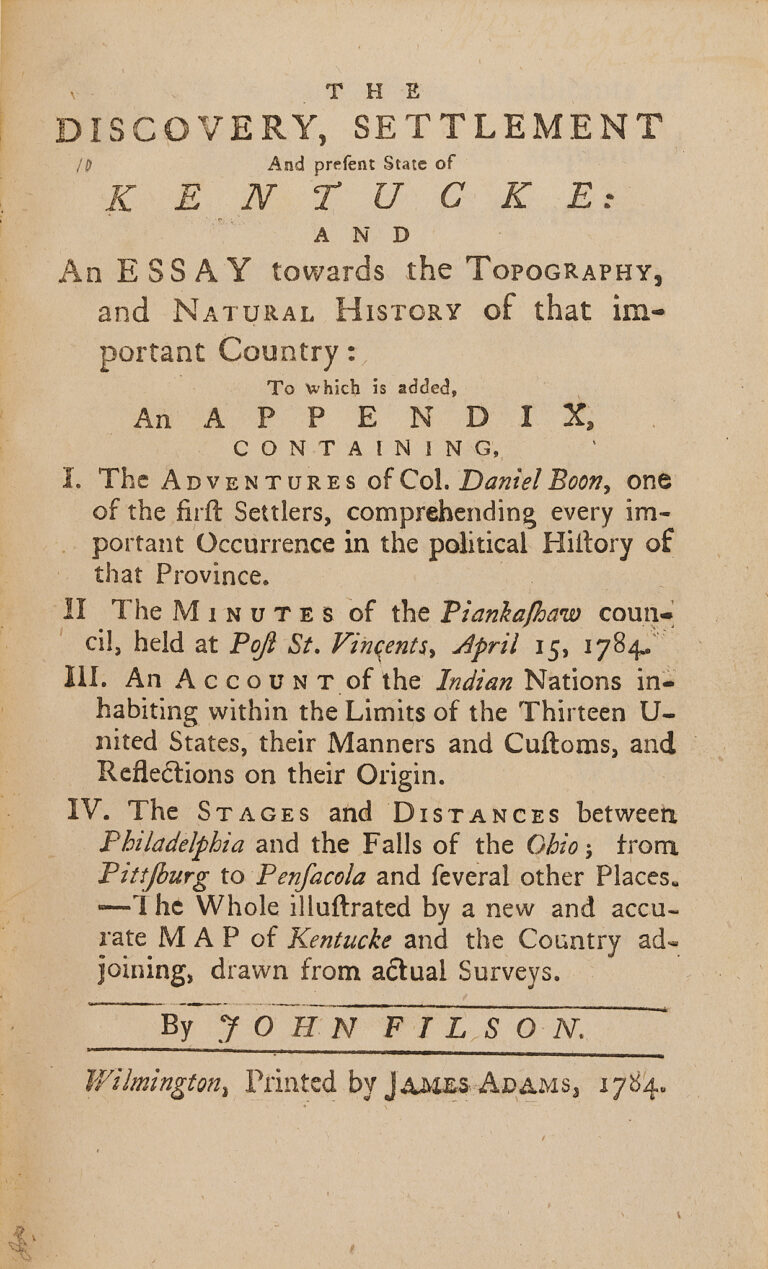
John Filson’s (American, 1747-c. 1788) “The Discovery Settlement and Present State of Kentucke: And An Essay Toward the Topography, and Natural History of that Important Country: To Which is Added, An Appendix, Containing, I. The Adventures of Col. Daniel Boone….II. The Minutes of the Piankashaw Council…III. An account of the Indian Nations…IV. The Stages and Distances Between Philadelphia and the Falls of Ohio…” Printed by James Adams, Wilmington, DE, 1784. Bound in a gilt-leather binding with marbled endpapers. With TWS (Thomas Winthrop Streeter) ex-libris.
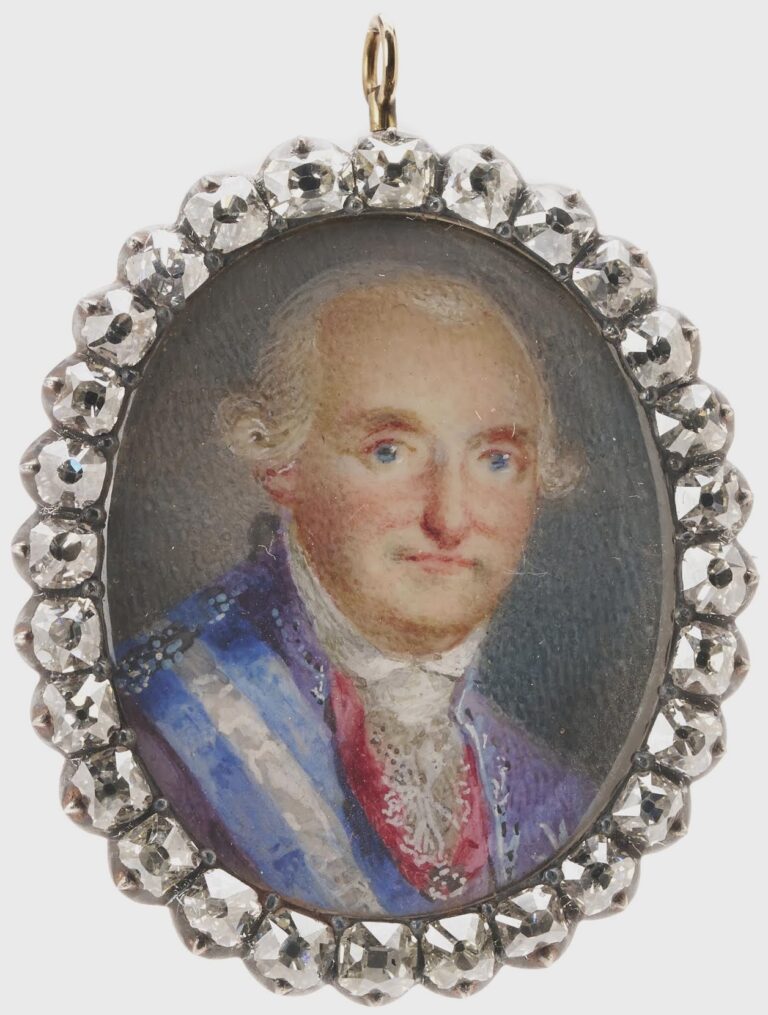
Late 18th-century portrait miniature and diamond brooch, depicting King Carlos IV of Spain (1748-1819, King of Spain, 1788-1808) wearing the sash of the Royal Order of Charles III and the ribbon of the Golden Fleece, painted by the circle of Francisco José de Goya y Lucientes (Spain, 1746-1828). The portrait is surrounded by twenty-eight (28) well matched, cushion cut, old mine-cut diamonds totaling approximately 8.4 carats, I/J color and VS clarity, with an 18K or higher engraved case with a silver surround. 2 in. H x 1 1/2 in. wide. Note: This brooch was presented to William Short (Virginia, 1759 – 1849), who served as Thomas Jefferson’s private secretary when Jefferson was peace commissioner in France. He later became the 1st United States Minister to Spain, the 2nd United States Minister to the Netherlands, and the 3rd United States Minister to France. According to family oral history and documented in an early photograph, this brooch was originally surrounded by a diamond-set frame featuring a cross and crown. The frame was later cut into six pieces and divided among the children of Charles W. Short, nephew of William Short.
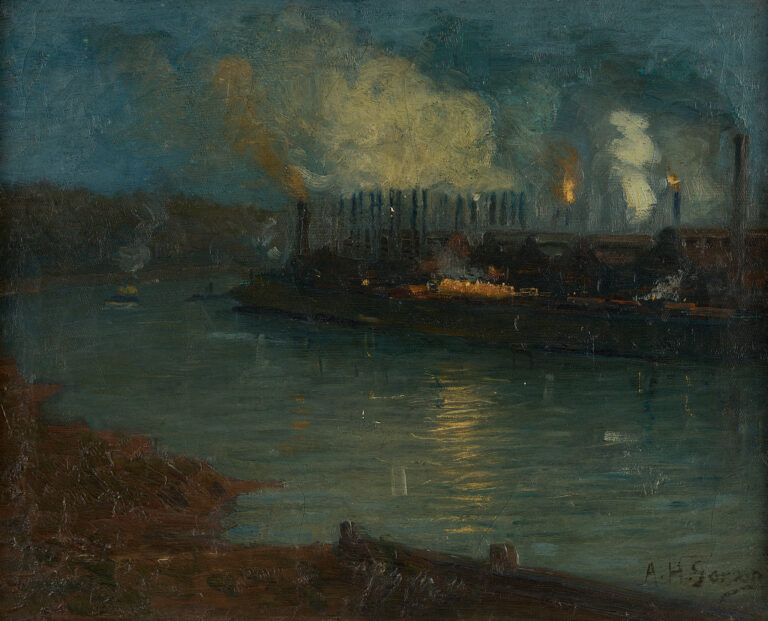
Aaron Harry Gorson (American, 1872-1933) oil on canvas landscape depicting a Pittsburgh steel mill on the Monongahela River. As night falls, light and steam still emanate from the busy complex, casting shadows and reflections in the water, while a boat rounds a bend in the distance. Signed A.H. Gorson lower right. Molded giltwood frame with Gillespie Galleries, Pittsburgh label verso. Sight: 19 1/2 in. W x 15 1/2 in. H. Frame: 24 in. W x 20 in. H.
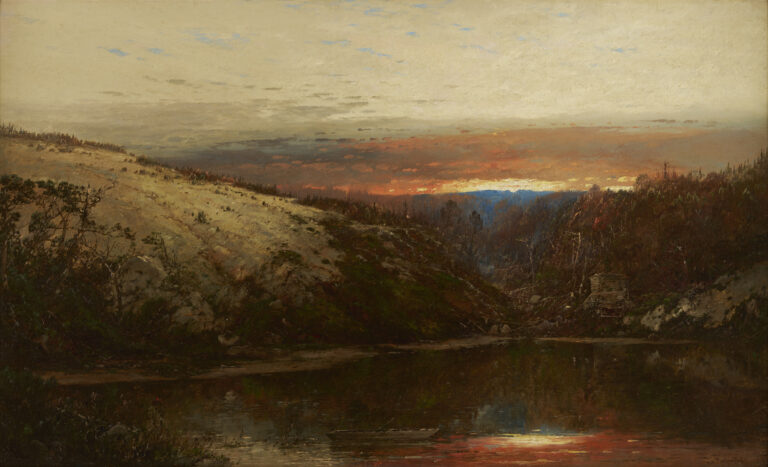
William Louis Sonntag, Sr. (American, 1822-1900) oil on canvas Hudson River School painting that depicts a snowy landscape in Chenango County, New York. A sunset and a distant, blue mountain range reflect upon a still body of water as clouds fill the sky above. A rowboat floats in the foreground and an old, wooden cabin stands on the opposite shore. Signed lower right. Housed in a molded giltwood frame. Sight: 21 1/4 in. H x 35 1/4 in. W. Framed: 31 1/4 in. H x 45 1/4 in. W.
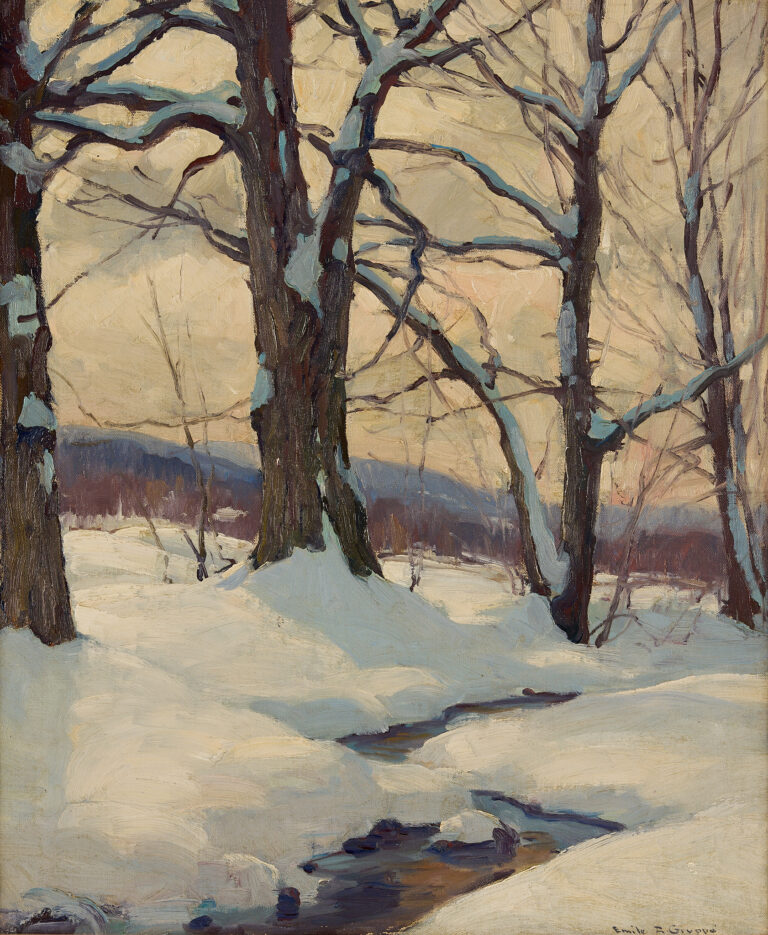
Emile Albert Gruppe (American, 1896-1978) oil on canvas winter landscape painting. A stream meanders through a snow covered forest, lit by the glow of a morning sunrise. Signed lower right “Emile A. Gruppe”. Hand carved gold leaf frame with molded polished edges. Sight: 23 1/2 in. H x 19 1/2 in. W. Frame: 33 1/2 in. H x 29 1/2 in. W.
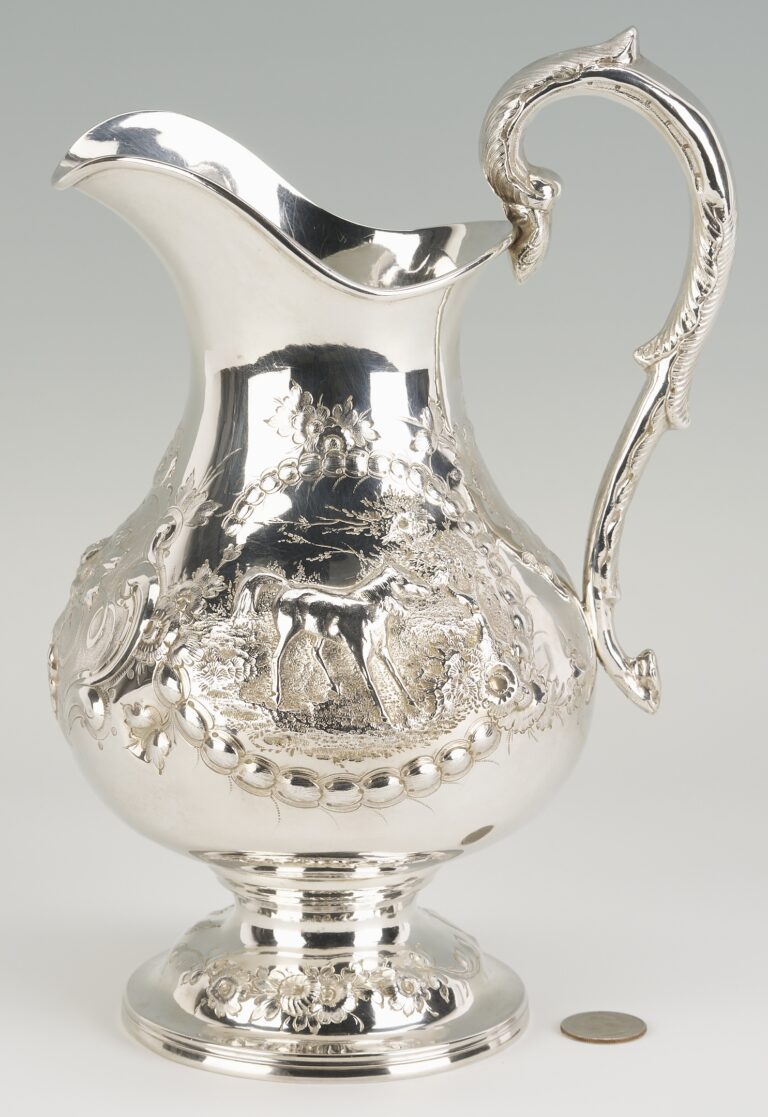
Kentucky coin silver racing trophy pitcher with chased horse motif, marked for John Kitts (working Louisville, KY, 1836-1878). By descent in the Butler Family. More details in the coming weeks.
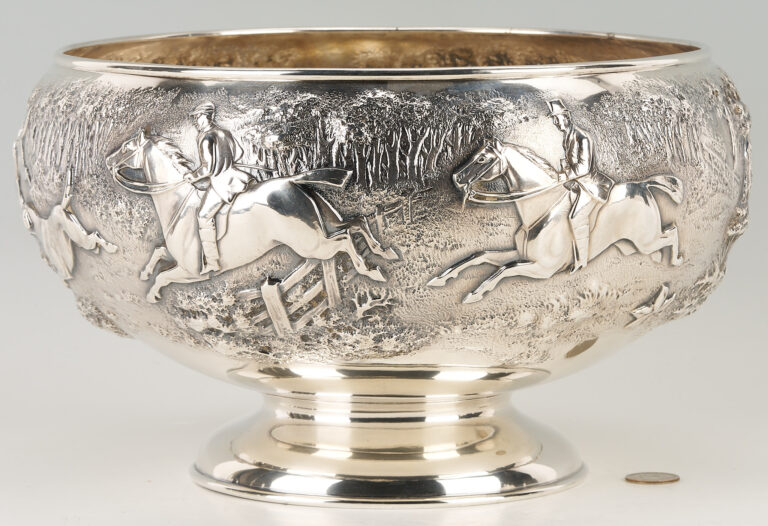
English Victorian Sterling Silver Hunt Themed Punch Bowl by James Barclay Hennell, London, hallmarked for 1883-1884. The round, footed bowl is encircled by an elaborate chased and repousse hunting scene with horses and riders followings dogs as they pursue a fox past groves of trees and cottages. Vacant monogram reserve. 13 1/2 inches diameter x 8 inches tall. 54.82 oz troy. Note: James Barclay Hennell was the last of the line of a family of celebrated English silversmiths whose clientele included the Royal Family and other English nobility. J.B. Hennell, son of Robert Hennell III, was famous for his novelty items, particularly those related to hunting, including whimsical stirrup cups. Following Robert Hennell III’s death in 1868 the firm was continued in the same style at the same address by James’ brother, R. Hennell IV. When he retired in 1877, R. Hennell & Sons was continued at the same address by J.B. Hennell until his own retirement in 1887. The firm was then sold to Holland, Aldwinckle & Slater.
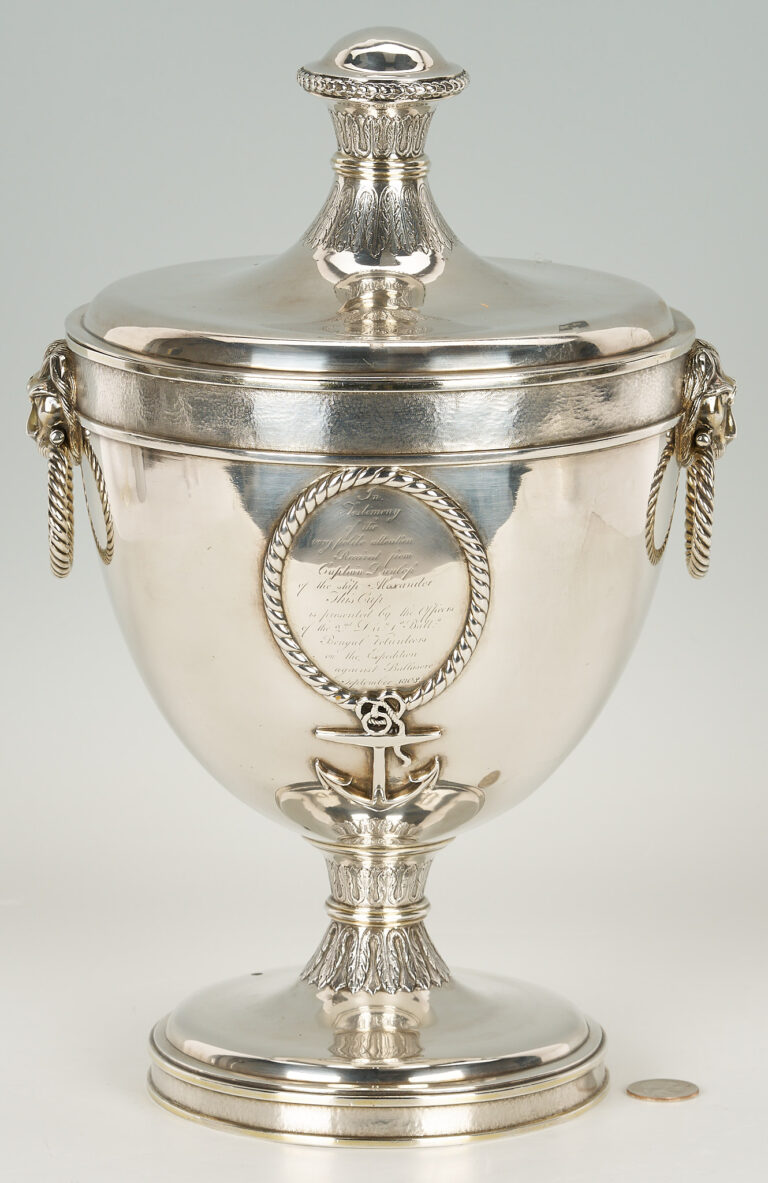
Indian Colonial nautical sterling silver lidded presentation urn, Neoclassical form with an acanthus-decorated lid, lion-mask rope-twist ring handles, an engraved oval cartouche surrounded by a rope-twist border and an anchor, and a round pedestal base with acanthus-leaf decoration. Hallmarked on the base for Hippolitus Poignand (1761-1805) working in Calcutta 1793-1805. Presentation inscription reads “In Testimony of the very polite attention Received from Captain Dunlop of the ship Alexander This Cup is presented by the Officers of the 2d Div 1st Batl, Bengal Volunteers on the Expedition against Ballasore September 1803.” 13 3/4 in. H x approx. 9 1/2 in. W. 65.26 troy ounces. Historical background: The inscribed text is in reference to the British East India Company’s invasion and capture of Balasore (located in modern-day Odisha, India) from the Maratha Empire, during the Second Anglo-Maratha War (1803-1805). The Campaign occurred in August and September 1803, when British forces, under the direction of Governor-General Richard Wellesley, launched a multi-front campaign against the Maratha confederacy, to seize the strategic port city of Balasore, which fell to British forces in September 1803. The inscription is a formal thank you note from military officers to Captain Dunlop’s “very polite attention,” meaning his hospitality, professionalism, and safe navigation during the dangerous naval transit and landing operations of the September 1803 campaign. Captain Dunlop likely refers to James Wallace Dunlop (Scotland, 1759 -1832), 21st of that Ilk, Scottish Laird, and British military officer who distinguished himself in India and the Napoleonic Wars. The Bengal Volunteers refers to a special unit of Indian soldiers (sepoys) and British officers, under the command of the East India Company’s Bengal Army. Volunteer units were typically raised from soldiers who agreed to serve overseas or in sea-bound expeditions, as regular Hindu sepoys often faced caste restrictions. The Alexander was a 746-ton merchant vessel launched at Bombay in 1803 and later owned by Charles J. Forbes. It was chartered by the British government to transport troops, ammunition, and provisions for this invasion, and was later shipwrecked off the English Channel in 1815 while on passage to London from Bombay; only 5 of the ship’s 140-150 crew and passengers survived the disaster.
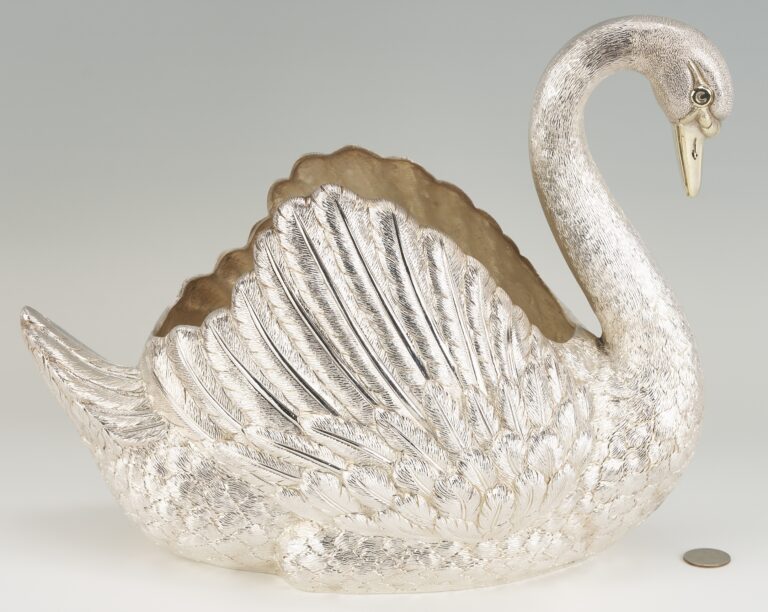
English Elizabeth II sterling silver swan centerpiece or wine caddy with gilt silver beak. Hallmarked for C.J. Vander, Sheffield, 1996. 11 in. H x 14 in. D x 6 1/2 in. W. 144.89 oz troy.
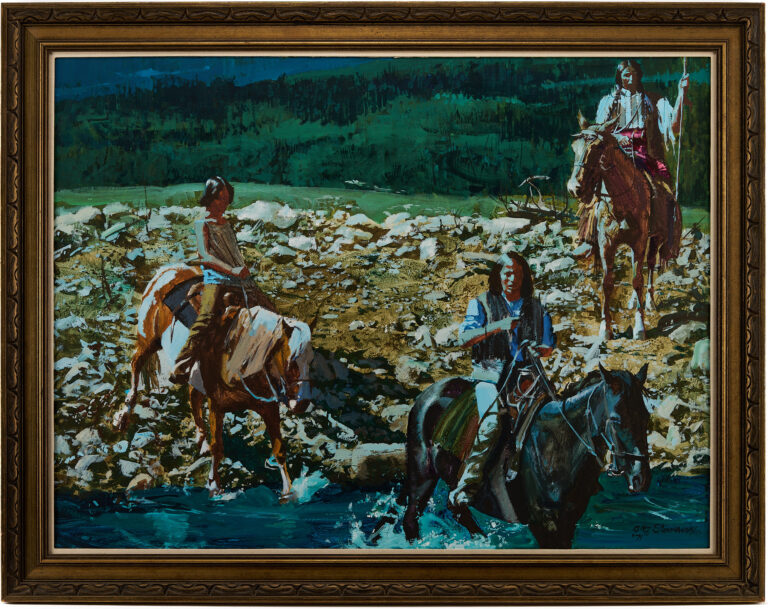
Oleg Stavrowsky (Texas/New York, 1927-2020) oil on canvas American Indian scene painting entitled “Moonlight Crossing.” Two men and a boy on horseback prepare to cross a rocky stream by night, rendered in loose, gestural brushstrokes. Signed and dated to lower right. Housed in giltwood frame with textile fillet. Sight: 35 1/2 in. H x 47 1/4 in. W. Framed: 43 1/4 in. H x 55 in. W. 1971.
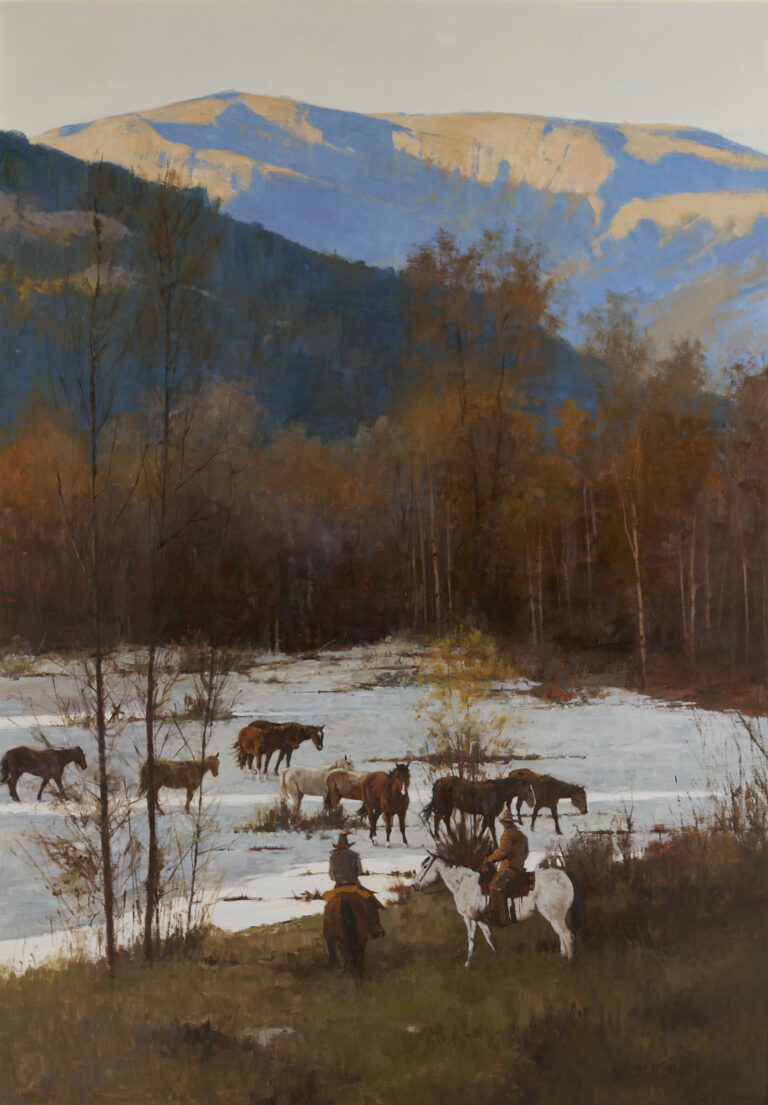
Large Richard D. Thomas (American, 1939-2019) oil on canvas Western landscape painting entitled “Fall Remuda.” Two cowboys on horseback observe a group of horses that stand in a snowy clearing. In the background a sunlit mountain range rises from behind colorful autumnal foliage. Signed lower right. Additionally signed, titled, and dated along tacking edge. With Breckenridge Galleries labels affixed to verso and to tacking edge. Housed in a distressed giltwood frame with tan textile liner, gilt fillet, and nameplate. Sight: 59 1/2 in. H x 41 1/2 in. W. Canvas: 60 in. H x 42 in. W. Framed: 67 in. H x 49 in. W. 2000.
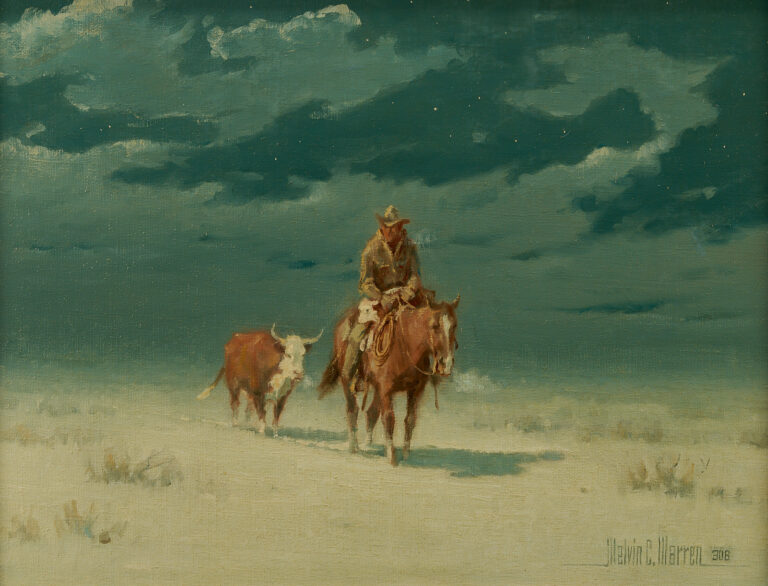
Melvin Charles Warren (American/Texas, 1920-1995) oil on canvas Texas scene painting entitled “Home to Shelter.” A cowboy rides a chestnut horse as he leads a steer through an open range on a cold night, each with visible breath faintly depicted before them. Signed and numbered “306,” lower right. Titled and dated en verso. Housed in a giltwood frame. Sight: 17 1/4 in. H x 23 in. W. Canvas: 18 in. H x 24 in. W. Framed: 29 1/2 in. H x 35 1/2 in. W. 1964.
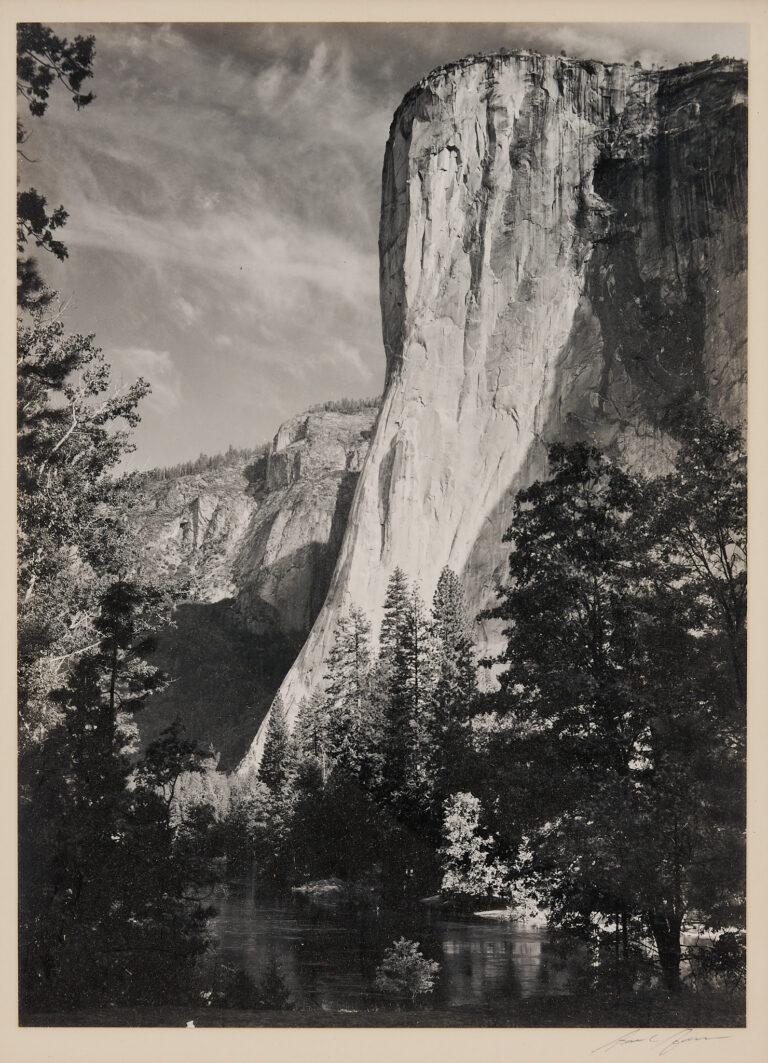
Ansel Adams (American, 1902-1984) gelatin silver print that depicts a snowy landscape with the Half Dome rock formation in Yosemite National Park, California, and the Merced River below. Signed to the mount en recto. Special Edition of Fine Prints / Photographs of Yosemite stamp numbered 271 of S.E.Y (Special Edition Yosemite) number 5 affixed to mount en verso. Floated under glass in a giltwood frame with red velvet mat. Photograph: 7 1/4 in. H x 9 1/4 in. W. Sight: 8 in. H x 10 in. W. Framed: 15 in. H x 17 in. W. 1938, printed c. 1960s.
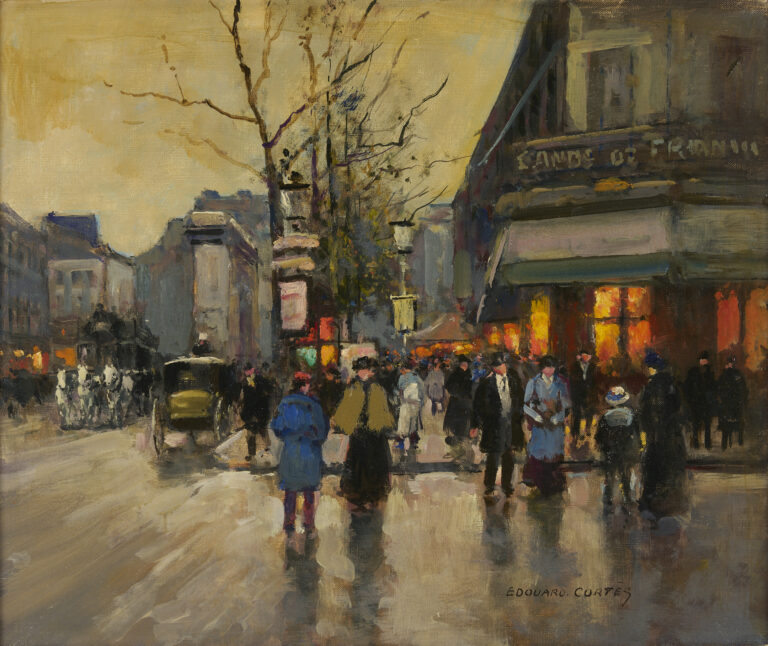
Edouard Leon Cortes (French, 1882-1969) oil on canvas Paris scene depicting a bustling avenue filled with figures and horse drawn carriages. Light glows from a cafe or shop in the foreground, and the dimming sky, bare trees and coats of the pedestrians suggest a late Autumn or early Winter time frame. Signed “Edouard Cortes” lower right. Titled “Porte St. Denis” on plaque at center of mat, surrounded by a molded giltwood frame. Wally Findlay Galleries label en verso. Sight: 21 in. W x 17 1/2 in. H. Frame: 29 in. W x 26 in. H.
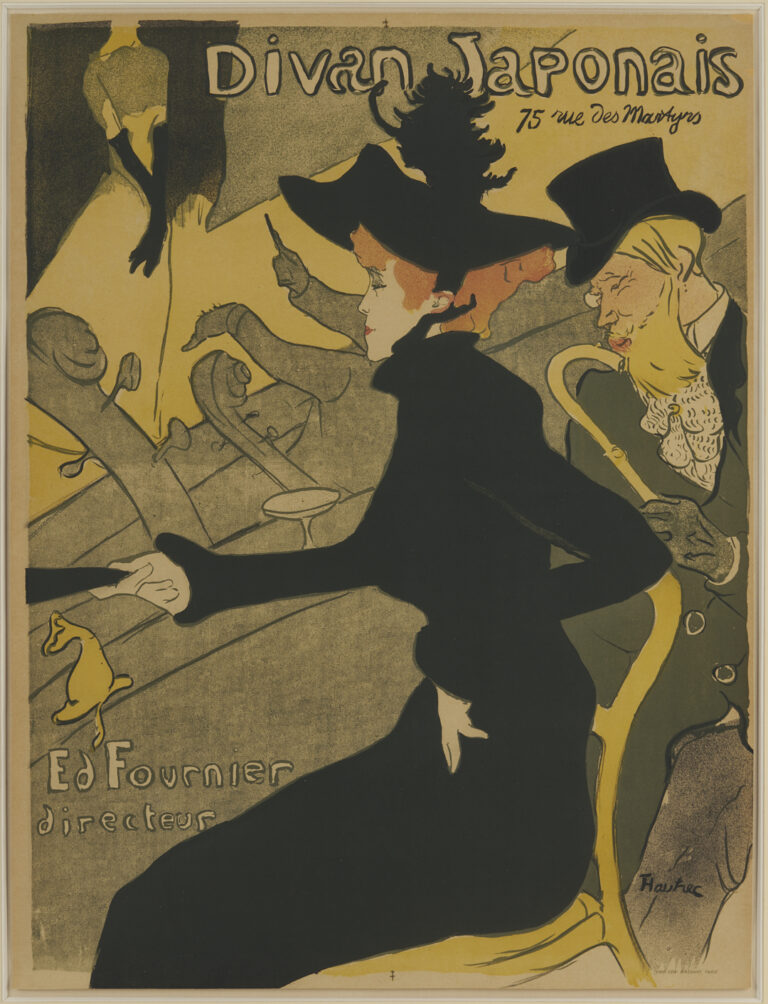
Henri de Toulouse-Lautrec (France, 1864-1901) color lithograph on wove paper, “Divan Japonais” (Japanese Divan). Printed by Ancourt, Paris. Signed in the stone and with printer information, lower right. Refs.: Delteil 341; Wittrock P11; Adhemar 11; Adriani 8. Floated under glass in a rusticated silvered frame with cream textile mat and white mount. Sheet: 31 3/4 in. H x 24 1/4 in. W. Framed: 41 1/2 in. H x 34 in. W. 1893.
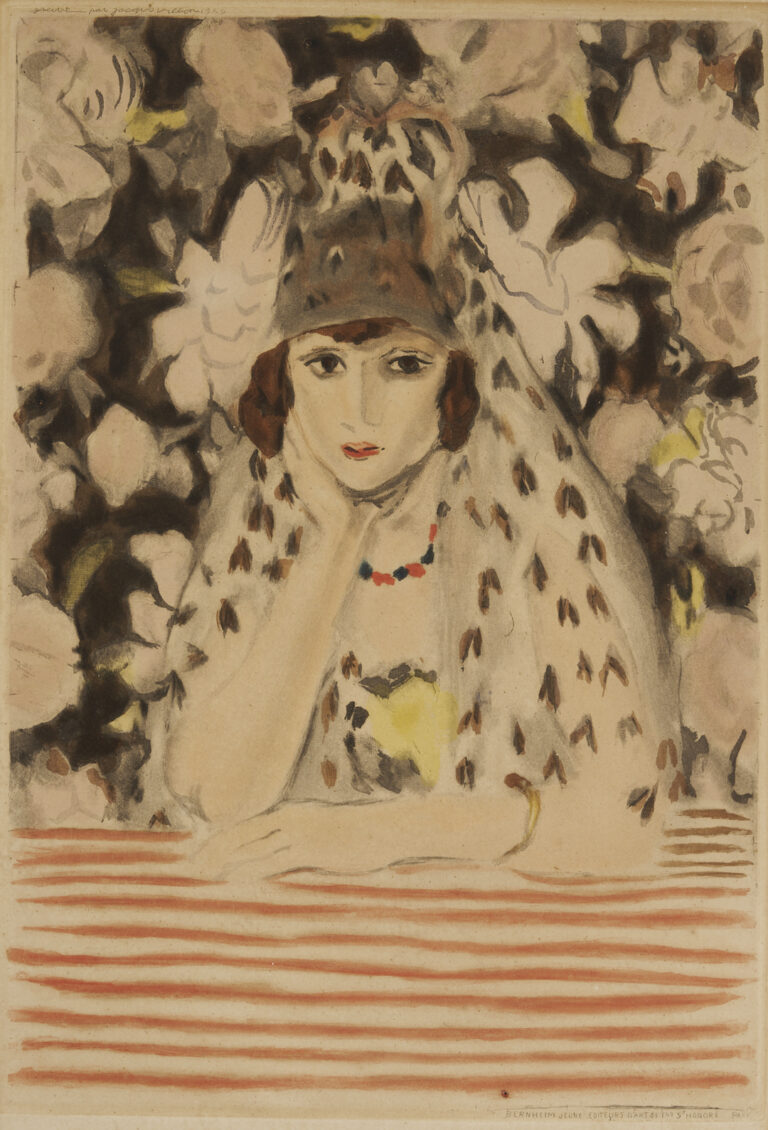
Etching and aquatint with roulette in colors on heavy wove paper after Henri Matisse (French, 1868-1854), “L’Espagnole” (The Spaniard) AKA “Espagnole a la Mantille” (Spanish Woman with a Mantilla), etched by Jacques Villon (French, 1875-1963). Published by Galerie Bernheim-Jeune, Paris. Signed in pencil by Matisse and numbered 175/200, lower margin. Additionally signed and dated by Villon in the plate, upper left, and with publisher information to the lower right. Ref.: Ginestet & Pouillon E645. Housed under glass in a giltwood frame with cream mat. Plate: 15 5/8 in. H x 10 13/16 in. W. Sight: 16 5/8 in. H x 11 in. W. Sheet: 19 3/4 in. H x 14 11/16 in. W. Framed: 24 3/4 in. H x 18 3/4 in. W. 1925.
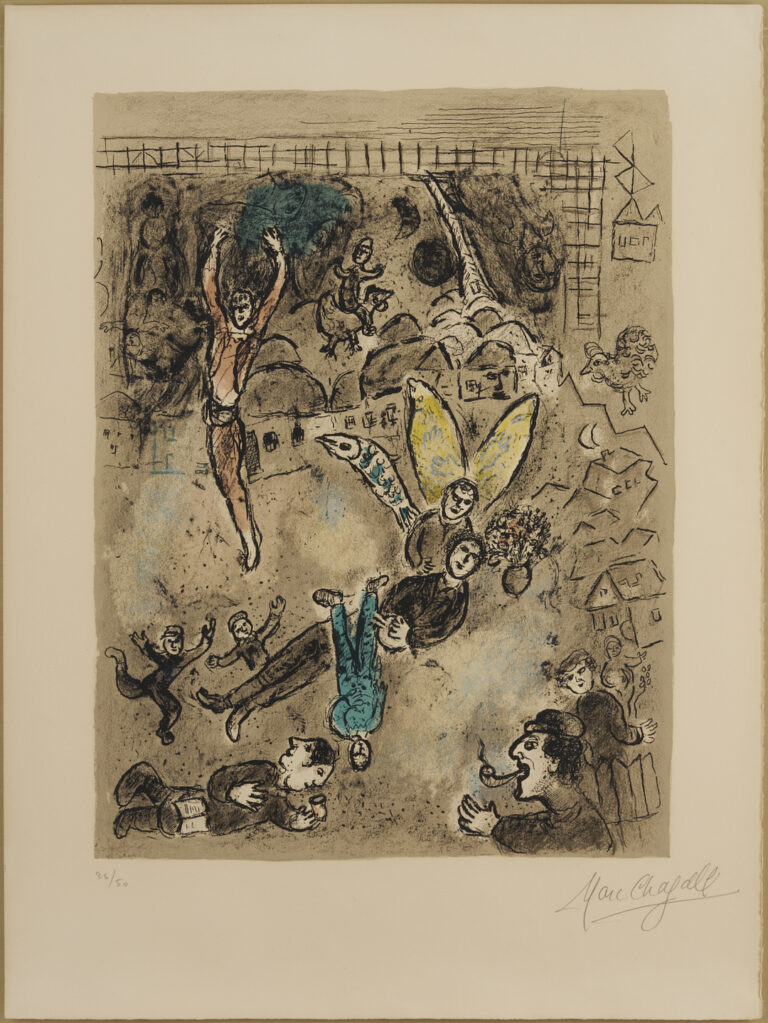
Marc Chagall (French/Russian, 1887-1985) color lithograph on Arches wove paper, “Composition Fantastique” (Fantastic Composition). The definitive state (etat definitif). Published by Maeght, Paris, and printed by Mourlot, Paris. Signed and numbered 26/50 in pencil, lower margin. Ref.: Mourlot 896a. Floated under acrylic in a metallic frame with cream textile mat, white reveal, and gold textile mount. Sheet: 32 15/16 in. H x 24 9/16 in. W. Framed: 40 1/4 in. H x 31 in. W. 1976.
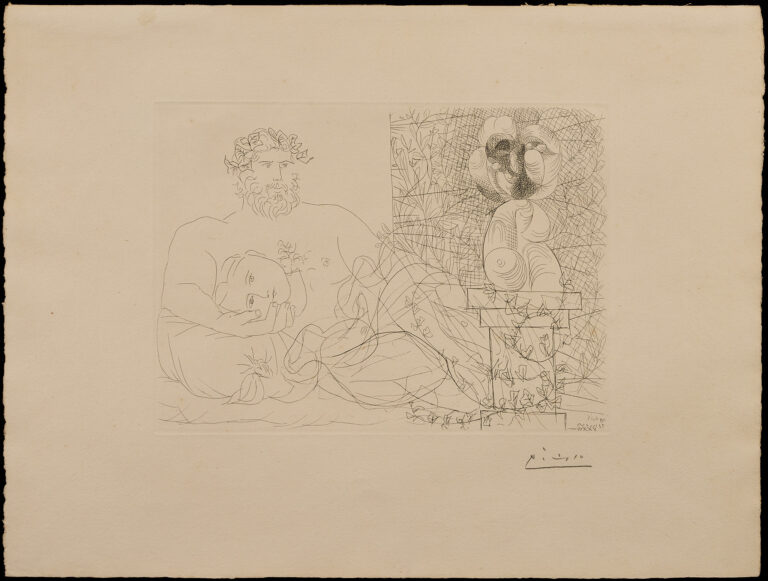
Pablo Picasso (Spanish, 1881-1973) etching on Montval wove paper, “Le Repos du Sculpteur et la Sculpture surrealiste” (Sculptor at Rest and the Surrealist Sculpture), from La Suite Vollard. Signed in pencil, lower right. Printed by Lacouriere, Paris, and published by Vollard, Paris, with Vollard watermark. From the edition of 260. Ref.: Bloch 169; Baer 322. Unframed. Sheet: 17 1/2 in. H x 13 1/4 in. W. Plate: 7 1/2 in. H x 10 1/2 in. W. 1933.
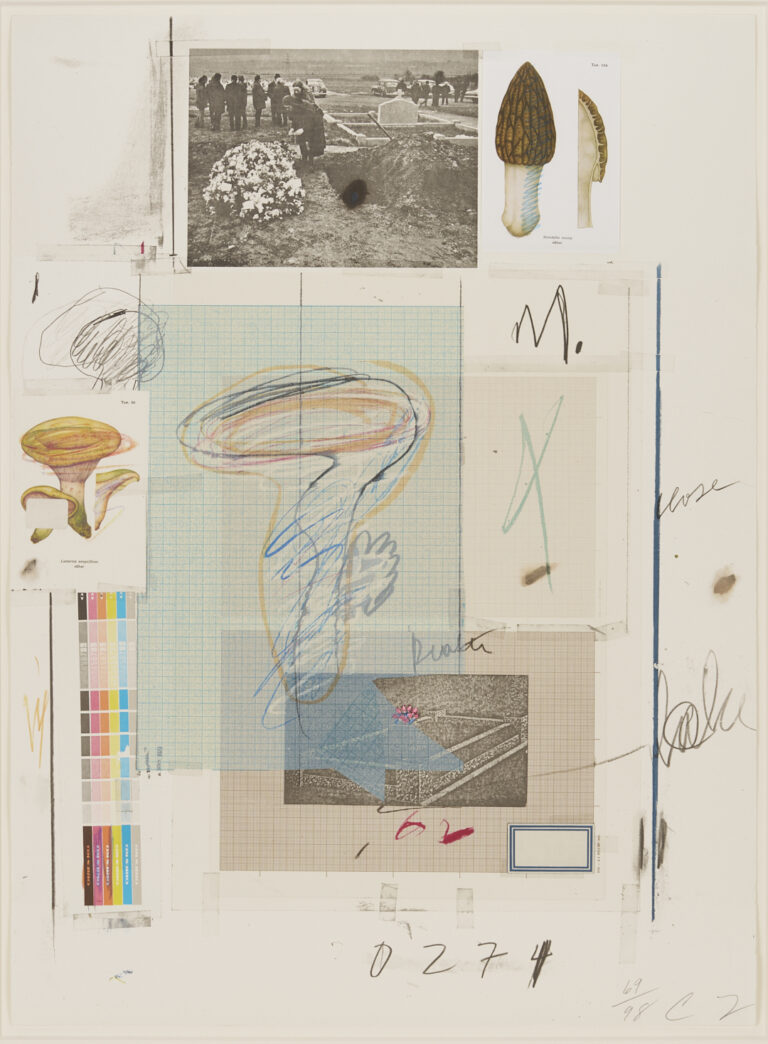
Cy Twombly (Virginia/American, 1928-2011) lithograph, grano-lithograph, and collotype in colors with collage and hand-coloring in crayon on wove paper. No. VII from the 1974 portfolio Natural History Part I: Mushrooms. Initialed and numbered 69/98 in pencil, lower right. Published by Propylaen Verlag, Berlin, and printed by Matthieu Litho, Switzerland, with their embossed blind stamp, lower left, along with embossed “VII” numbers and 1974 copyright date. Ref.: Bastian 48. Housed under acrylic in a modern wooden frame with cream mat. Sheet: 29 3/4 in. H x 22 in. W Framed: 38 1/2 in. H x 30 1/2 in. W. 1974.
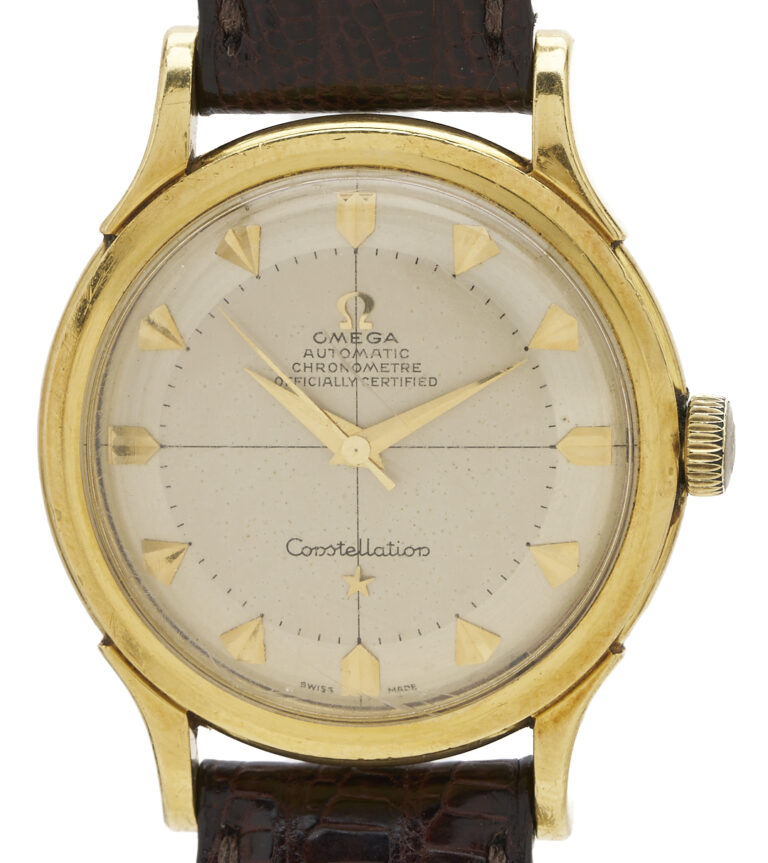
Omega Constellation wristwatch, 18K yellow gold. Ref #2782 and #2799SC. Case serial #11288969 with Caliber 354, 17-jewel. Movement serial #13969689. Two-tone silver crosshair dial, arrowhead hour markers, brown leather band. Circa late 1950’s/Early 1960’s.
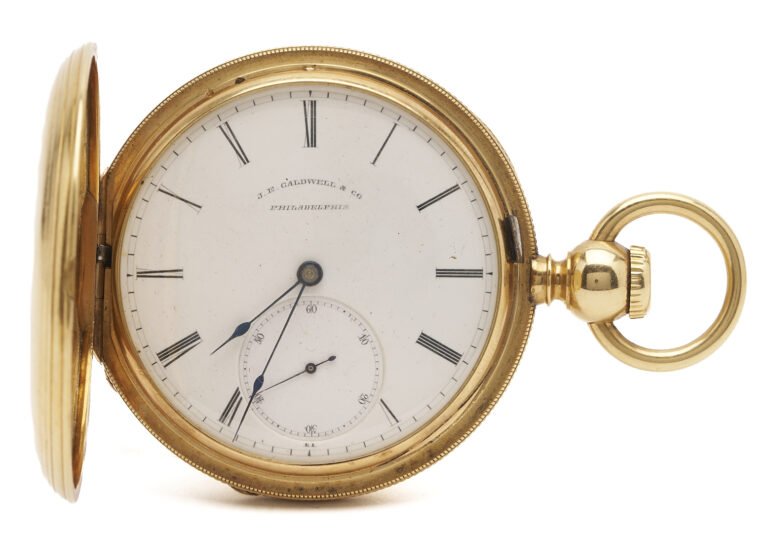
J. E. Caldwell and Company, Philadelphia, 18K closed-face pocket watch, key-wound, serial #3769, approximately 17 jewels. White enameled dial with Roman numerals and seconds dial. 18K yellow gold engine-turned engraved hunter case with cartouche. Inner case marked “J. E. Caldwell & Co. Philada 18K 7071”. 50mm. The watch XRF tests 18K. 110.87 total gross grams. 19th century.
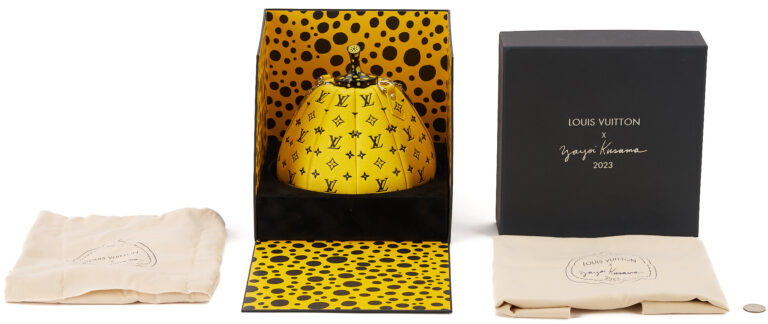
Louis Vuitton black and yellow pumpkin bag, designed by Yayoi Kusama (Japanese, 1929-2026) and first released for the 2023 LV x YK collaboration. Silver-tone hardware and dual-zippers, with cowhide exterior and trim. Bag opens to reveal a co-branded yellow badge, with cowhide and fabric interior. Includes original presentation box, leather strap, paper inventory inserts, and 2 dust bags. Copy of original purchase receipt is available to the winning bidder on request. Bag dimensions: 8 in H x. 7 in. 7 in. dia. Box: 9 in. H x 9 in. W x 9 in. D.
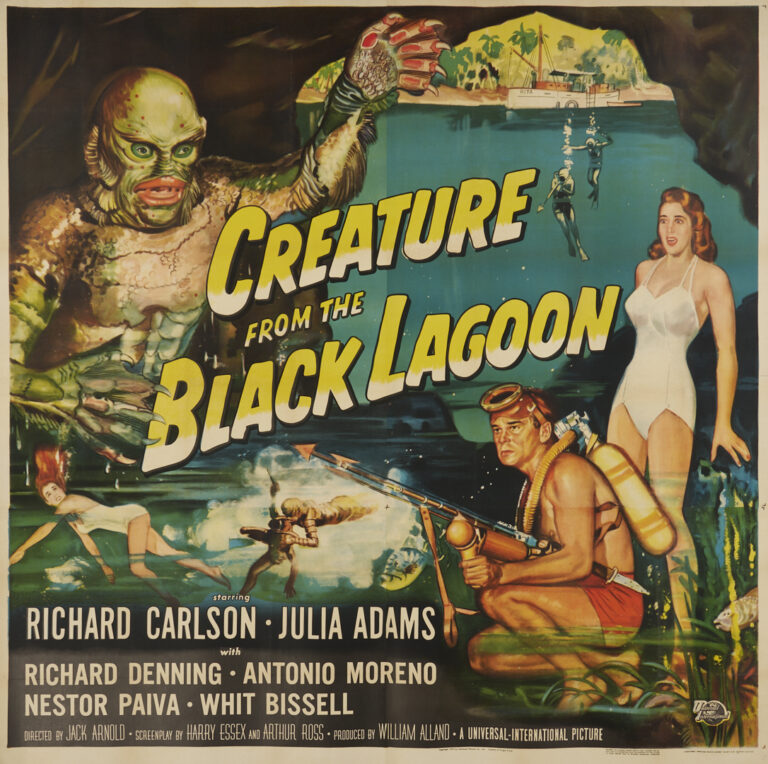
Creature from the Black Lagoon Universal International six-sheet horror movie poster. Artwork by Hollywood poster artist Reynold Brown (1917-1991) depicts the film’s iconic Gill-Man alongside the title text and stars Richard Carlson and Julia Adams. With Universal International logo, lower right, and copyright information in lower margin. Floated under acrylic in an ebonized wood frame with white mount. Poster: 79 in. H x 81 in. W. Framed: 89 in. H x 91 in. W. 1954.
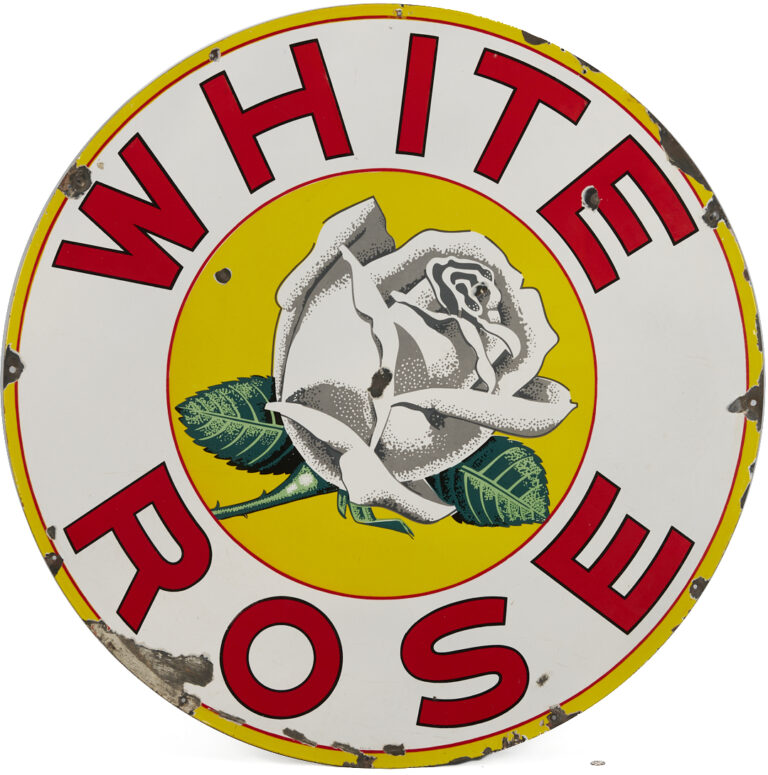
White Rose service station enamel sign. 47 3/4 in. dia. More information coming soon.