Our Summer Auction will take place Saturday, August 1st and Sunday, August 2nd at our Main Gallery in Knoxville and features fine art, antiques, and jewelry from Southern institutions, collections, and estates. We are continually adding new preview items, so please check in regularly. We expect to publish our full catalog on our website later in June.
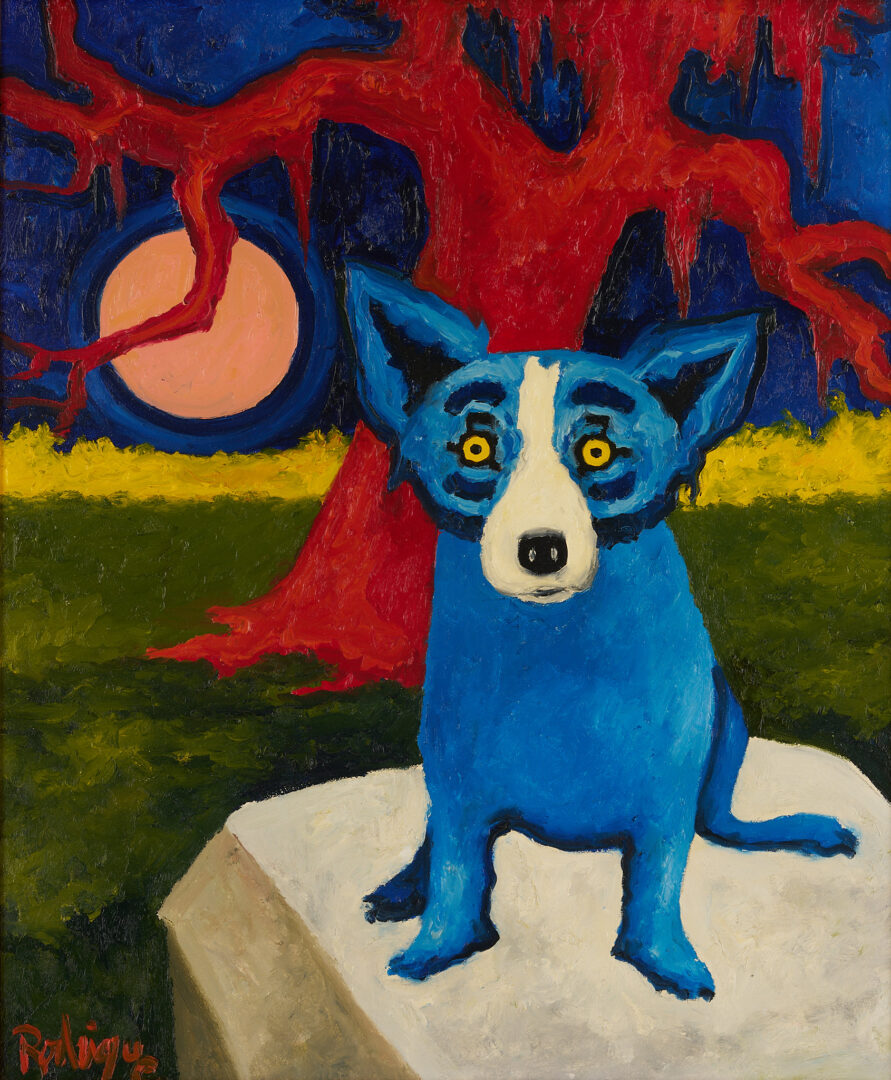
George Rodrigue (American/Louisiana, 1944-2013), “The Return of the Loupe-Garou,” acrylic on canvas painting featuring Rodrigue’s iconic Blue Dog seated atop a white tombstone or monument. A full moon, glowing pink, rises from the horizon and casts shadows around a bare, red tree. Signed “Rodrigue” lower left. Molded giltwood frame. Stretcher: 24 in. H x 20 in. W. Frame: 29 in. H x 25 in. W.
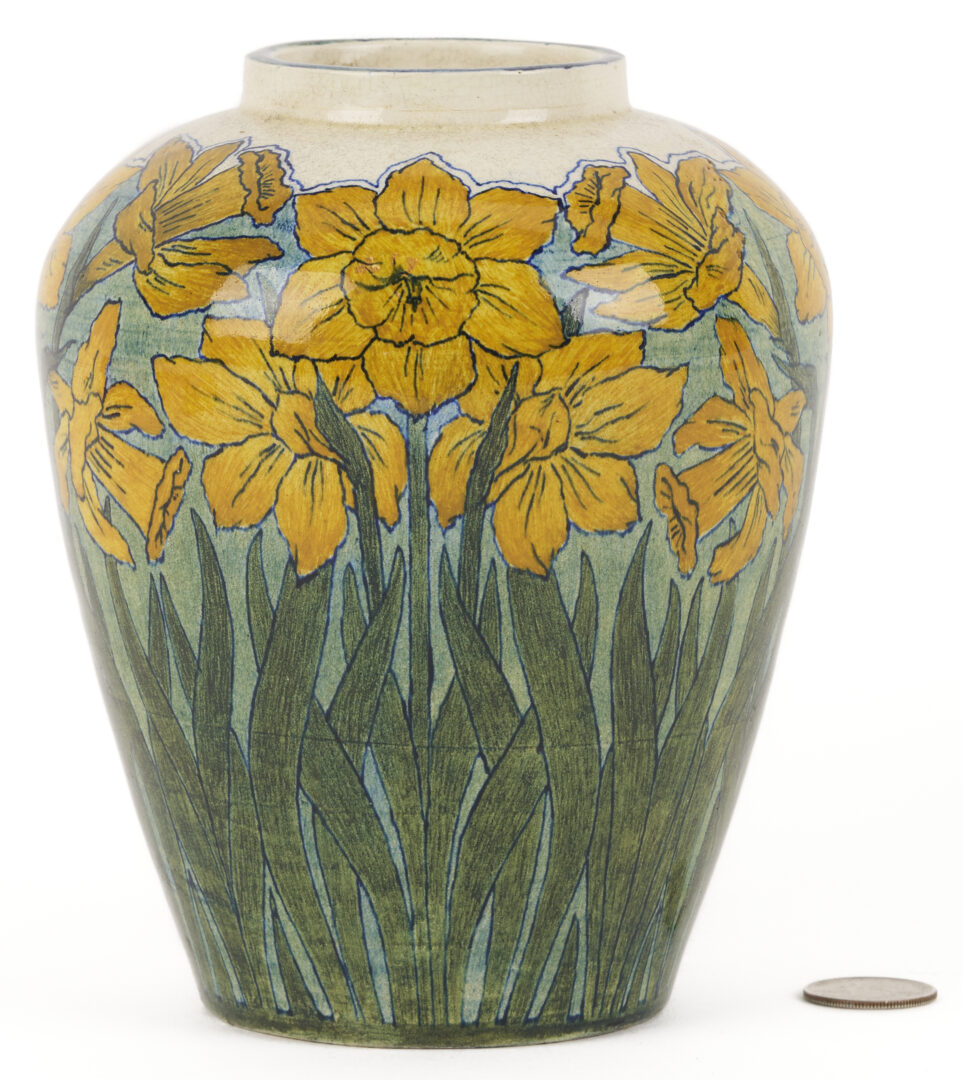
Important Exhibited Newcomb Art Pottery “Daffodil Vase,” circa 1897. This early vase, thrown by Joseph Meyer, is decorated by painter Katherine Kopman. The unique underglaze painting features long narrow leaves in varying tones of green rising up against a background of lighter color green to the yellow blooms which encircle the shoulder. The blossoms are delineated by a narrow black line, all under a glassy, faintly crackled glaze. 6 7/8 in. H x 5 5/8 in. diameter (at widest point). Note: this vase was the cover object for the 2013 traveling exhibit, WOMEN, ART & SOCIAL CHANGE: THE NEWCOMB POTTERY ENTERPRISE (a brochure for the exhibit accompanies this lot). This vase is also featured in the catalog.
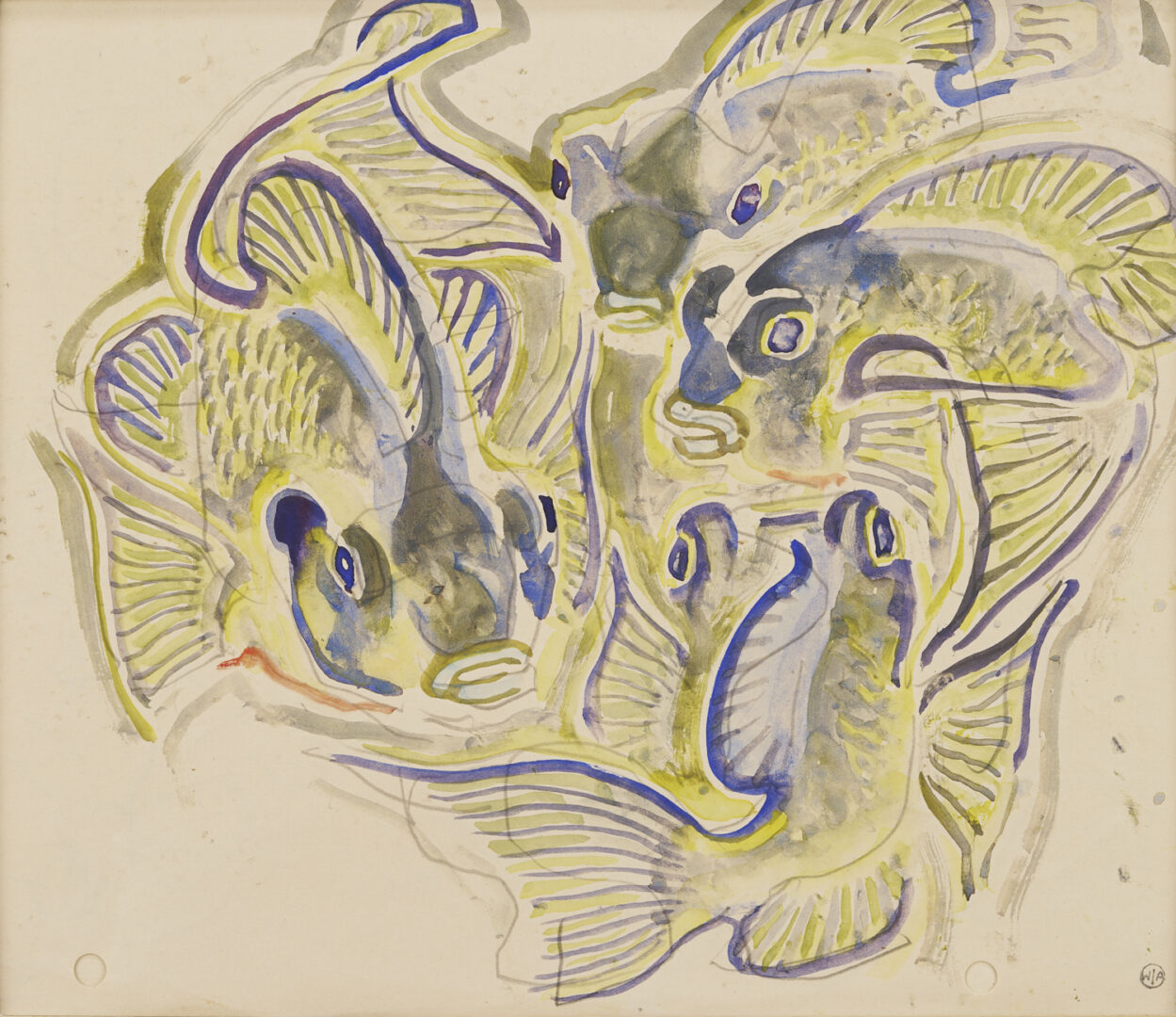
Walter Inglis Anderson (American/Mississippi, 1903-1965) watercolor and graphite on paper painting that depicts four perch huddled closely together. With estate stamp to lower right. B. Bullock Walters Studio, Houston, TX label affixed to backing. Housed under glass in a giltwood frame with pale green mat and purple reveal. Sight: 7 3/4 in. H x 9 in. W. Sheet: 8 in. H x 10 3/8 in. W. Framed: 15 1/4 in. H x 16 in. W.
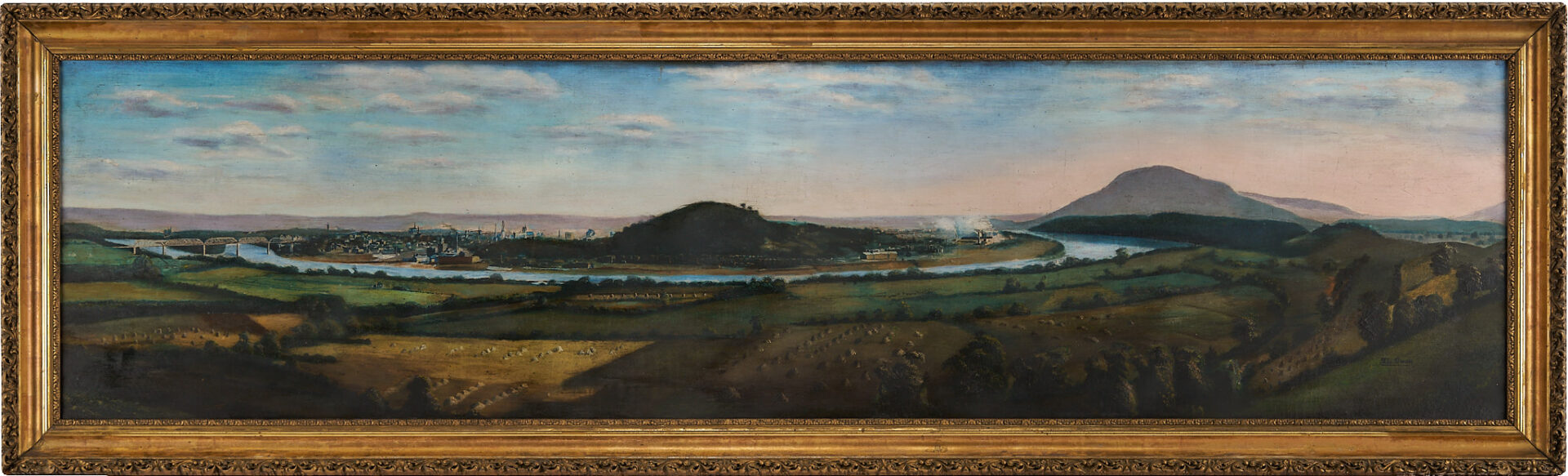
Panoramic landscape of Chattanooga from Stringer’s Ridge, signed S.L. Owen. 7 ft. W x 3 ft. H. 1904. More information in the coming weeks.
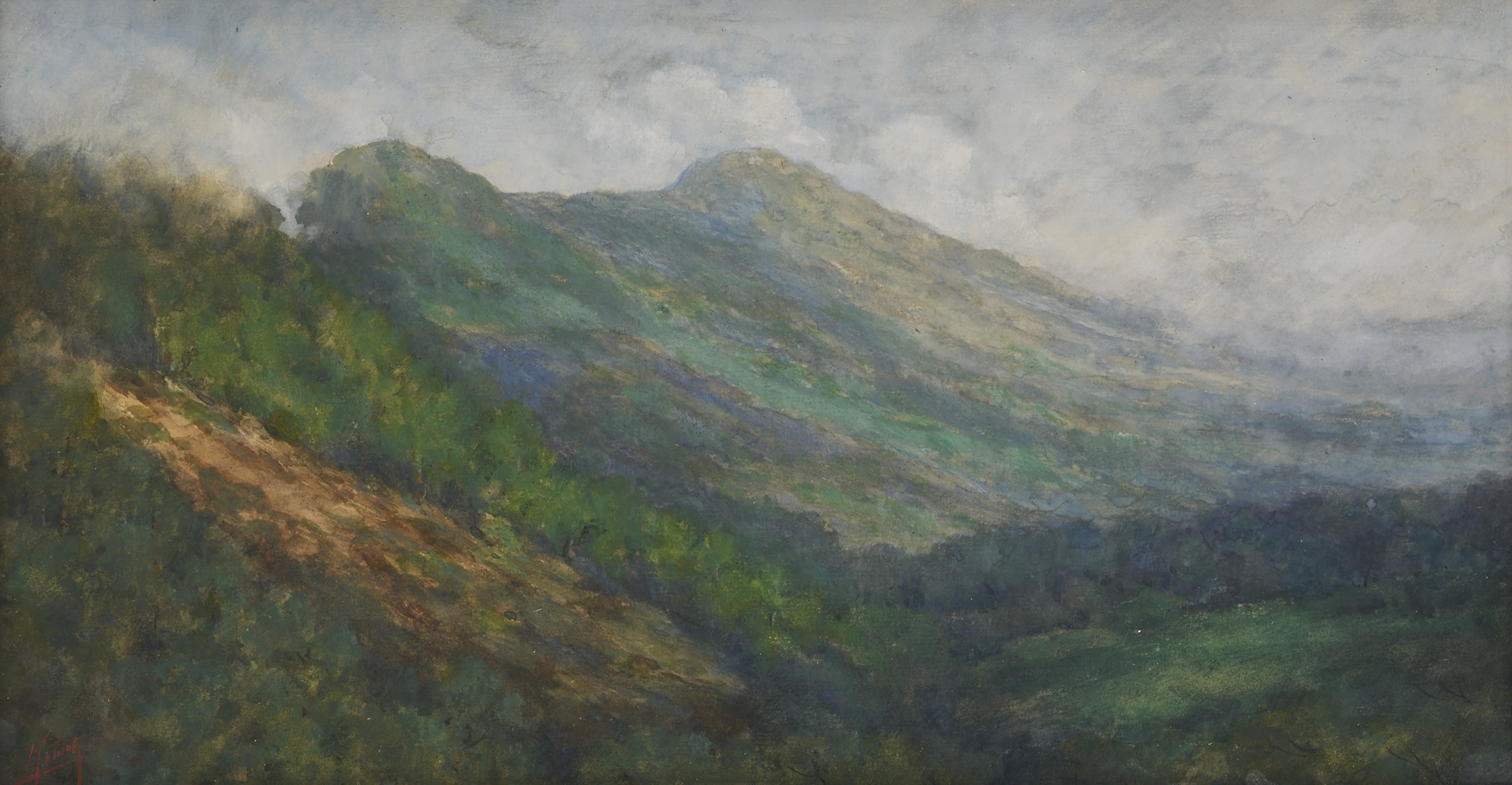
Charles Krutch (Tennessee, 1849-1934) watercolor East Tennessee landscape that depicts an atmospheric Smoky Mountain vista beneath a cloudy sky. Fog gathers in the valley at right and a break in the trees reveals a patch of bare earth at left. Signed “Krutch” lower left in red. Housed under acrylic in a likely original giltwood frame. Sight: 9 1/8 in. H x 17 7/16 in. W. Framed: 13 1/4 in. H x 21 9/16 in. W.
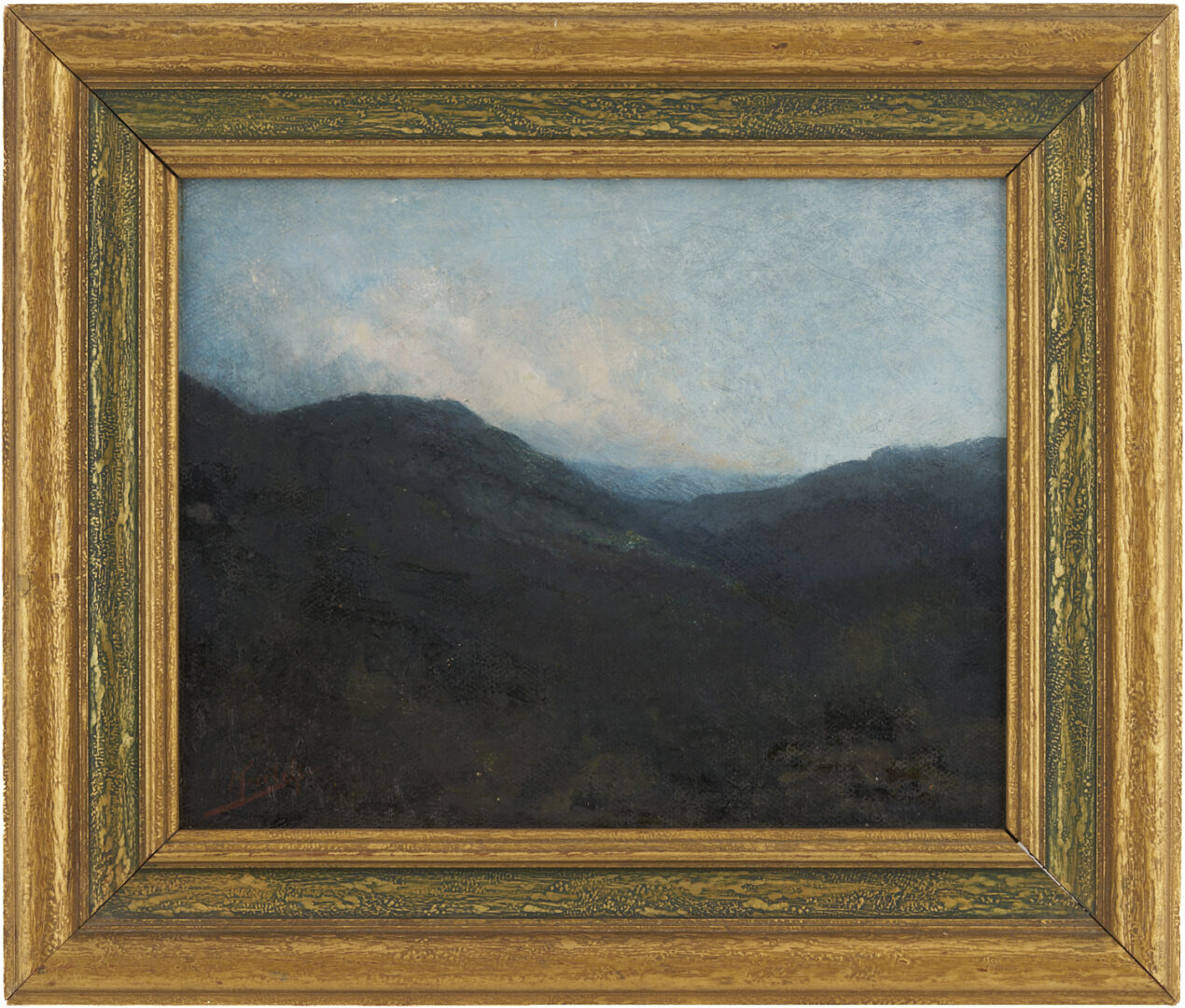
Charles Krutch (Tennessee, 1849-1934) oil on canvas laid to board East Tennessee Smoky Mountain landscape painting. Signed “Krutch” lower left in red. With E.G. Gagg, The Picture Framery, Knoxville, Tenn. label affixed to back of frame. Housed in a painted and giltwood frame. Sight: 7 1/2 in. H x 9 1/2 in. W. Canvas: 7 7/8 in. H x 9 5/8 in W. Framed: 11 1/2 in. H x 13 1/2 in. W.
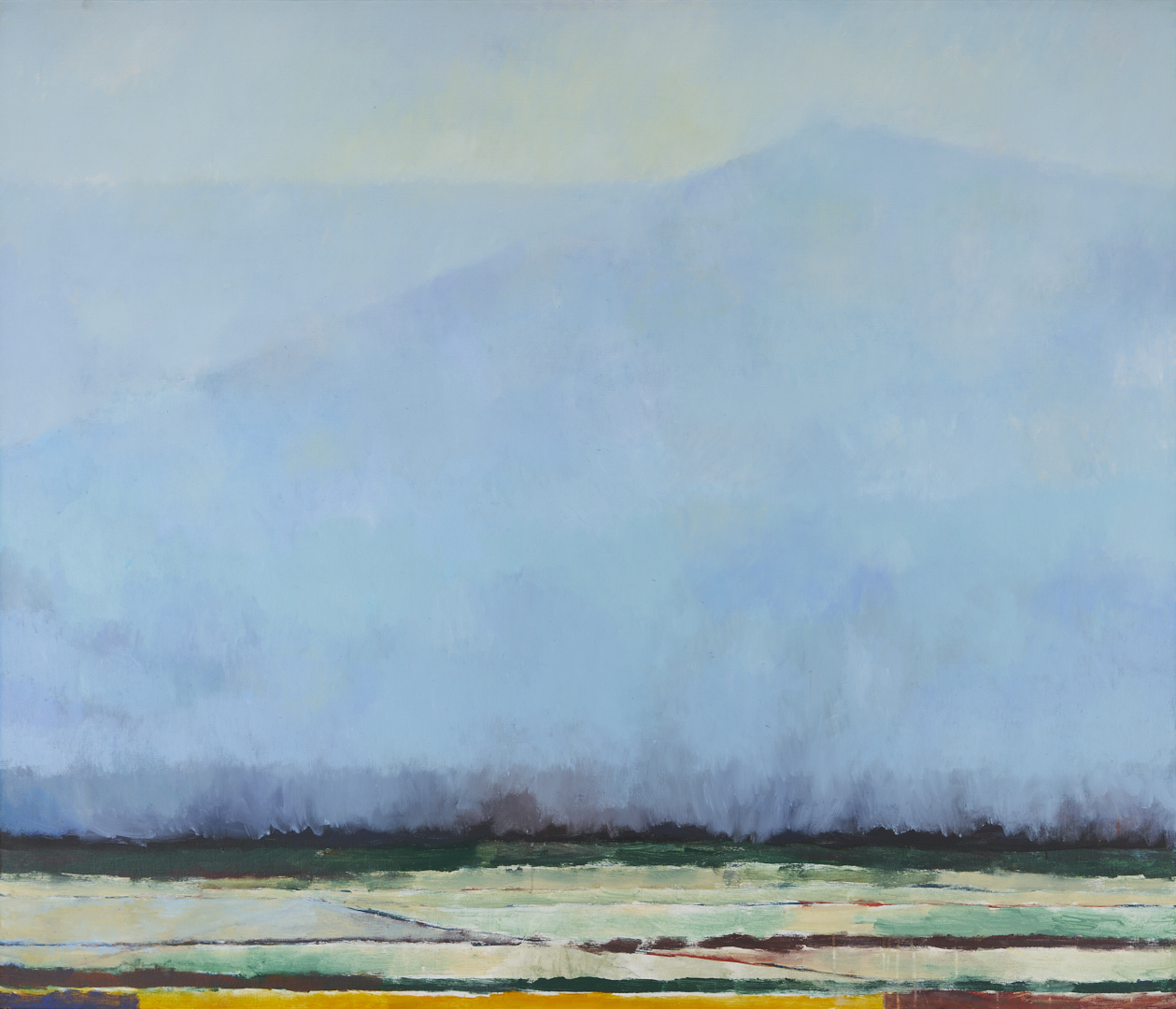
Joanna Higgs Ross (Tennessee, 1934-2025) acrylic on canvas modernist East Tennessee landscape painting, “Cades Cove No. 8.” A green, yellow, and red valley lies at the foot of a towering blue mountain range, with a line of trees that separates the two. Signed, titled, and dated to back of stretcher. Unframed. 61 3/4 in. H x 72 1/4 in. W. 1985.
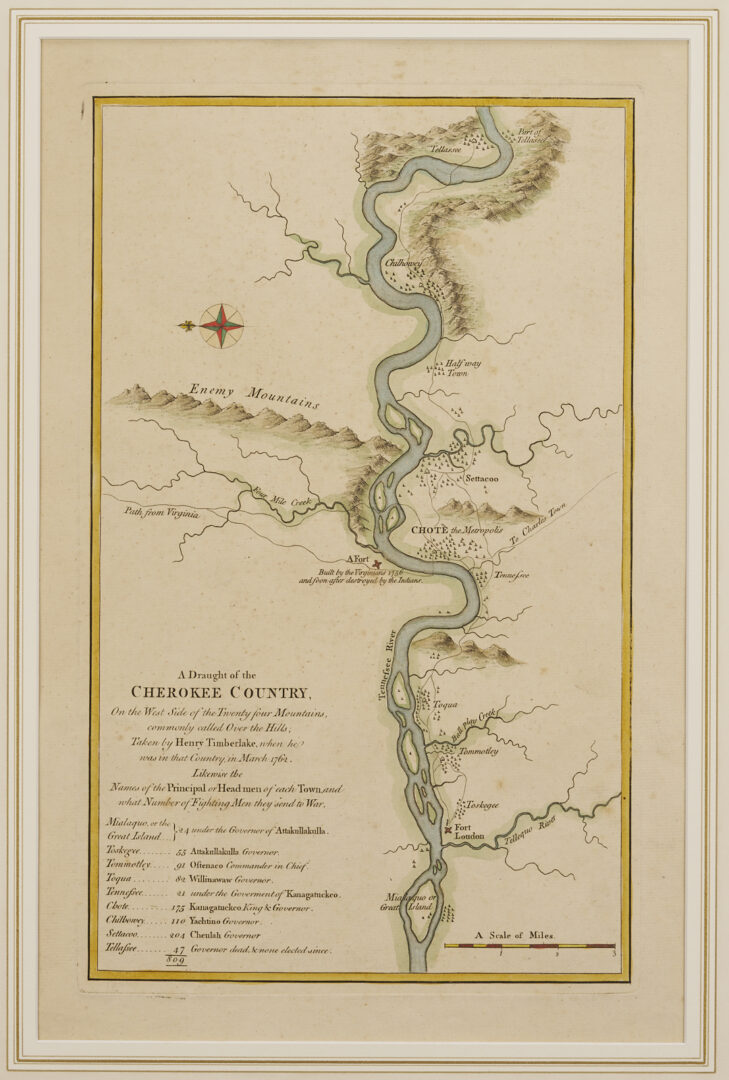
Important early Tennessee map: “A DRAUGHT OF THE CHEROKEE COUNTRY… taken by Henry Timberlake when he was in that Country in March 1762.” Matted and housed under glass in an ebonized and parcel gilt wood frame. Plate: 15 1/2 in. x 9 5/8 in. Sight: 17 1/4 in. x 11 1/8 in. Frame: 26 in. x 20 in. This hand colored, engraved map on laid and watermarked paper was included as part of Thomas Jefferys and Robert Sayer’s 1768 “General Topography of North America”. Ref. Margaret Pritchard, Degrees of Latitude, p. 190. Only state. Another example is in the collection of Colonial Williamsburg.
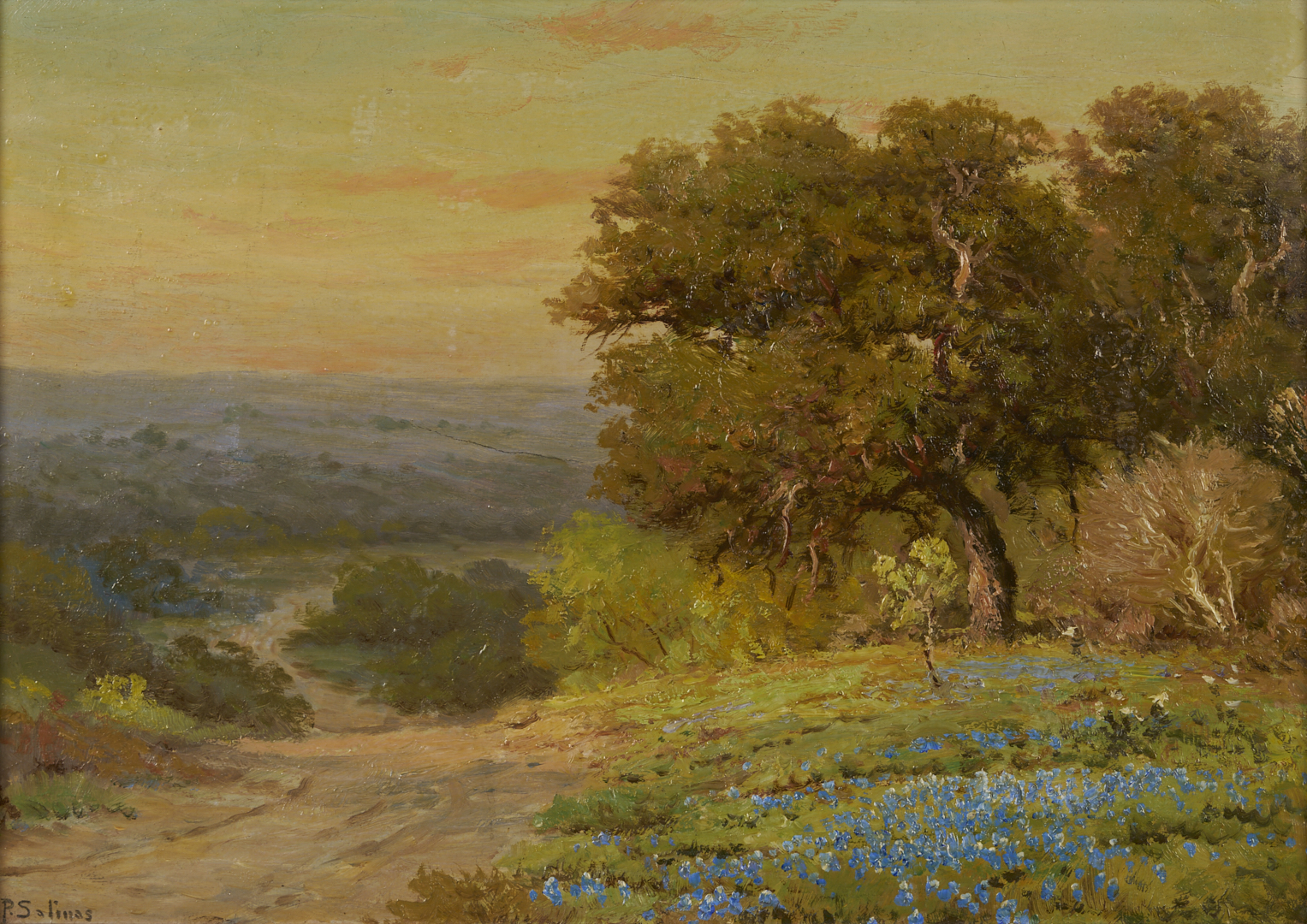
Porfirio Salinas (Texas, 1910-1973) oil on panel painting depicting a Texas hill country road winding past a patch of bluebonnets and a large tree, down into a shadow-covered valley. Signed “P. Salinas” lower left. Possibly original textured giltwood frame with Bradford Paint Co. Austin TX label en verso. Sight: 13 1/4 in. W x 9 1/2 in. H. Frame: 18 in. W x 14 in. H.
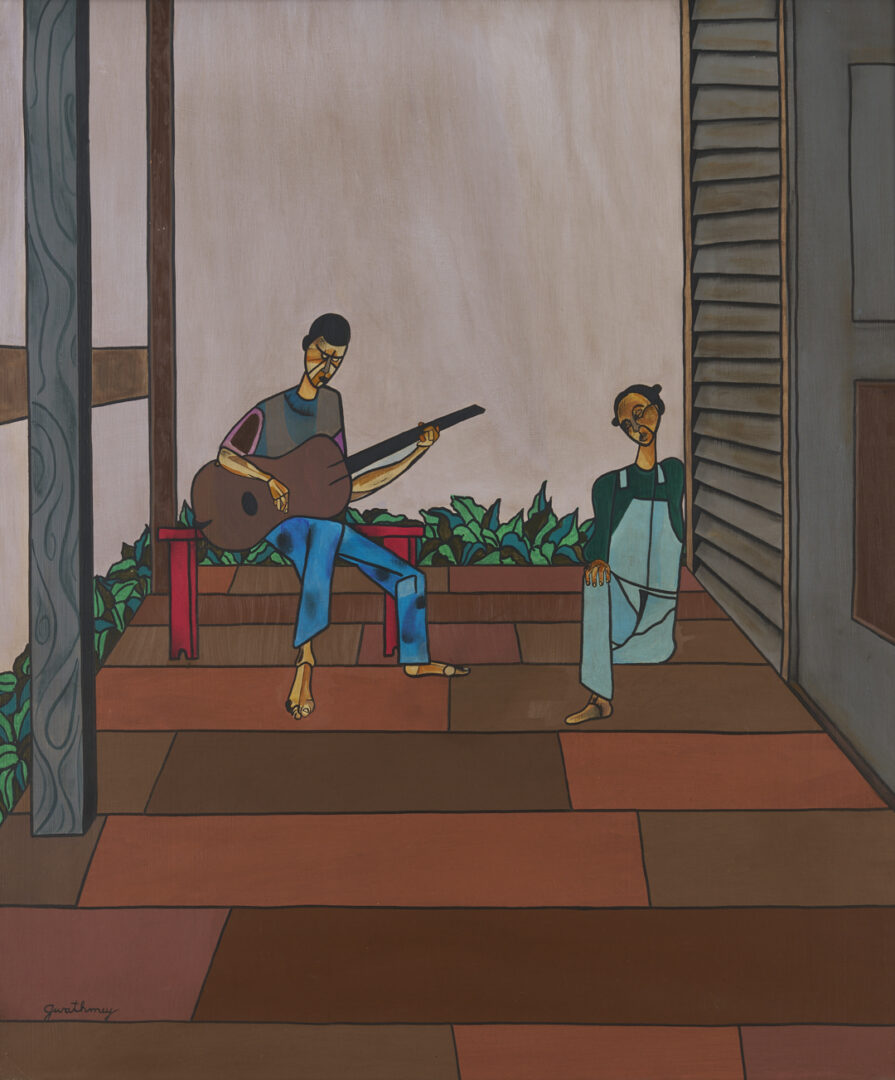
Robert Gwathmey (Virginia/New York, 1903-1988) oil on canvas painting of an African American man and woman seated outdoors on a porch. The man plays an acoustic guitar while the woman listens with eyes closed. Signed lower left. With The House of Heydenryk, New York, framer’s label affixed to back of frame. Housed in a distressed painted and giltwood frame. Sight: 35 1/2 in H. x 24 1/2 in. W. Framed: 47 in. H x 41 in. W.
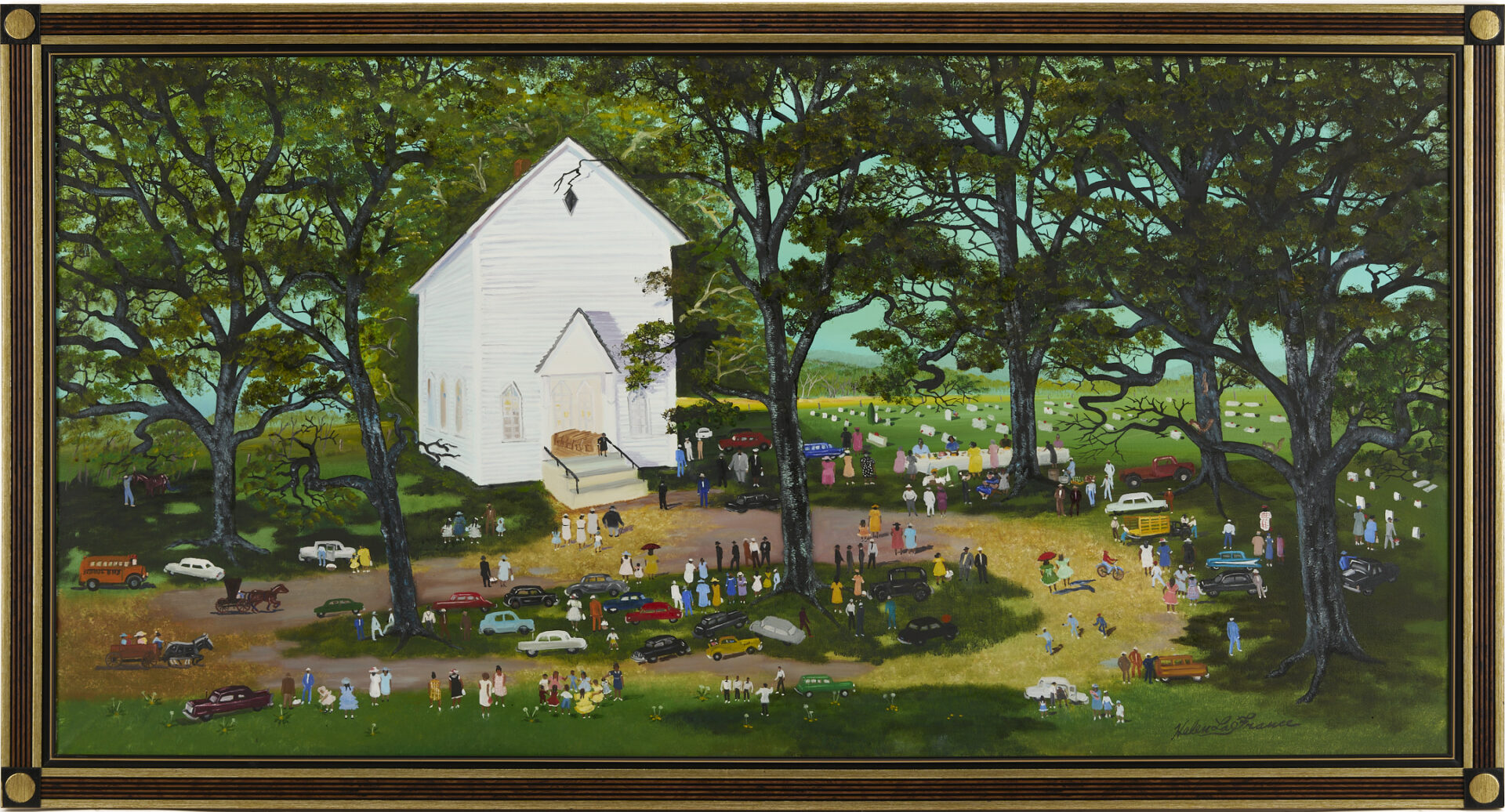
Exceptionally large Helen La France (Kentucky, 1919-2020) oil on canvas landscape painting depicting an African American church community gathering for a Decoration Day or Memorial Day picnic celebration. Signed lower right. Note: This is the largest Helen LaFrance “Church Picnic” painting we have ever offered, with the canvas measuring 60 in. W x 30 in. H and the frame, 64 in. W x 34 in. H.
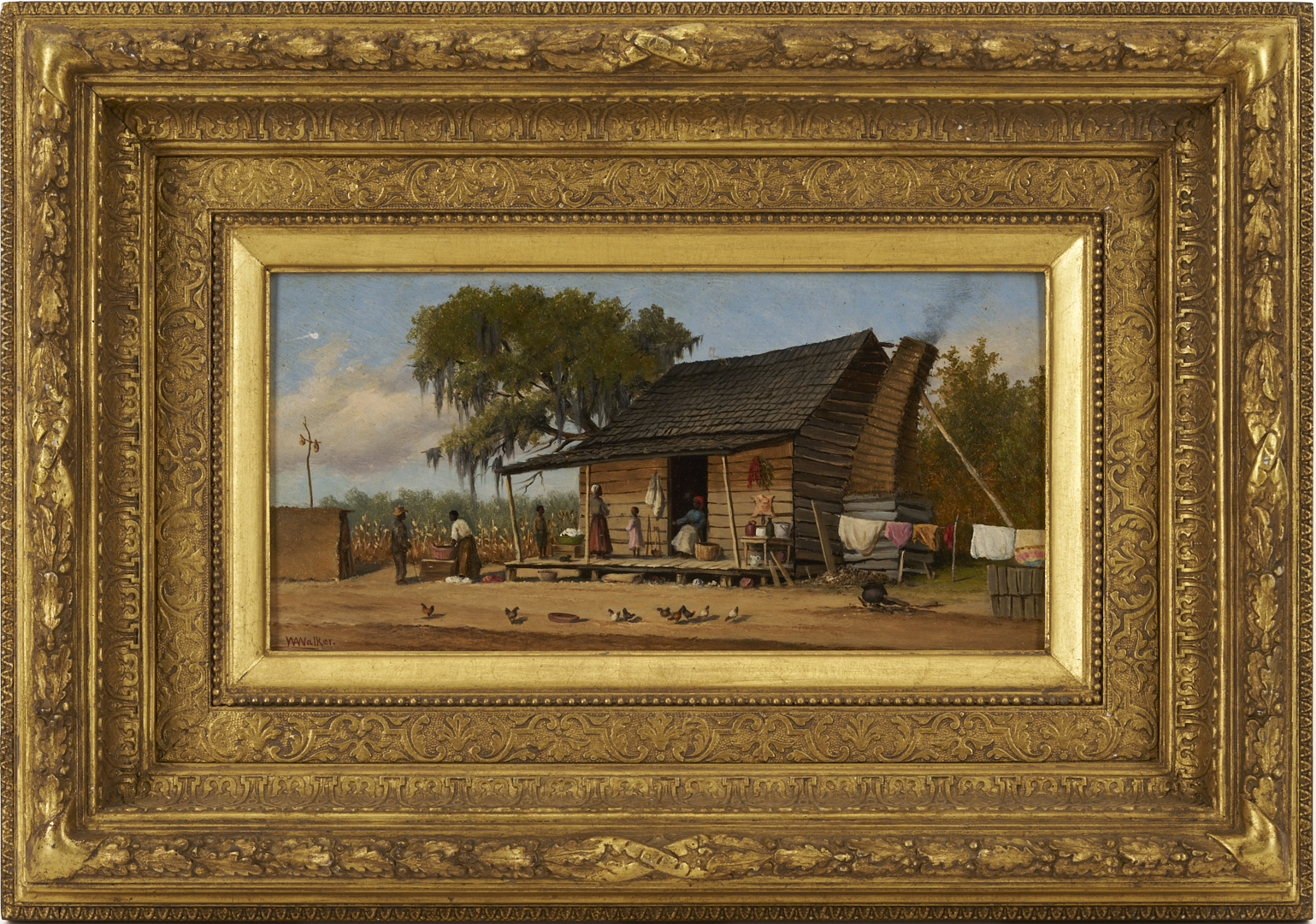
William Aiken Walker (American/South Carolina, 1838-1921) oil on academy board cabin scene painting with an African American family gathered before a cabin or small house and accompanied by a small cat. Chickens walk through the foreground while laundry dries on a line at right. Spanish moss hangs from the branches of a tree that reaches over a cornfield visible in the background at left. Signed lower left. Inscribed “Cabin” along with other text en verso. Housed in an ornate giltwood frame. Board: 6 1/2 in. H x 12 1/4 in. W. Sight: 5 3/4 in. H x 11 5/8 in. W. Framed: 14 in. H x 20 in. W.
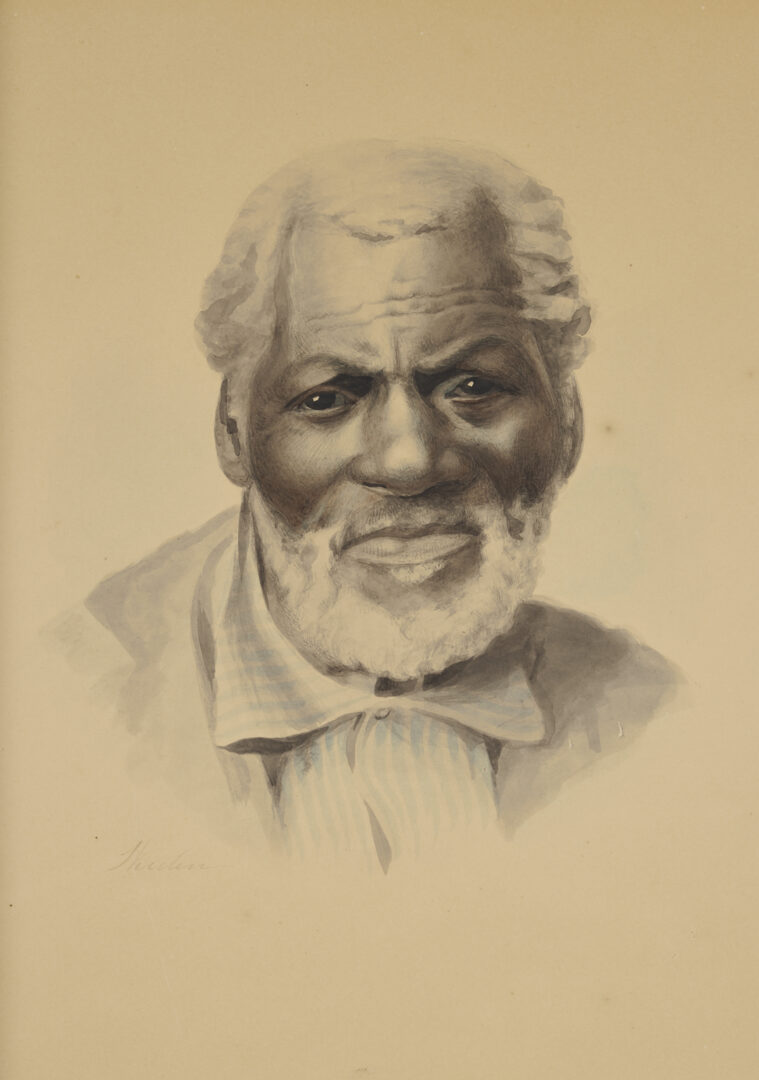
Maria Howard Weeden (Alabama, 1846-1905) watercolor on card portrait of an elderly African American man shown in bust-length. He wears a striped, blue shirt under a jacket and looks directly toward the viewer. Signed “Weeden,” lower left. Inscribed “Mm. A. L. Eastland / Los Gatos” and “Mm. Ha[rrison?]” in pencil to verso. Framer’s note inscribed the lower edge of recto reads “Make nearly sa[me s]ize as [others?] as possible.” “W.K. Vickery / Publisher and Art Dealer / 224 Post Street / San Francisco” gallery label affixed to old backing board (housed behind newer backing board). Gallery label, verso, and mat all numbered 5593. Framed under glass in a giltwood frame with textured creat mat. Card: 11 in. H x 9 in. W. Sight: 9 1/4 in. H x 7 in. W. Framed: 16 in. H x 13 1/2 in. W. Note: W.K. (William Kingston) Vickery (1851-1925) established his W.K Vickery gallery in San Francisco in the last decades of the 19th century. By 1900, the firm took the better-known name of Vickery, Atkins, & Torrey. The present painting was likely framed or sold by Vickery prior to 1900.
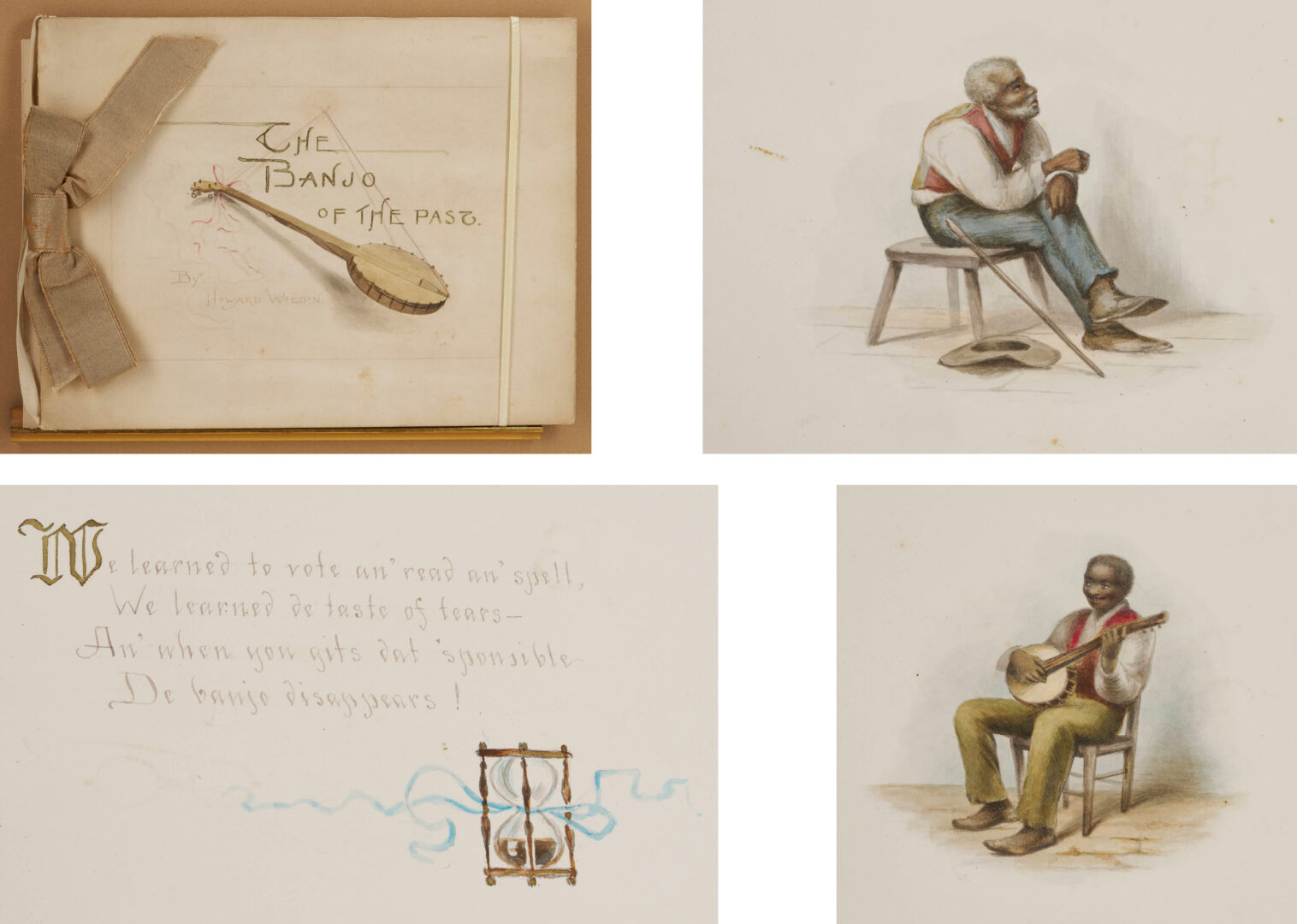
Maria Howard Weeden (Alabama, 1846-1905) watercolor and pencil artist’s book on two sheets of bifolded card entitled “The Banjo of the Past” with the text of the poem published in Weeden’s 1899 book of poetry Bandanna Ballads plus six accompanying watercolor illustrations, including cover. Cover with illustration that depicts a banjo which hangs on a string, title, and text that reads “By Howard Weeden.” Second illustration depicts an elderly African-American man seated with legs crossed on a stool. A hat lies on the floor and a cane leans against his stool. With the first verse of the poem, written in calligraphic text, on the preceding page.
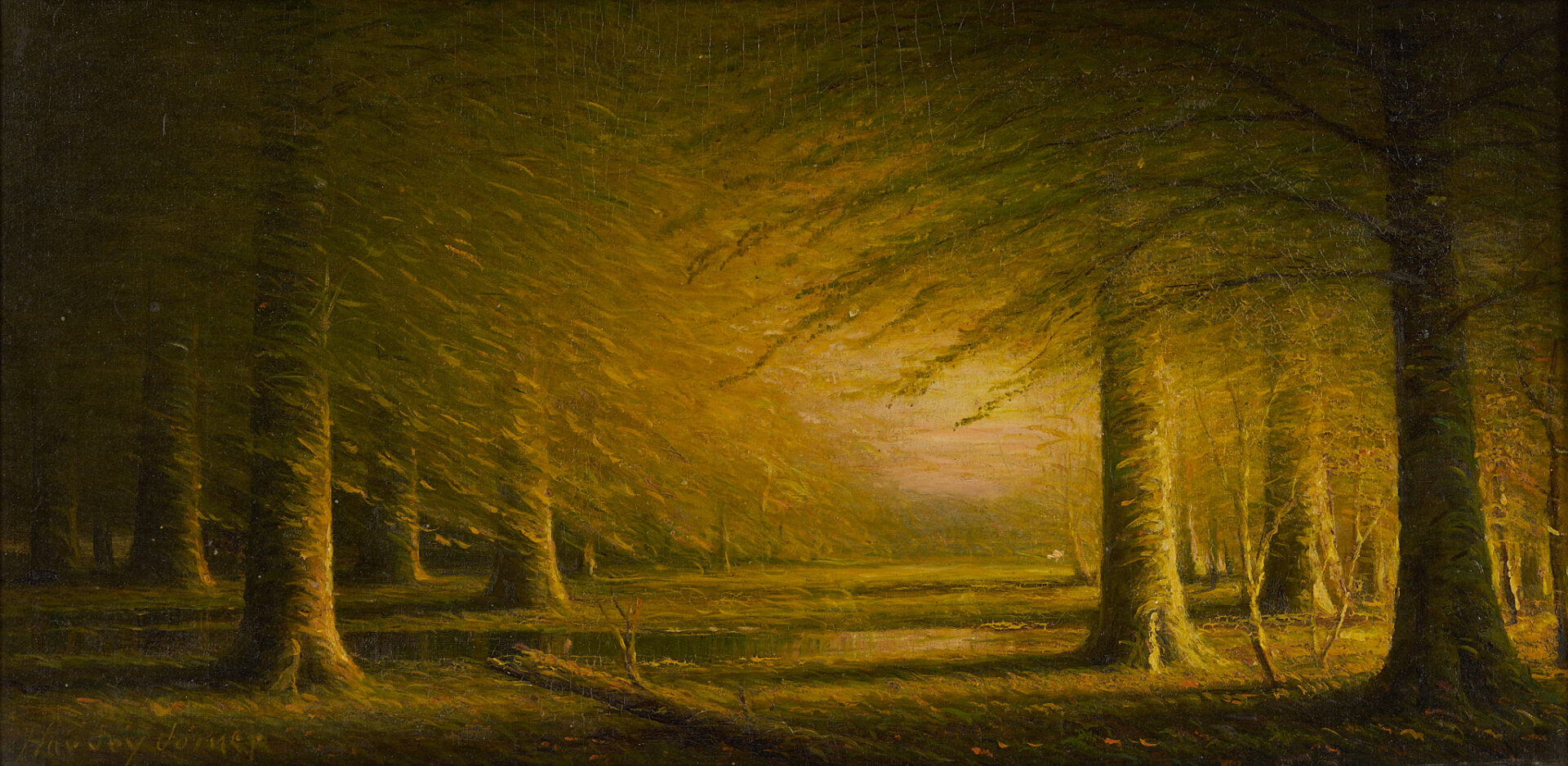
Harvey Joiner (Kentucky/Indiana, 1852-1932) oil on canvas or linen laid to board landscape painting that depicts sunlight breaking through a grove of trees and onto a grassy clearing and small body of water. A fallen tree lies in the foreground. Signed lower left. Housed in a giltwood frame with name plate. Sight: 9 1/2 in. H x 19 1/2 in. W. Board: 10 in. H x 20 in. W. Framed: 15 3/8 in. H x 25 1/2 in. W.
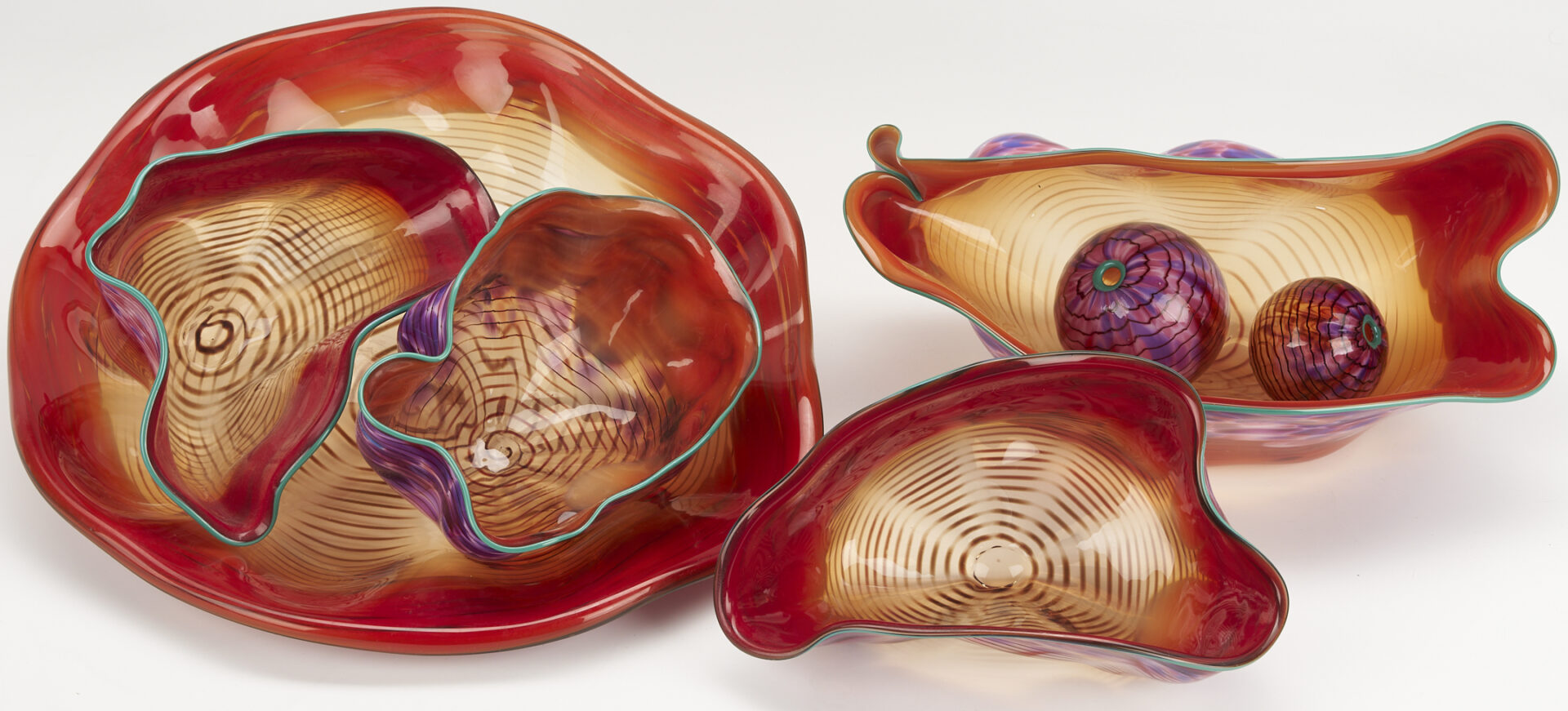
Dale Chihuly (American, b. 1941) art glass sculpture, Vermillion Macchia Set with Viridian Lip Wraps, 1987. Seven pieces of graduated sizes, featuring a mottled purple-white exterior with red striated interior accentuated by bright green lips. Largest piece: 16 in. W x 13 in. D x 8 1/2 in. H. A copy of the original sales receipt from Chihuly Inc., dated June 2, 1987, numbering this piece as 454.87.7 is available to the winning bidder.
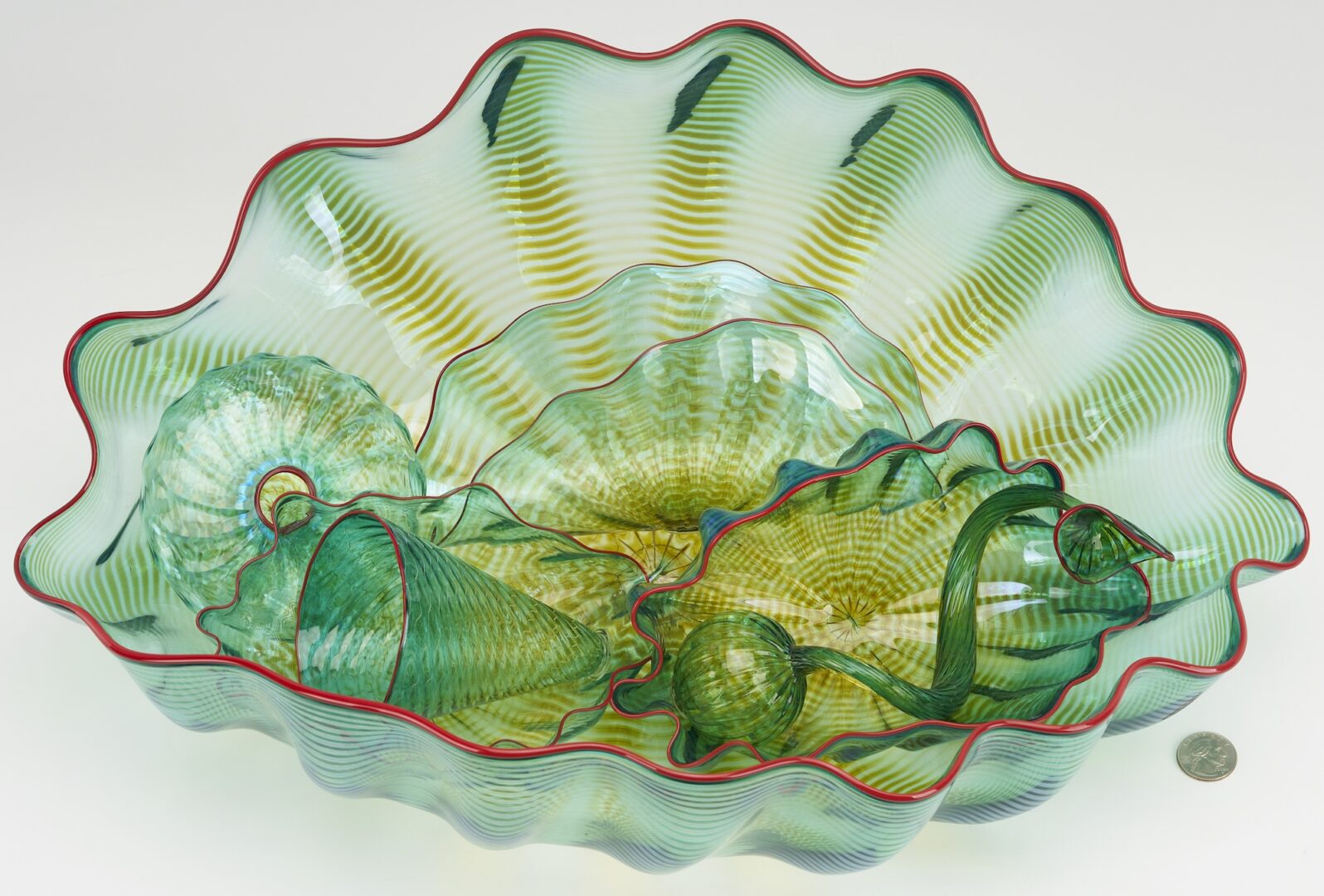
Dale Chihuly (American, b.1941) art glass sculpture, Clover Green Seaform Set with Carmine Lip Wraps. Seven pieces of graduated sizes and in various forms feature striped green and yellow surfaces accentuated by bright red lips. Signed and dated to the base of one piece. Largest piece: 19 1/2 in. x 12 1/4 in. 7 1/2 in. 2001.
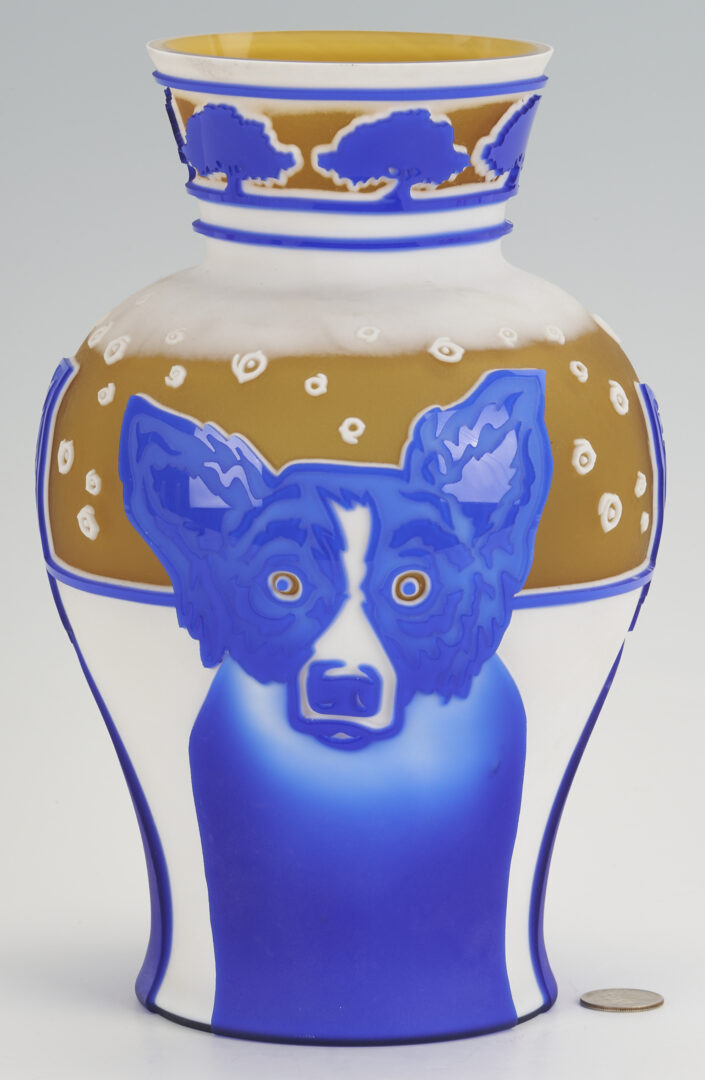
George Rodrigue (American/Louisiana, 1944-2013) “Blue Dog” Winter Fest cameo glass vase, 1995, signed “Rodrigue” in the design to side and numbered to underside 33 or 35/35. 10 7/8 in. H x 7 in diameter. Note: Between 1993 and 1995, George Rodrigue worked with Kelsey Murphy and Pilgrim Glass in West Virginia to recreate his Blue Dog designs in cameo glass. The layered pieces are sandblasted, revealing Rodrigue’s raised patterns. A total of three bowls and one vase were designed, each in editions of thirty-five.
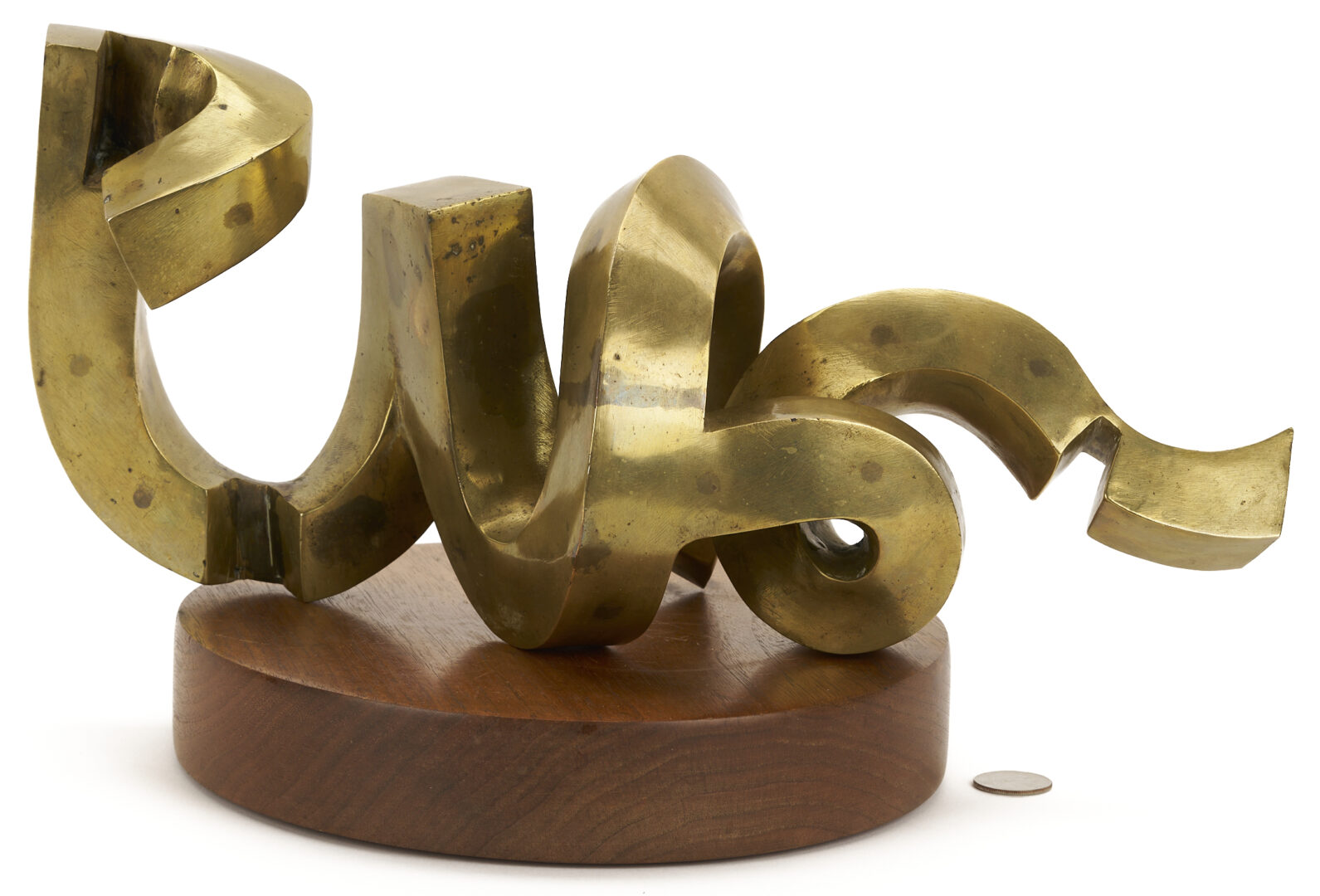
Martin Chirino (Spanish, 1925-2019), “Raiz” (Root), 1970, gilded chromed iron abstract sculpture, 16 in. W x 7 in H x 5 1/2 in. D. (40 cm x 18 cm x 13 cm). Accompanied by a circular wooden turntable base, 1 3/4 in. H x 9 1/2 in. diameter. Note: this lot includes the 1970 purchase receipt from the Galeria Juana Mordo, Madrid, with certification that it is an original sculpture by the artist, along with a 1990 letter from the same gallery appraising it at $27,000.
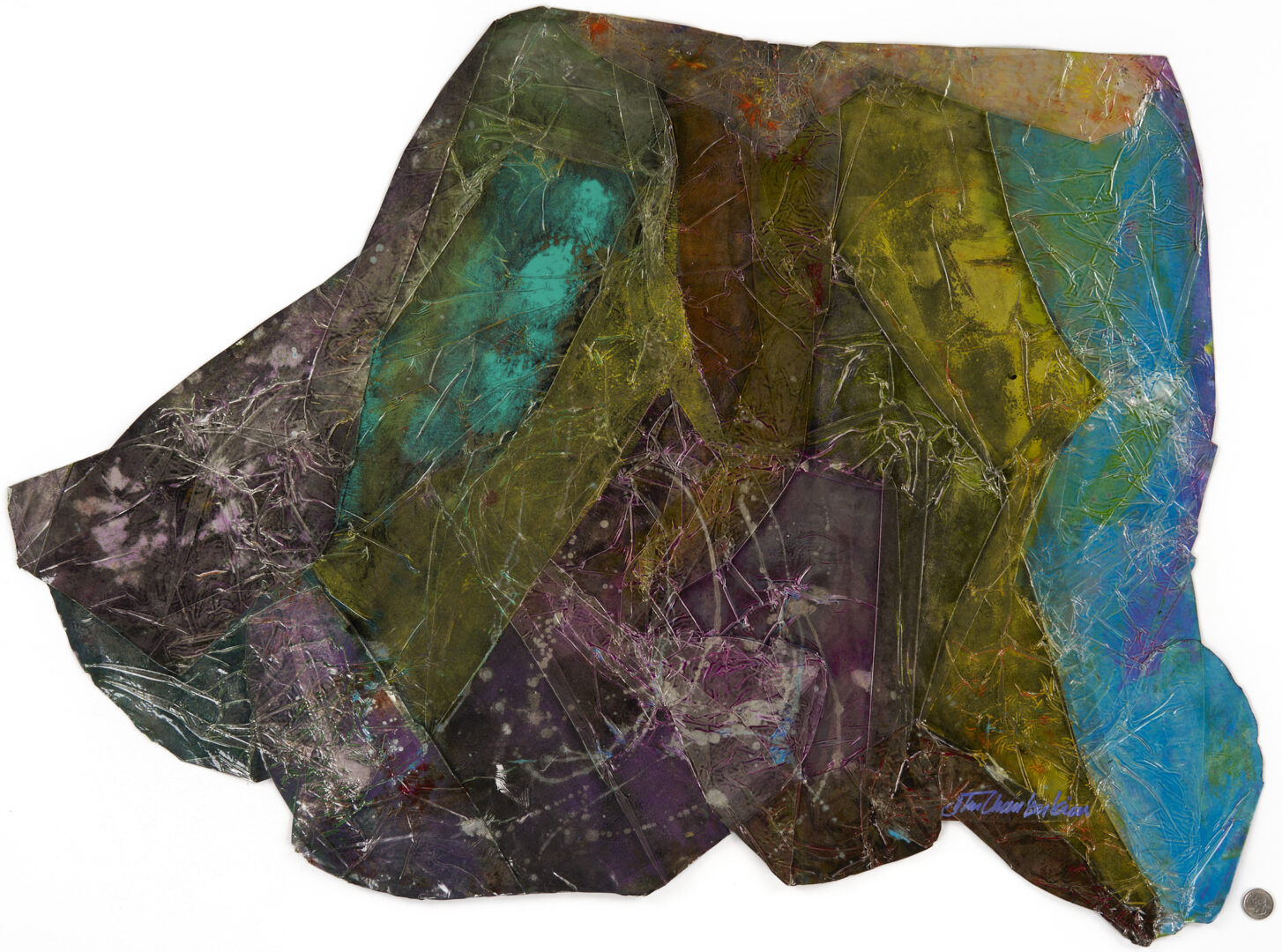
John Angus Chamberlain (1927-2011), “T.V. Christmas,” cased ink on aluminum sculpture, colored ink on crushed aluminum, signed lower right, “John Chamberlain”. 39 in W x 29 in. H x 1/4 in.
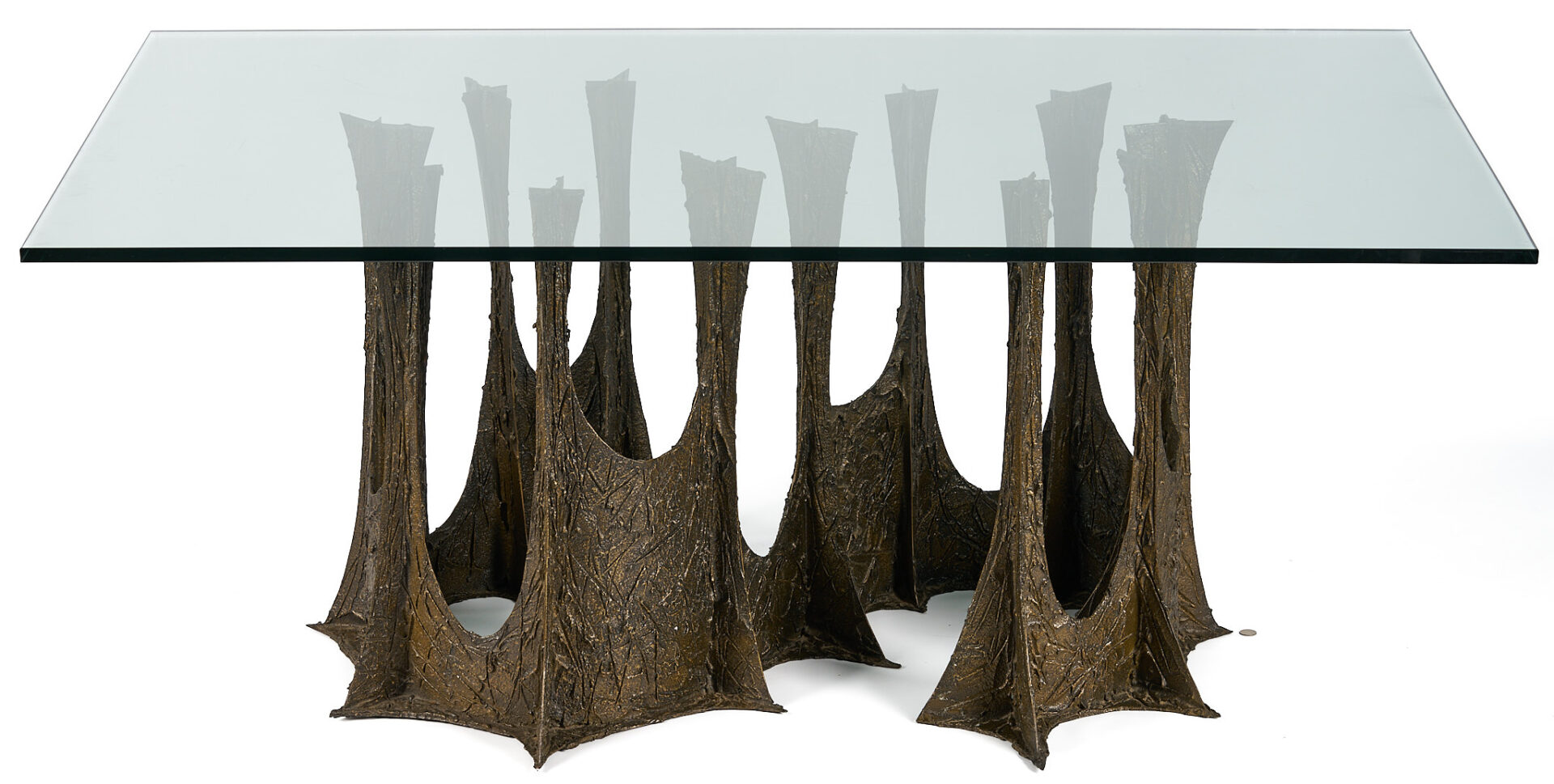
Paul Evans (American 1931-1987), Stalagmite dining table, model PE-102, Paul Evans Studio for Directional, USA, sculpted bronze, the artist’s signature technique of atomized bronze resin over steel, with original glass top, base incised PE 72. 29 in. H x 72 in. L x 48in. W. Circa 1972.
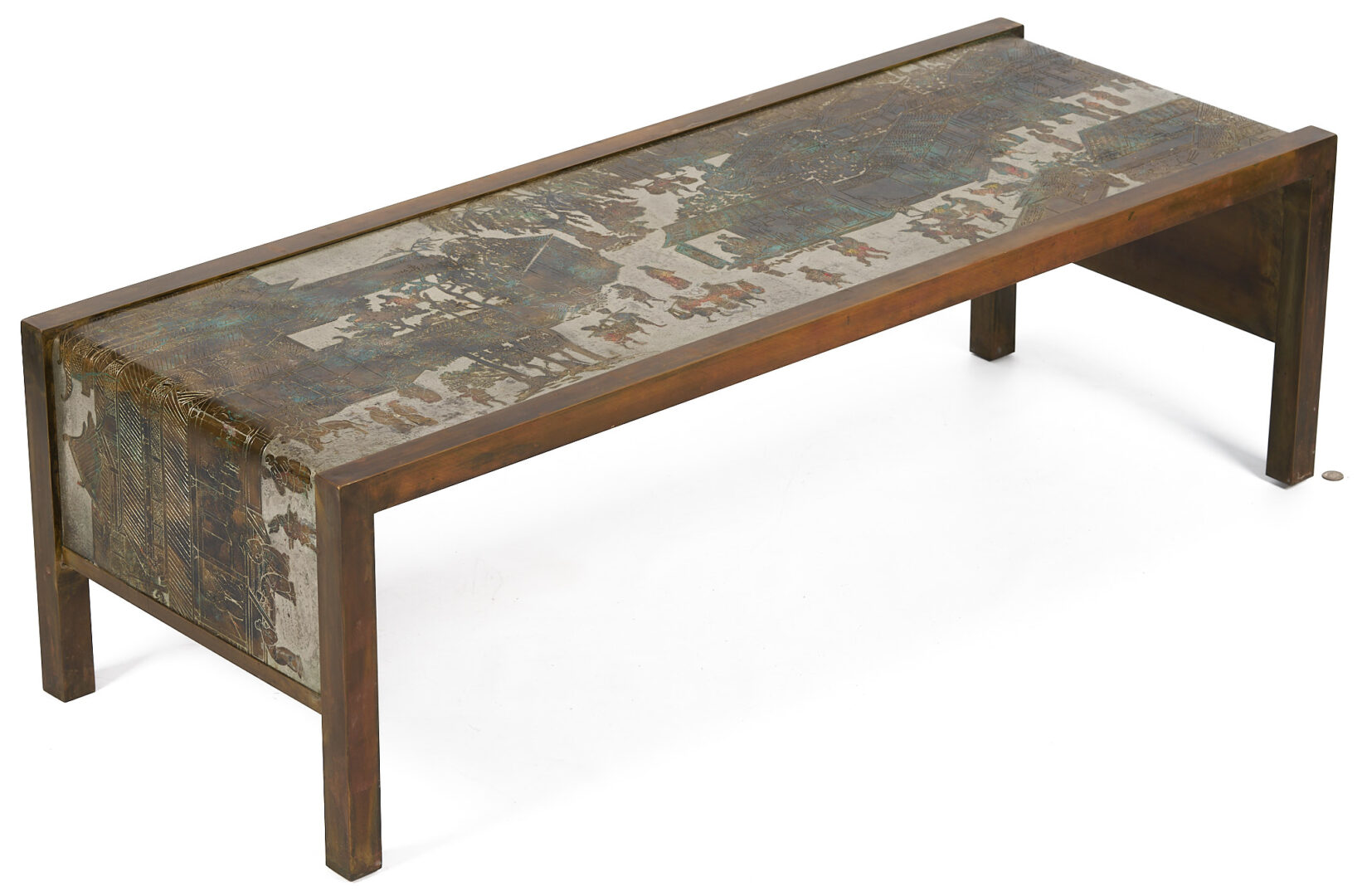
Philip (1907-1987) and Kelvin LaVerne (1937 – 2025) Studios “Spring Festival” etched, patinated, and polychromed bronze and pewter coffee table. Rectangular form, designed in the manner of a Chinese scroll depicting various figures and structures in a spring landscape, resting on squared legs. Raised signature to the lower middle edge. Retains the original Philip LaVerne Collection, New York, label. 16 in. H x 53 in. W x 20 in. D. Circa 1960’s.
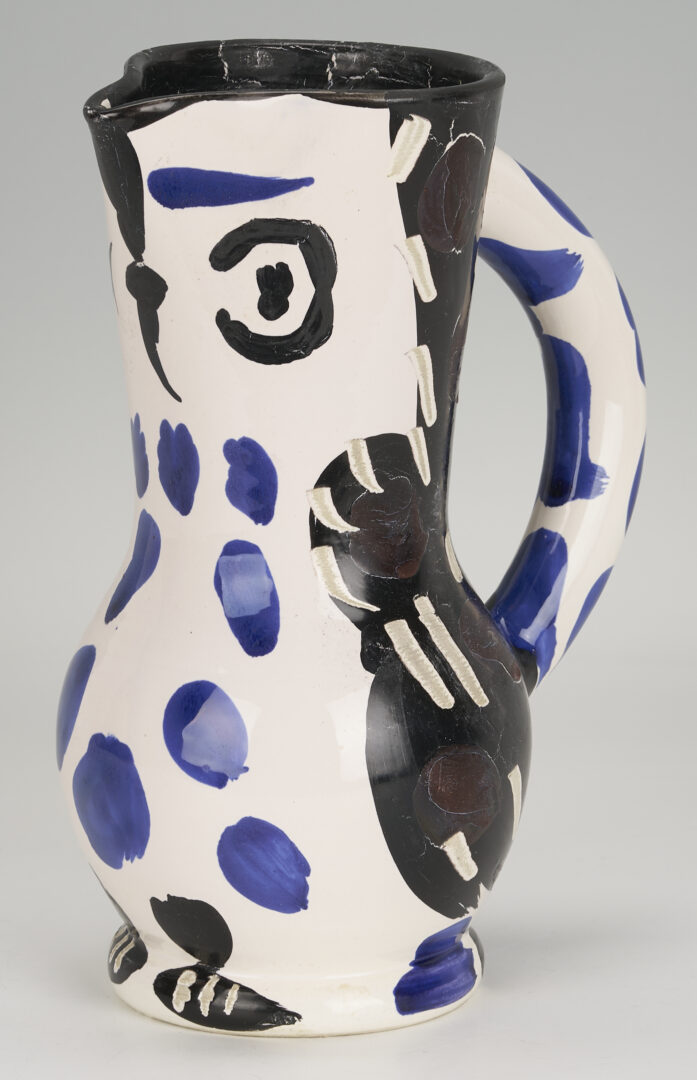
Pablo Picasso (1881-1973) Madoura Owl Jug, Cruchon Hibou, 1955 (Ref. A.R. no. 293). Glazed ceramic pitcher painted in black, blue and brown. Inscribed on the underside “Edition Picasso Madoura,” with the “Edition Picasso” and “Madoura Plein Feu” pottery stamps. From the edition of 500. Measures 10 in. H (25.5 cm) x 7 in. W x 5 1/2 in. D.
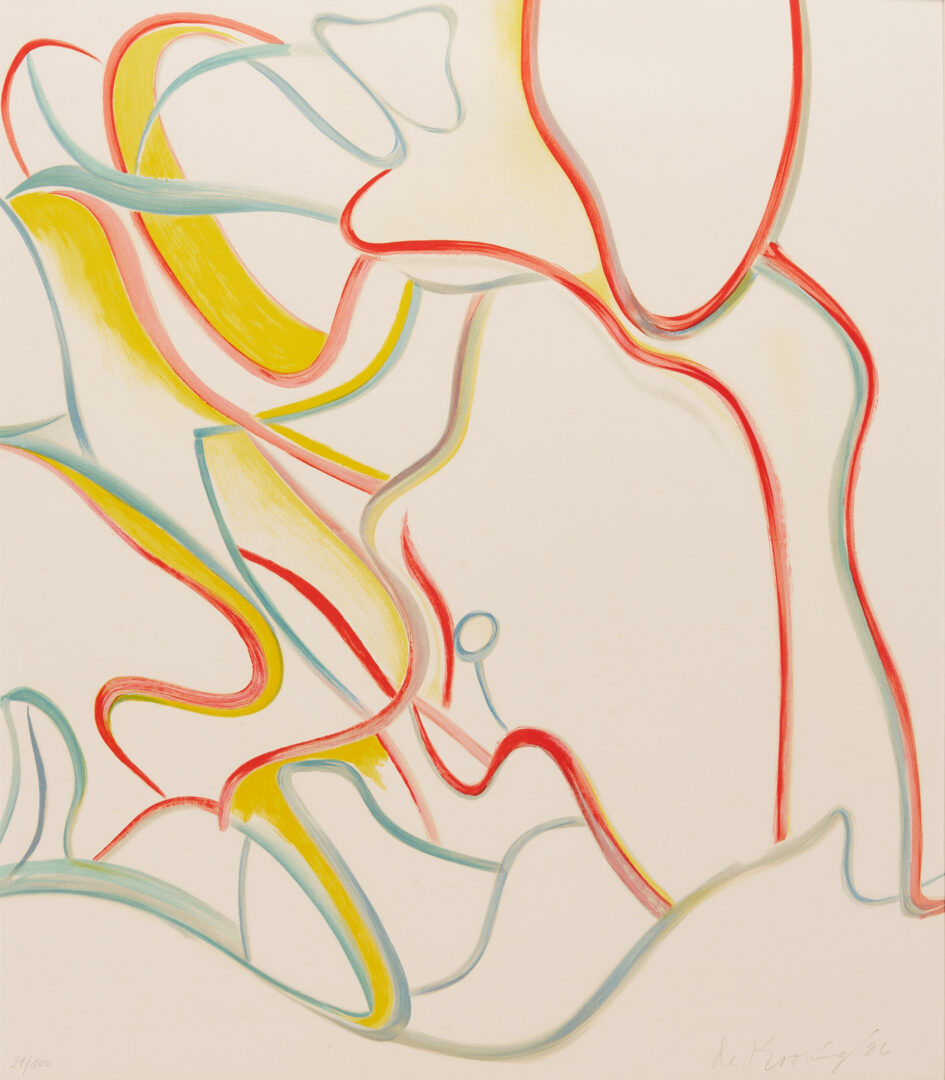
Willem De Kooning (American/Dutch, 1904-1997) abstract color lithograph on Arches paper, untitled from the Quatre Lithographies (Four Lithographs) portfolio. Red and blue lines augmented by graduated and solid yellow forms fill the composition. From the edition of 100 printed by Art Estampe and published by Editions de la Difference, Paris. Signed, dated, and numbered 21/100 in pencil along lower edge. Housed under acrylic in a painted wood frame with cream mat. Sight: 27 1/4 in. H x 23 3/4 in. W. Sheet: 28 1/4 in. H x 24 3/4 in. W. Framed: 34 1/2 in H. x 31 in. W. 1986.
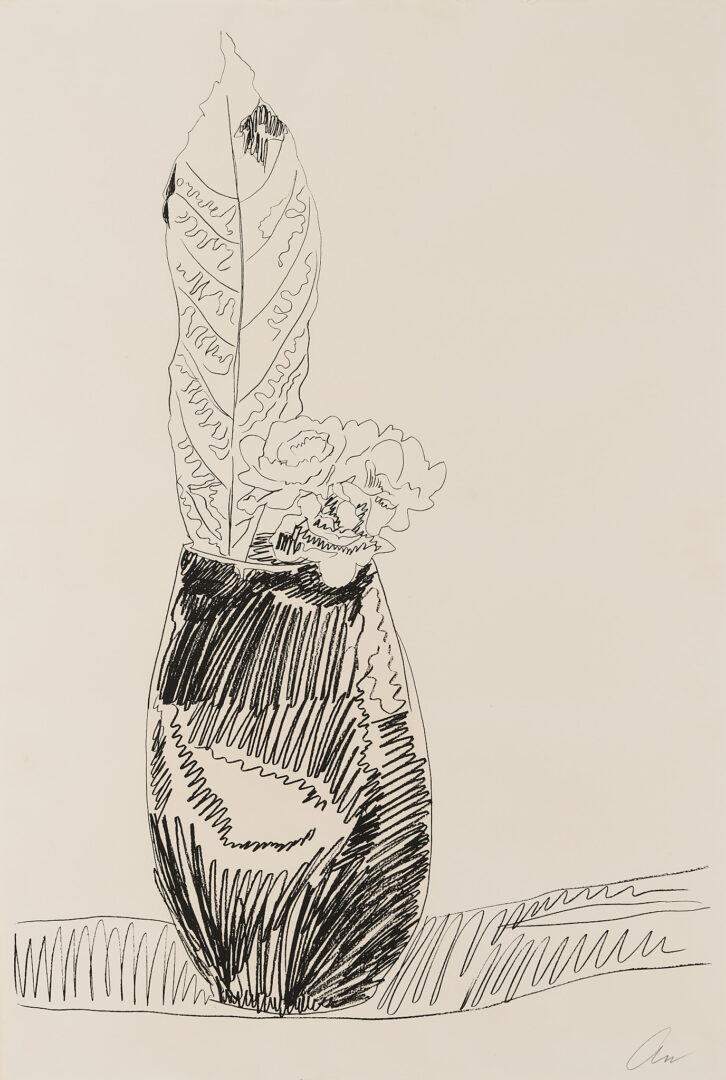
Andy Warhol (American, 1928-1987) serigraph in black on J. Green wove paper, “Flowers.” Three blossoms and a long leaf extend from the top of a vase described with gestural linework. Printed by Studio Heinrici and published by Castelli Graphics. Initialed in pencil to lower right. Pencil signed, dated, and numbered 91/250 to verso along with “Copyright By / Andy Warhol Multiples Inc. / & Castelli Graphics 2, 1974” stamp. “J. Green” blindstamp to upper left and “JG” watermark to lower left. Ref.: Feldman/Schellmann II.105. Floated under acrylic in a modern ebonized wood frame. Sheet: 40 1/2 in. H x 27 in. W. Framed: 51 3/4 in. H x 38 3/4 in. W. 1974.
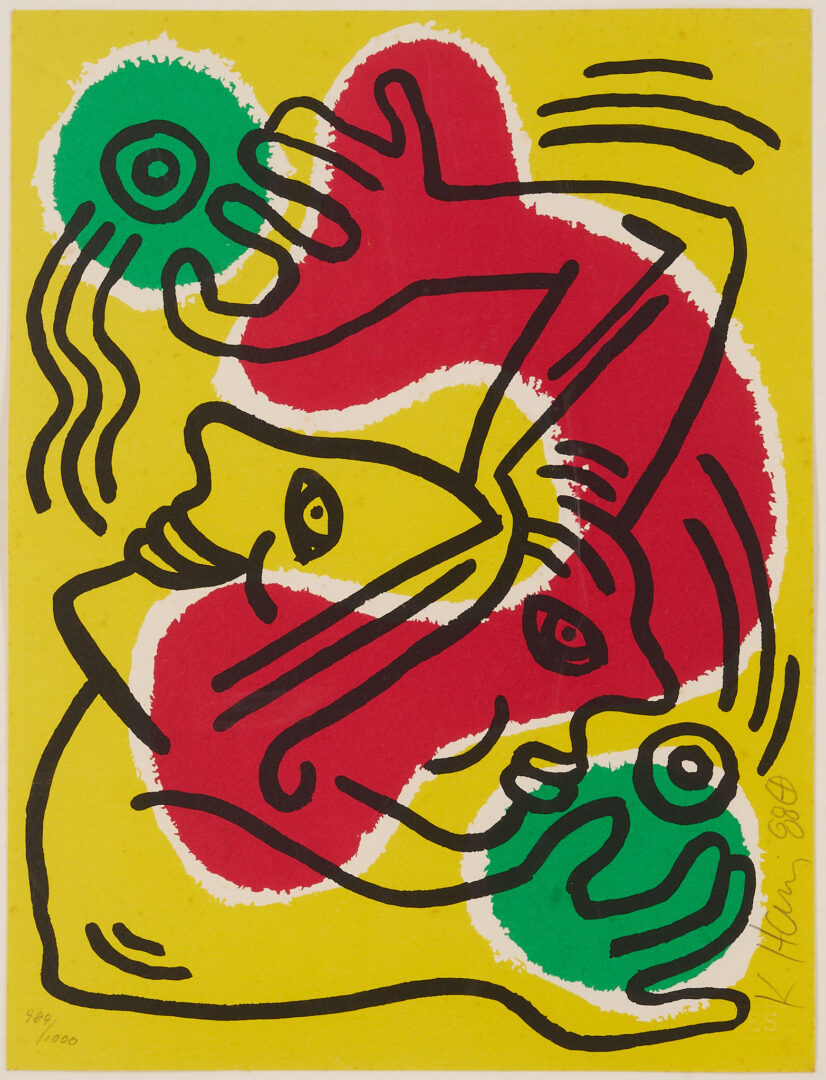
Keith Haring (American 1958-1990) color lithograph, “International Volunteer Day.” Signed, dated, and numbered 989/1000 in pencil. Printed by Emiliano Sorini Studio, New York, with their blindstamp to lower right, and published by the World Federation of United Nations Association. With Martin Lawrence Limited Editions label and World Federation of United Nations Association documentation certificate numbered 989 and signed by Annabelle Weiner affixed to backing. Ref.: Littmann p. 93. Floated under acrylic in an ebonized wood frame. Sheet: 11 in. H x 8 1/2 in. W. Framed: 16 3/4 in. H x 14 in. W. 1988.
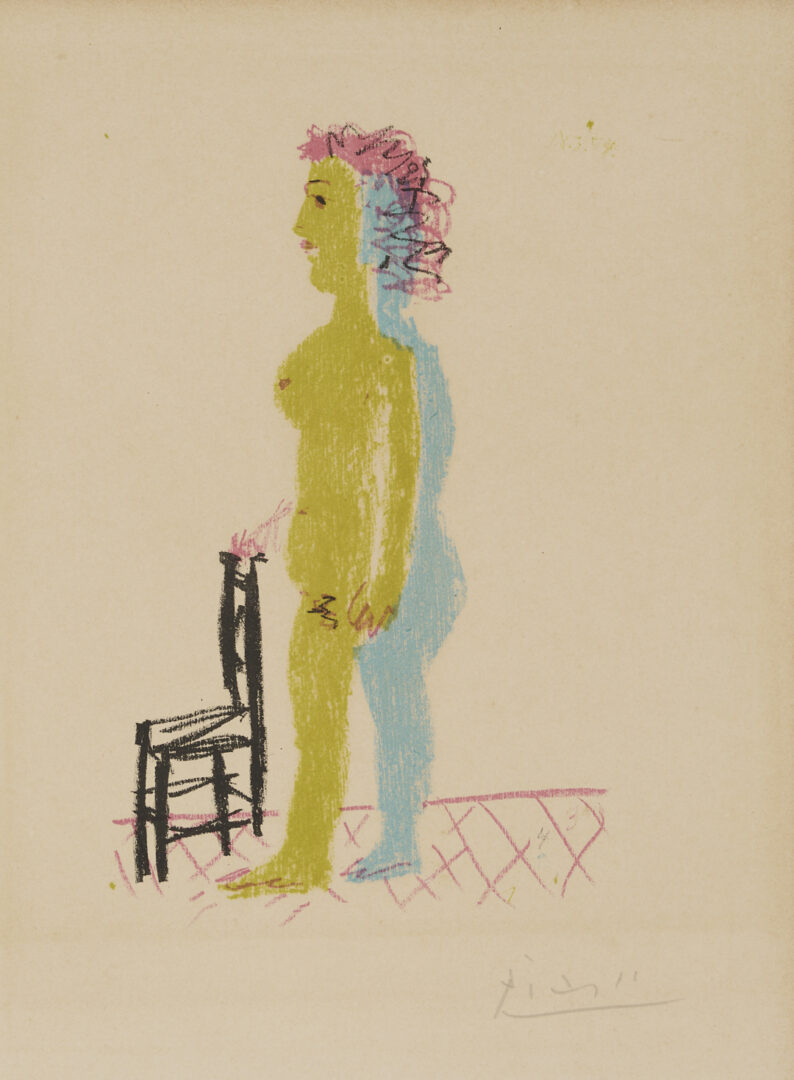
Pablo Picasso (Spanish, 1881-1973) color lithograph on Arches paper, “Nu a la Chaise” (Nude with Chair). A standing, nude woman shown in profile and rendered in green and blue rests her right hand on the back of a black chair. Pencil signed to lower right and numbered 16/50, lower left. From the edition of 50 plus five proof impressions. Ref.: Bloch 763, Mourlot 261. Housed under acrylic in a giltwood frame with cream textile mat and gilt fillet. Sheet: 19 3/4 in. H x 25 1/2 in. W. Frame: 27 3/4 in. H x 33 3/4 in. W. 1954.
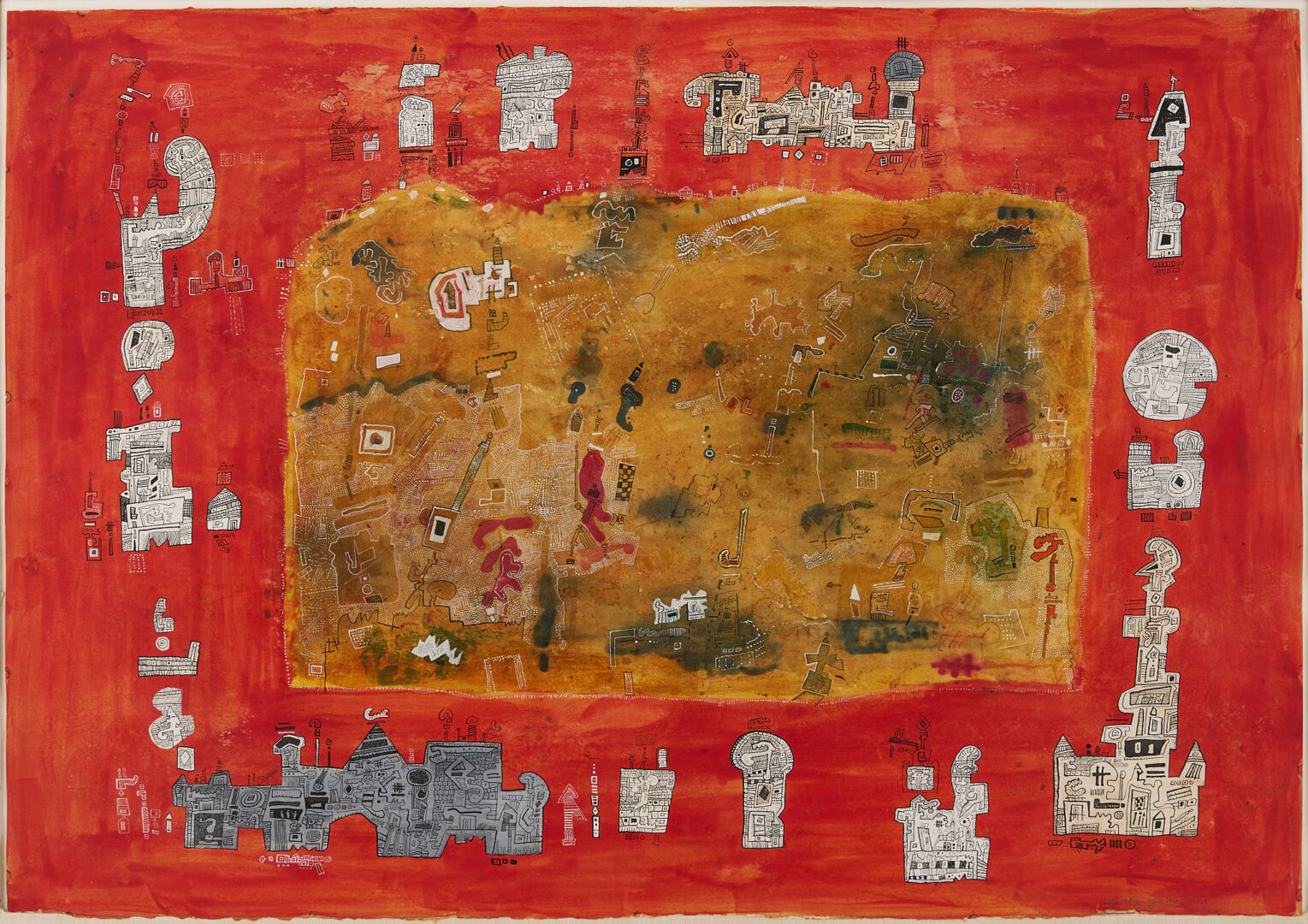
Ynez Johnston (California, b. 1920-2019) large watercolor and ink on paper titled “Beyond the Gobi”. Mounted on a white mat with beige linen mat under glass in a silver metal frame. Sheet: 27 1/2 in H x 39 in. W. Frame: 39 in. H x 50 in. W.
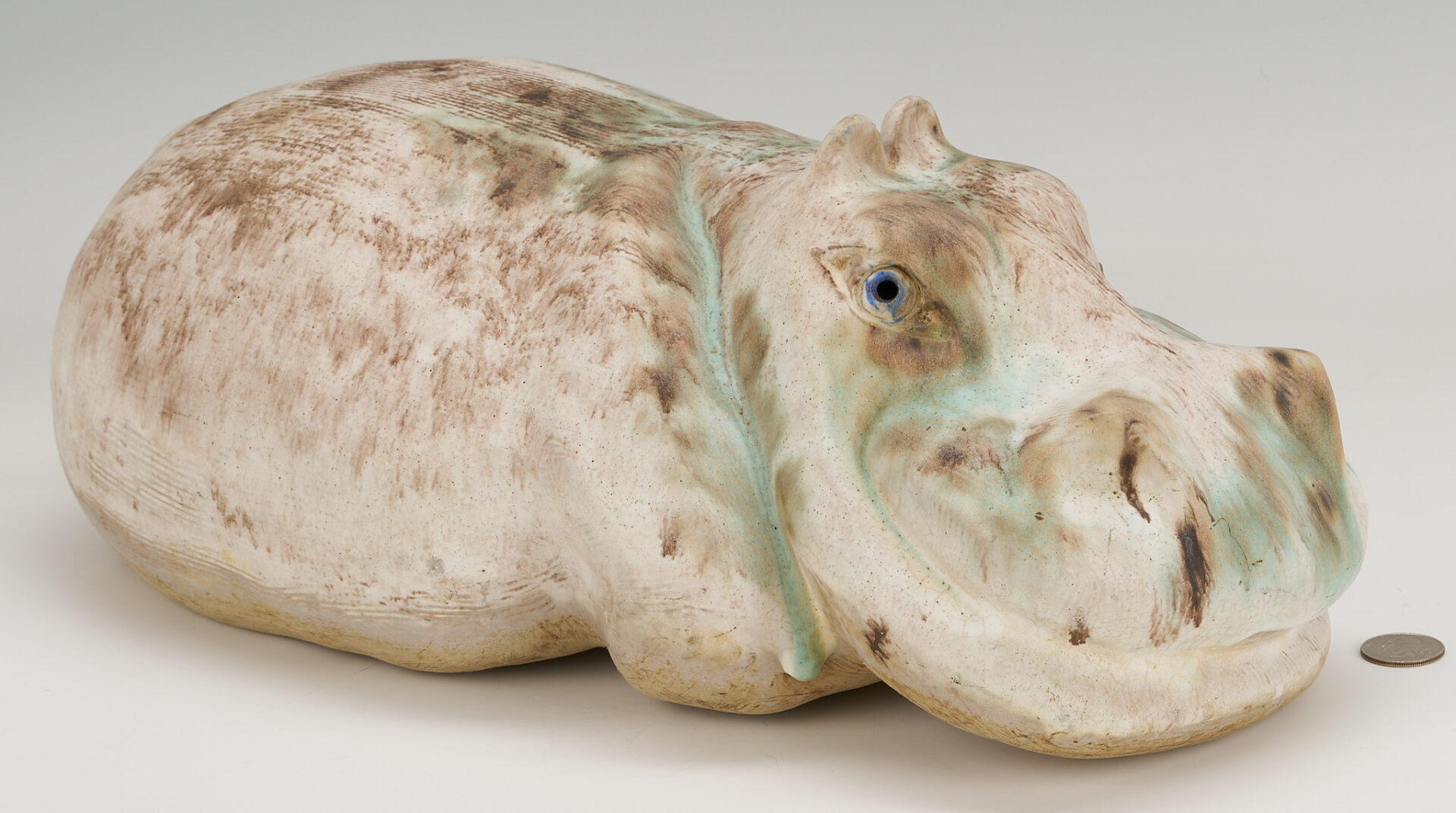
Large Hippopotamus pottery figurine by McCarty Pottery of Merigold, Mississippi, with four-tone glaze and cobalt eyes. Inscribed “McCarty P/ Merigold / Miss” to the underside. 15 1/2 in. L x 8 1/2 in. W x 6 1/2 in. H. Circa 1960s.
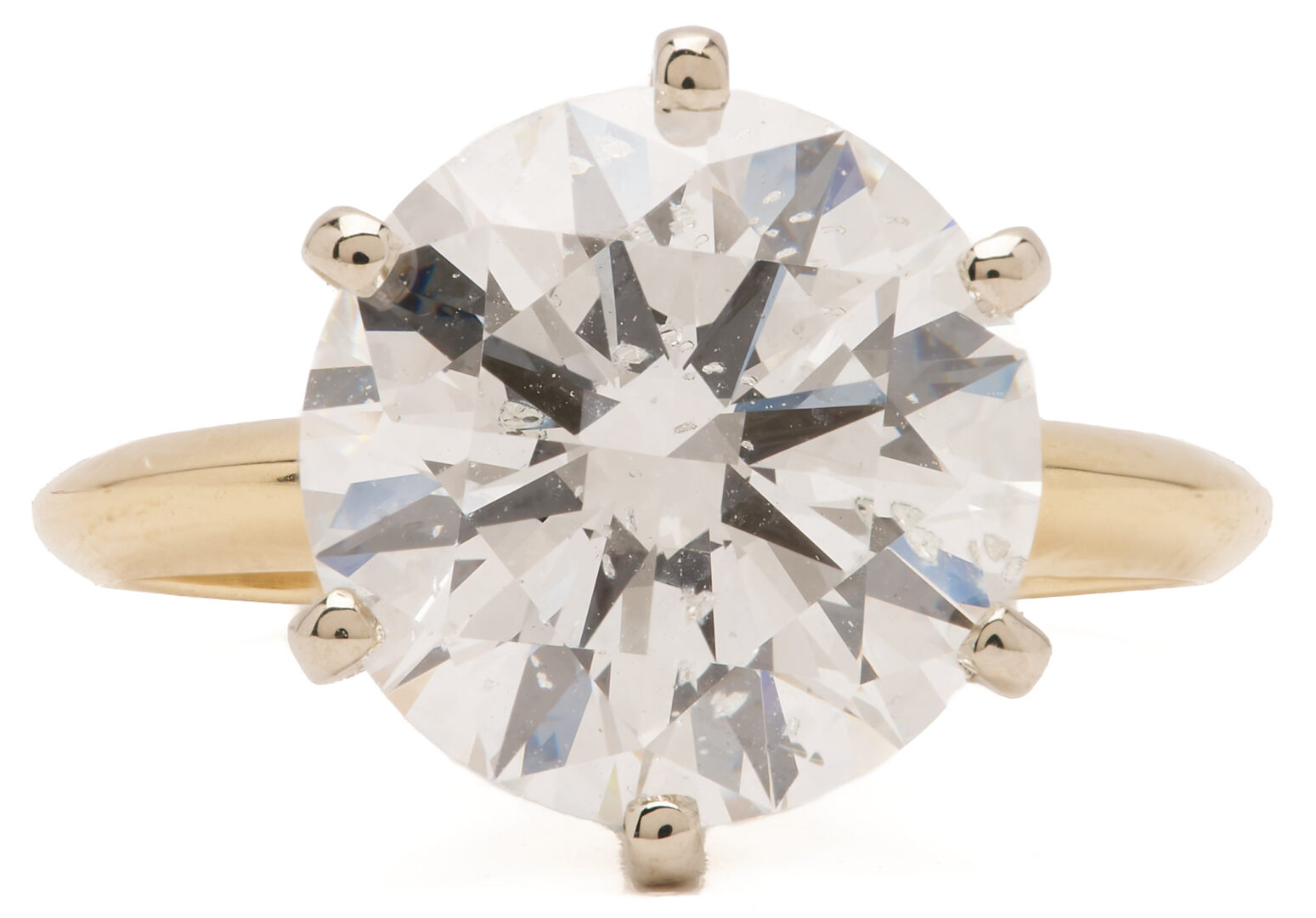
Ladies’ 14K yellow and white gold diamond solitaire ring containing one (1) 5.03 carat round brilliant-cut diamond measuring 11.12 x 11.16 x 6.64 mm, with D color, I1 clarity. Diamond with very good polish, very good symmetry, and excellent cut grade. Mounted in a 14K gold setting with a 14K white gold head and 14K yellow gold shank. Ring size 6.5. Accompanied by GIA report no.1236957126.
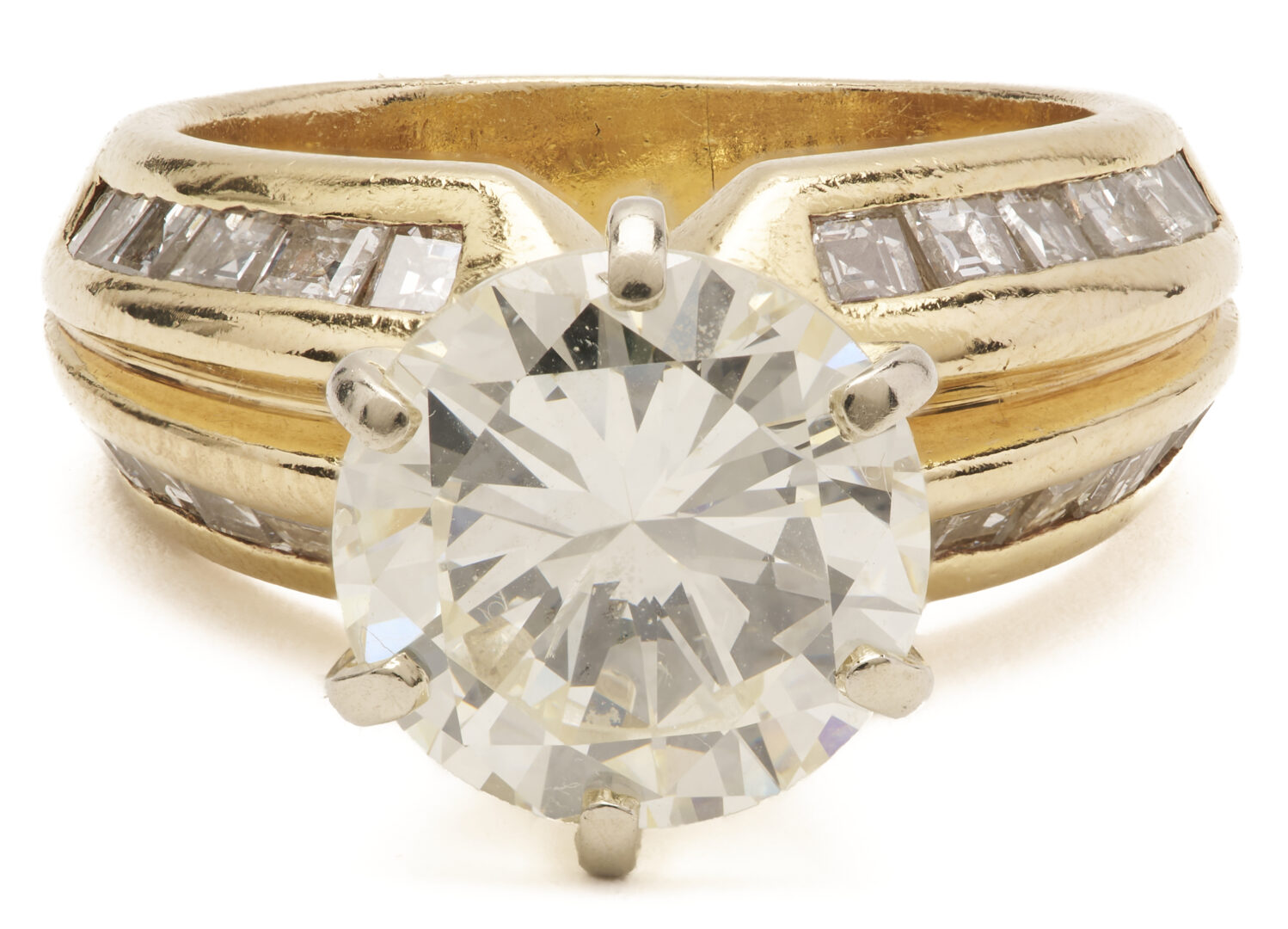
Ladies’ 5.86 carat diamond ring in 14K yellow and white gold, the mounting cast and hand-assembled with a white gold six-prong Tiffany-style head. Featuring a 4.18 carat center diamond measuring 10.50–10.61 x 6.13 mm, graded SI2 clarity and L color, accompanied by GIA Report #5231930090. Accented by twenty-four (24) square step-cut diamonds measuring approximately 2.25 x 2.25 mm each, with a combined weight of approximately 1.68 carats, graded H color and SI1-VS2 clarity.
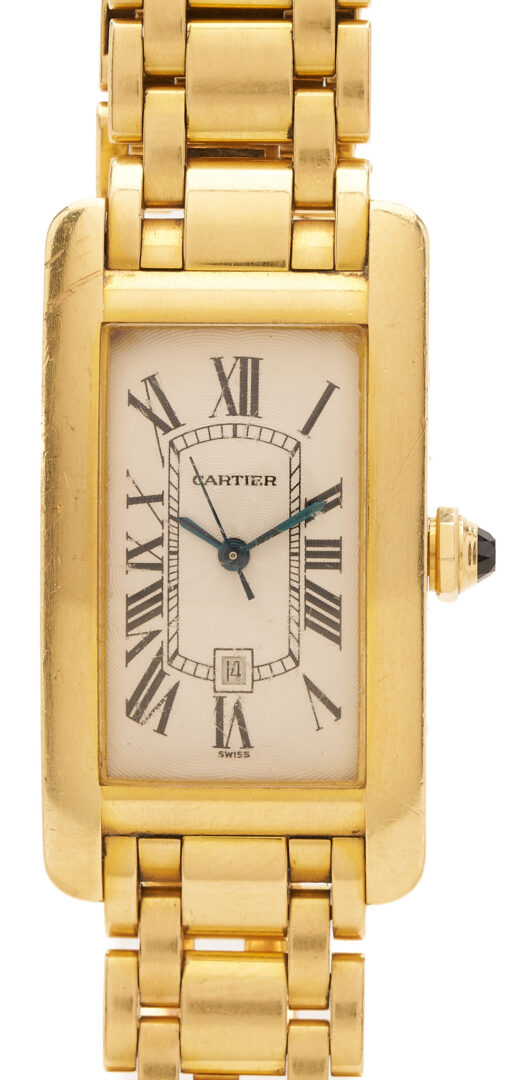
Men’s Cartier 18K yellow gold Tank Américaine wristwatch, Ref. No. 1725, Serial No. 229885CD. Featuring an elongated curved case, guilloché dial with Roman numerals, blued steel hands, date aperture, and automatic movement. Fitted with an 18K yellow gold Cartier link bracelet with concealed clasp. Case back marked “Cartier Automatic Water Resistant Swiss Made 18K 1725 229885 CD.” Bracelet marked “Cartier” and “750” together with additional hallmarks. Approximate interior circumference 9″. Includes two additional bracelet links. The watch weighs 121.57 total gross grams. Extra links weigh 8.33 grams.
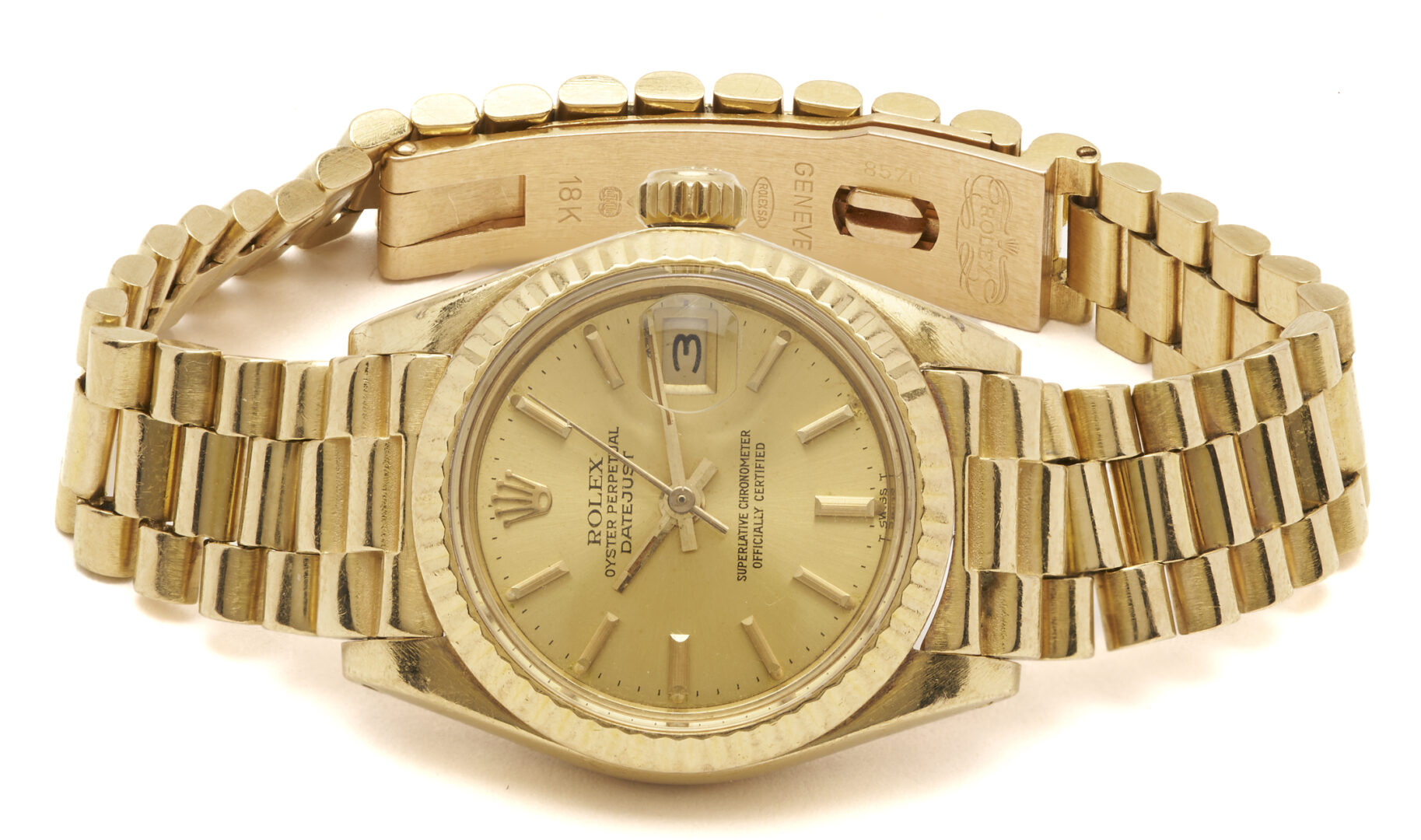
Ladies’ 18K Rolex yellow gold Oyster Datejust wristwatch, 26mm, reference # 6917, serial # 7394101, automatic movement with date, champagne dial with bar hour markers, 18K yellow gold President bracelet with concealed crown clasp. Bracelet numbered 8570. 63.8 total gross grams. 6 in. interior measurement.
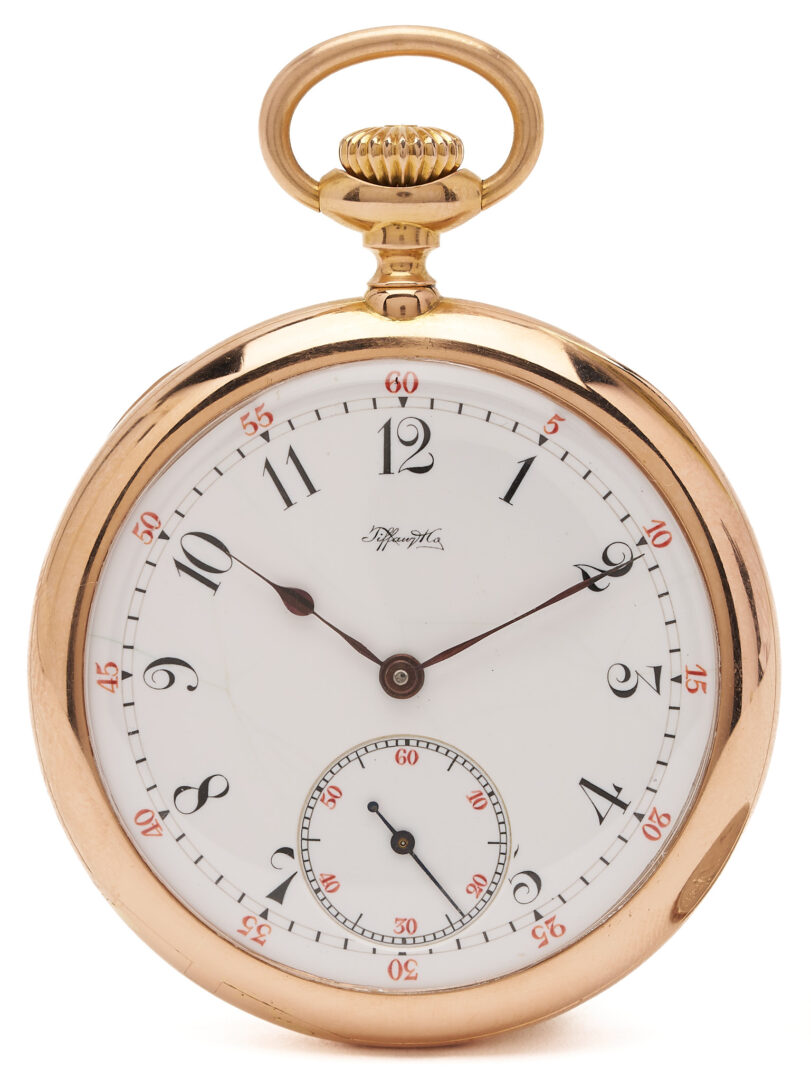
Men’s 18K Rose Gold Tiffany pocket watch, 45mm, open-cover design. Triple-marked “Tiffany” on the dial, case, and movement, and numbered 80875 on the case and movement. Presentation engraving on the inner cover: “Feb. 1905 – Theodore from Hazel”. 38.3 grams without the crystal and movement. 45.8 total gross grams.
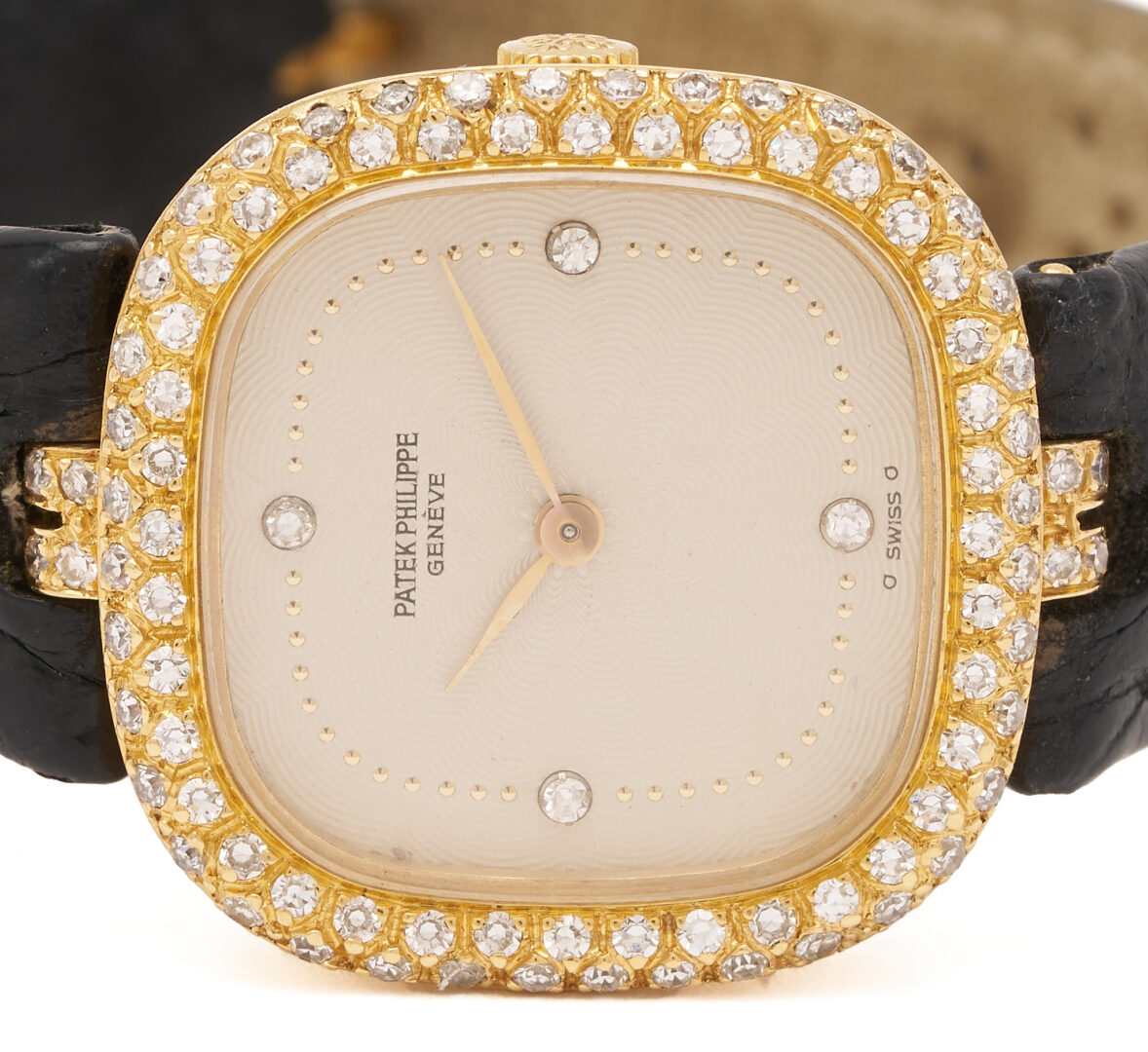
Ladies 18K yellow gold Patek Phillipe wristwatch, Ref. #4503, caliber 16-250, movement Serial # 1401013, case serial #2788688. Square face with tapering corners, 23mm x 23mm, diamond-set bezel, champagne sunburst dial with diamond hour markers, mechanical movement. Black alligator strap and tang buckle. 22.25 total gross grams. Circa 1980s.
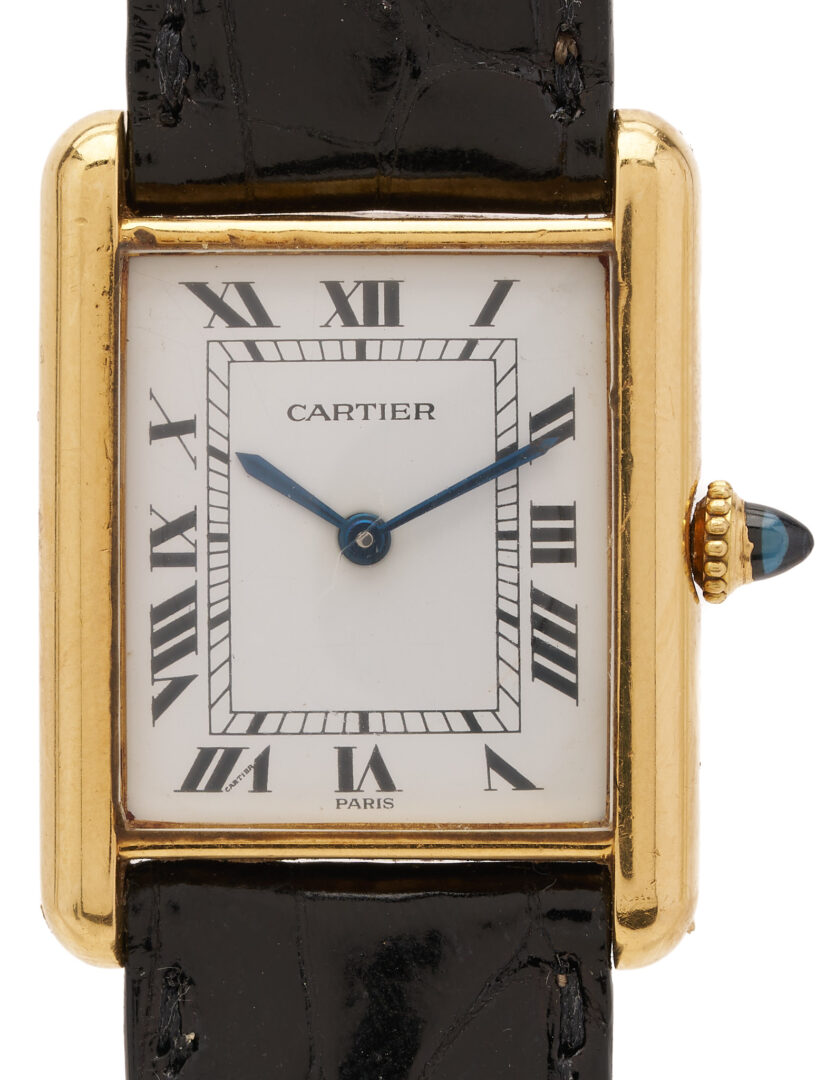
Cartier 18K yellow gold Tank Louis wristwatch, Reference 78086, featuring a 23 mm x 31 mm case, white “Paris” dial with Roman numerals, blued steel hands, and a beaded crown set with a cabochon sapphire. Manual mechanical movement. Case back marked “Cartier Paris” and numbered “780864702”; interior marked “18K 750 18K Swiss.” Fitted with a new Cartier black crocodile leather strap and an 18K gold Cartier buckle.
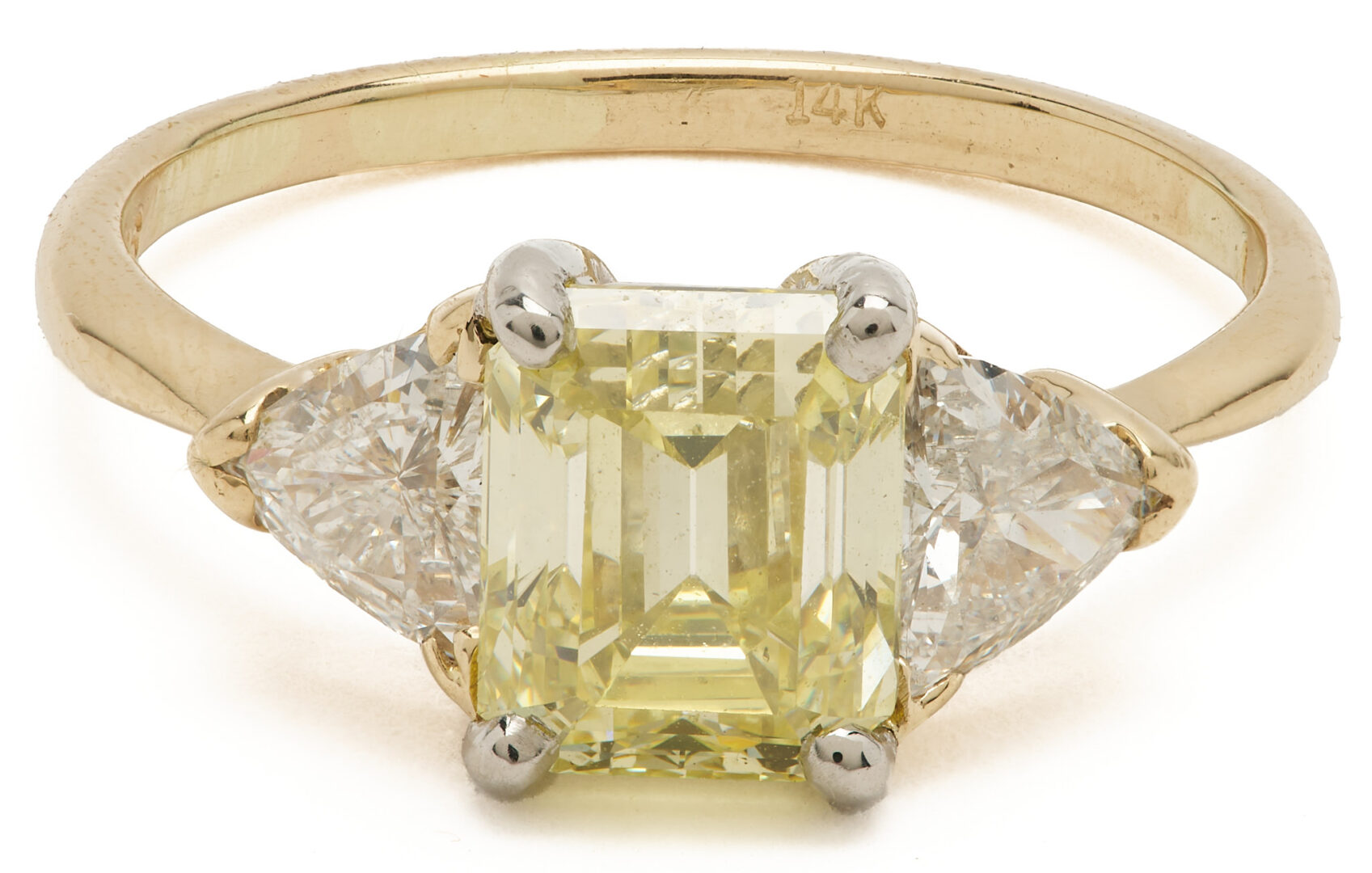
Ladies’ 14K and platinum three-diamond ring featuring a 2.01 emerald-cut natural fancy intense yellow diamond, SI1 clarity, measuring 7.69 x 6.37 x 4.70mm, good Polish, good symmetry, and faint fluorescence, GIA# 2231957557. Accented by 2 trillion-cut diamonds weighing approximately .75 ctw. Band is marked “14K, 900PT and M F” for Marin Flyer. Band XRF tests 14K, and the head XRF tests 90% platinum. Size 7 1/4. 3.45 total grams.
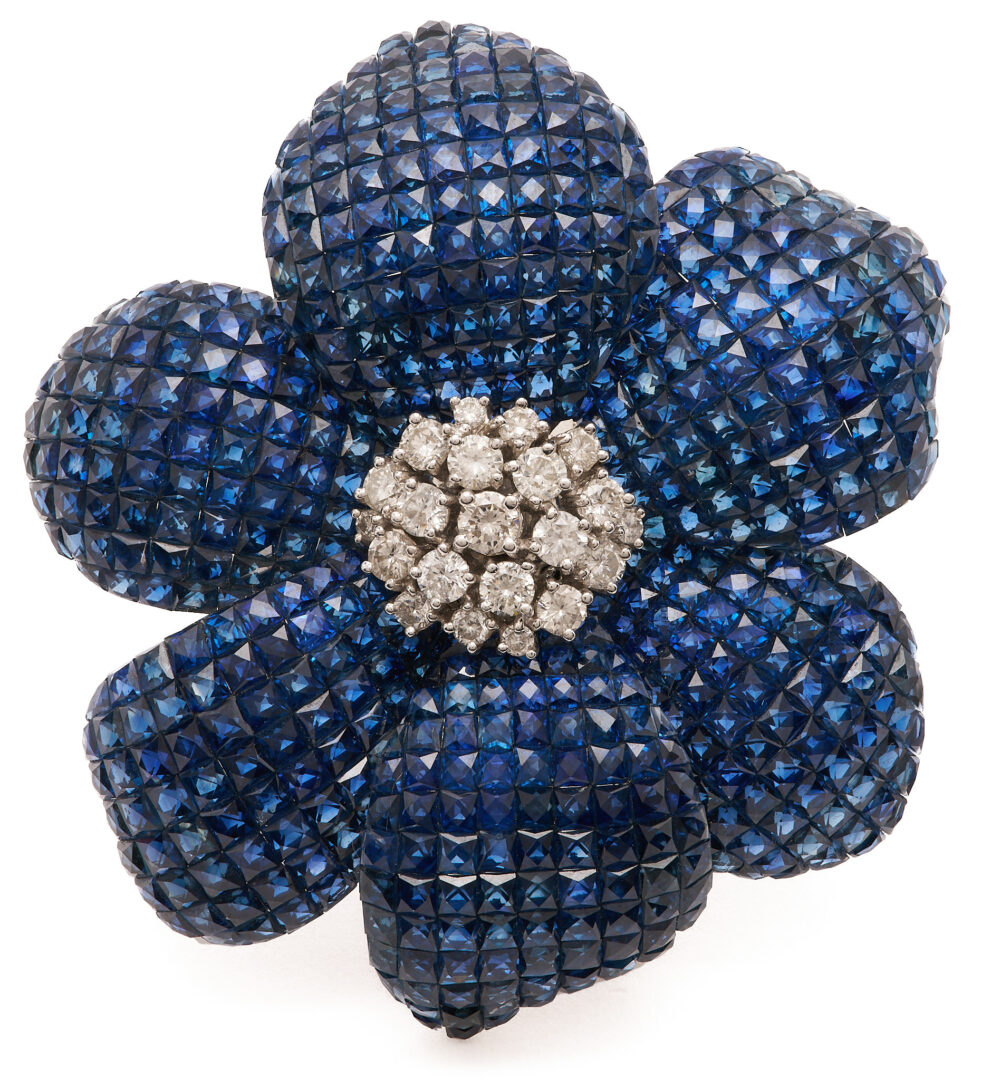
18K white gold sapphire and diamond floral brooch featuring an intricate openwork design set with invisibly set square French-cut natural blue sapphires and containing approximately 700 sapphires with an estimated total weight of 70.0 carats. Accented by 20 round brilliant/full cut diamonds with an approximate total weight of 1.8 carats, graded H-I color and SI1 clarity. Measuring approximately 56 x 58 x 17.5 mm. Brooch XRF tests 18K. Total weight: 48.9 grams.
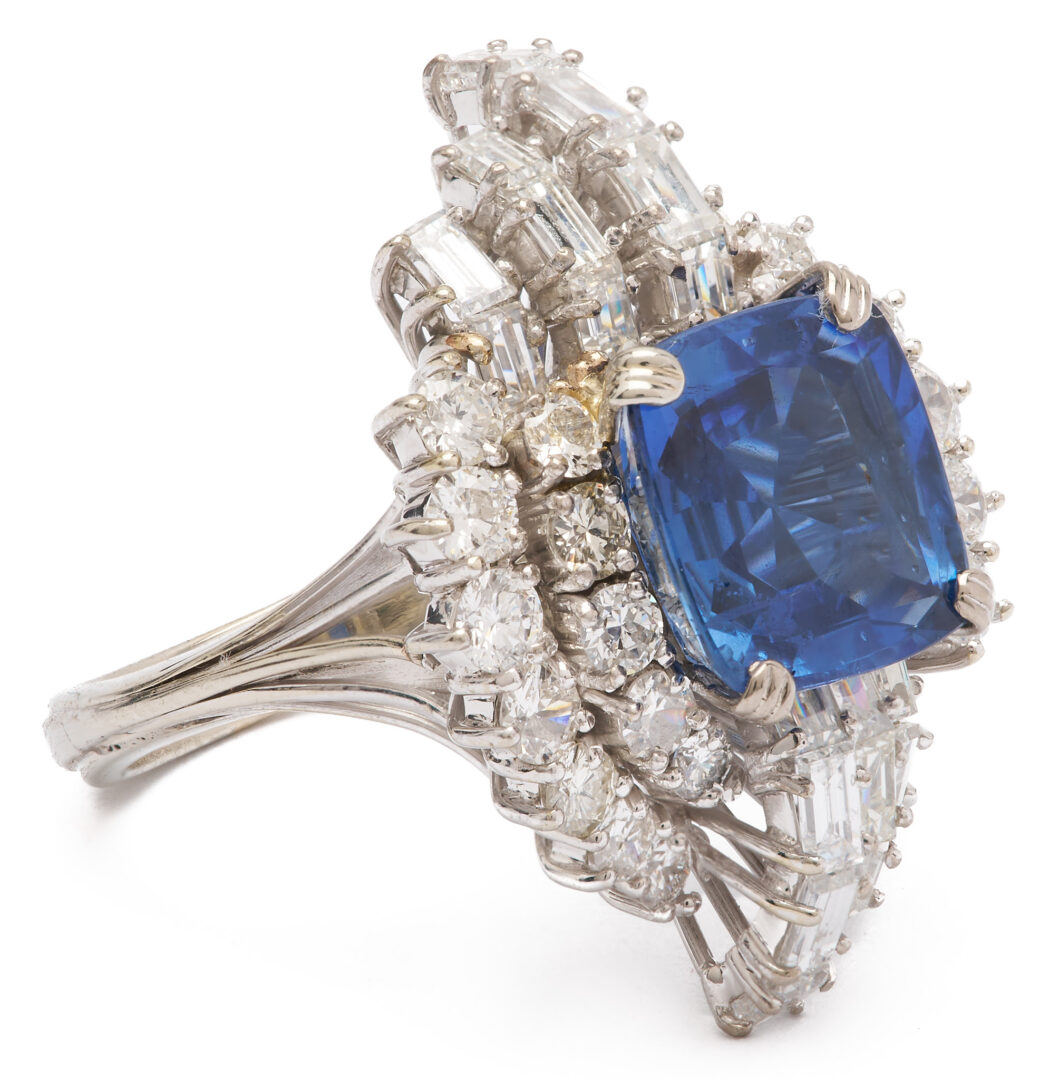
Ladies’ 14K white gold sapphire and diamond ring, featuring a 5.65 carat square cushion-shaped modified step cut natural blue Ceylon sapphire, measuring 10.32 x 10.00 x 4.96 mm, accompanied by AGL Report No. 1151938. Accented by eighteen (18) baguette cut diamonds and twenty-four (24) round diamonds, including a mixture of old European cut and transitional old European cut diamonds, all totaling approximately 4.00 carats, graded approximately E-F color and VS-SI clarity. Ring size 6 1/2. Circa 1950s.
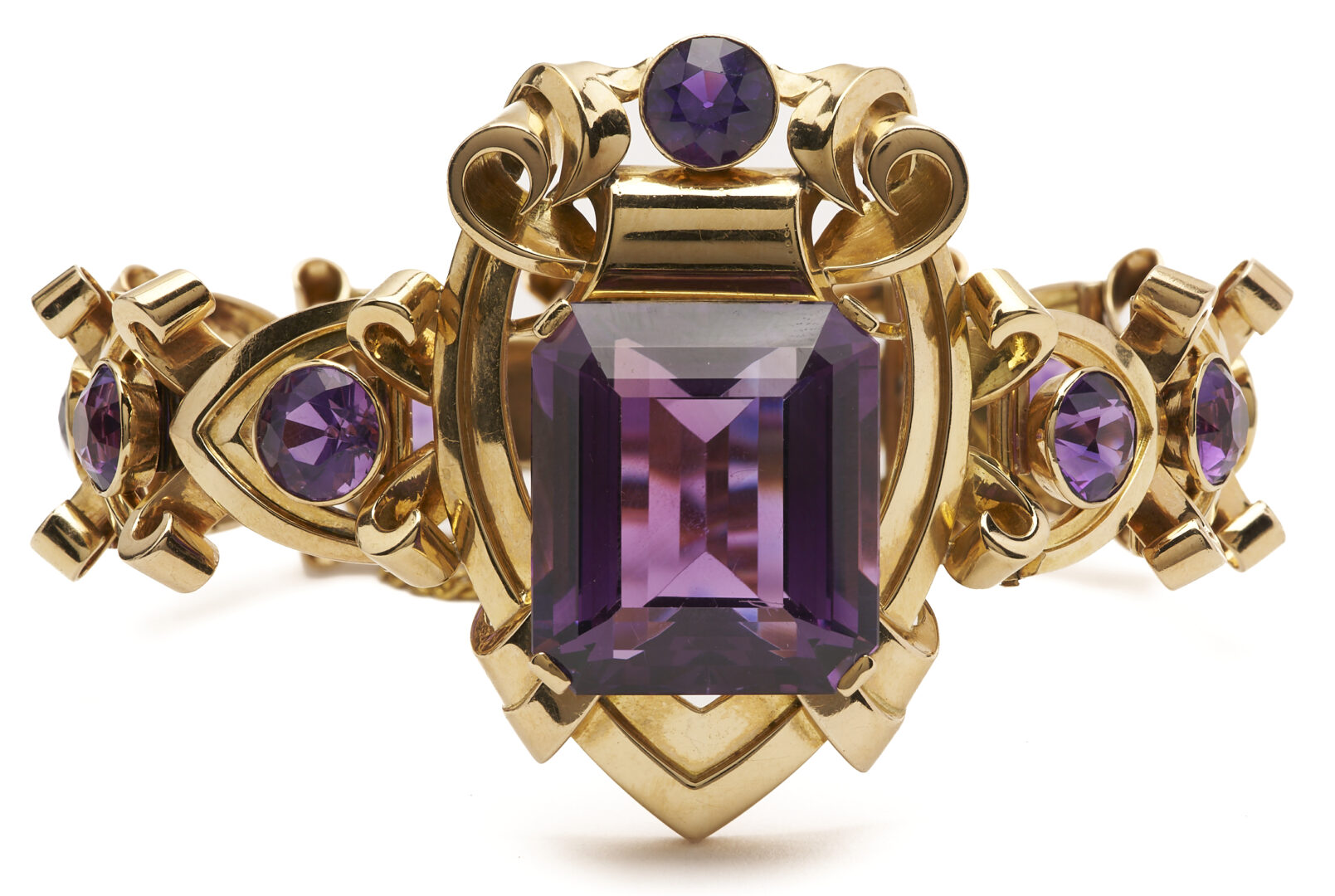
Antique 18K gold and amethyst bracelet featuring one step-cut (emerald-cut) amethyst weighing 37.37 carats, accented by eleven round mixed-cut faceted amethysts with a total approximate weight of 16.73 carats. 44mm W. XRF tests 18K. Total weight: 68.4 grams.
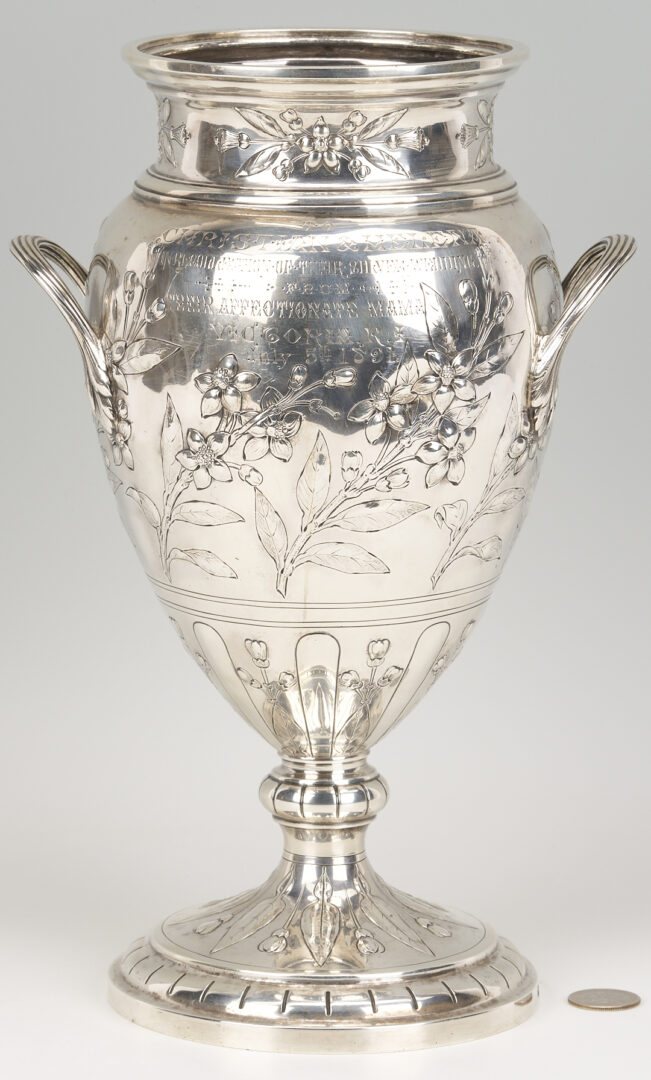
Important Elkington Sterling Silver Urn, presented by Queen Victoria to her daughter, Princess Helena in 1891, as a wedding anniversary gift. The vase is of classical form with stepped lip, over a body with repousse floral decoration surrounding the inscription, TO CHRISTIAN AND HELENA, IN RECOLLECTION OF THEIR SILVER WEDDING, FROM THEIR AFFECTIONATE MAMA, VICTORIA R I, JULY 5, 1891. The body is flanked by reeded handles terminating in foliate mounts, and has a ribbed lower column with repousse leaf and bud decoration, atop a weighted base with circular foot. Hallmarked at base for Elkington & Co., Birmingham, with date mark for 1876 or 1882, and with lion passant and same date mark to underside of base. The original cover to the vase has been modified for later conversion to a lamp and is not shown in the main images. Vase: 12 1/2 in. H x 8 1/2 in. W (at handles) x 5 1/2 in. D. Note: Princess Helena Augusta Victoria and Prince Frederick Christian Charles Augustus, Duke of Schleswig-Holstein, wed on July 5, 1866 at Windsor Castle. They were both the great great grandchildren of English George III. The couple were married for 51 years until Prince Christian’s death in 1917, Princess Helena died in 1923. This vase is one a pair -both originally including covers- given to the couple for their twenty-fifth wedding anniversary.
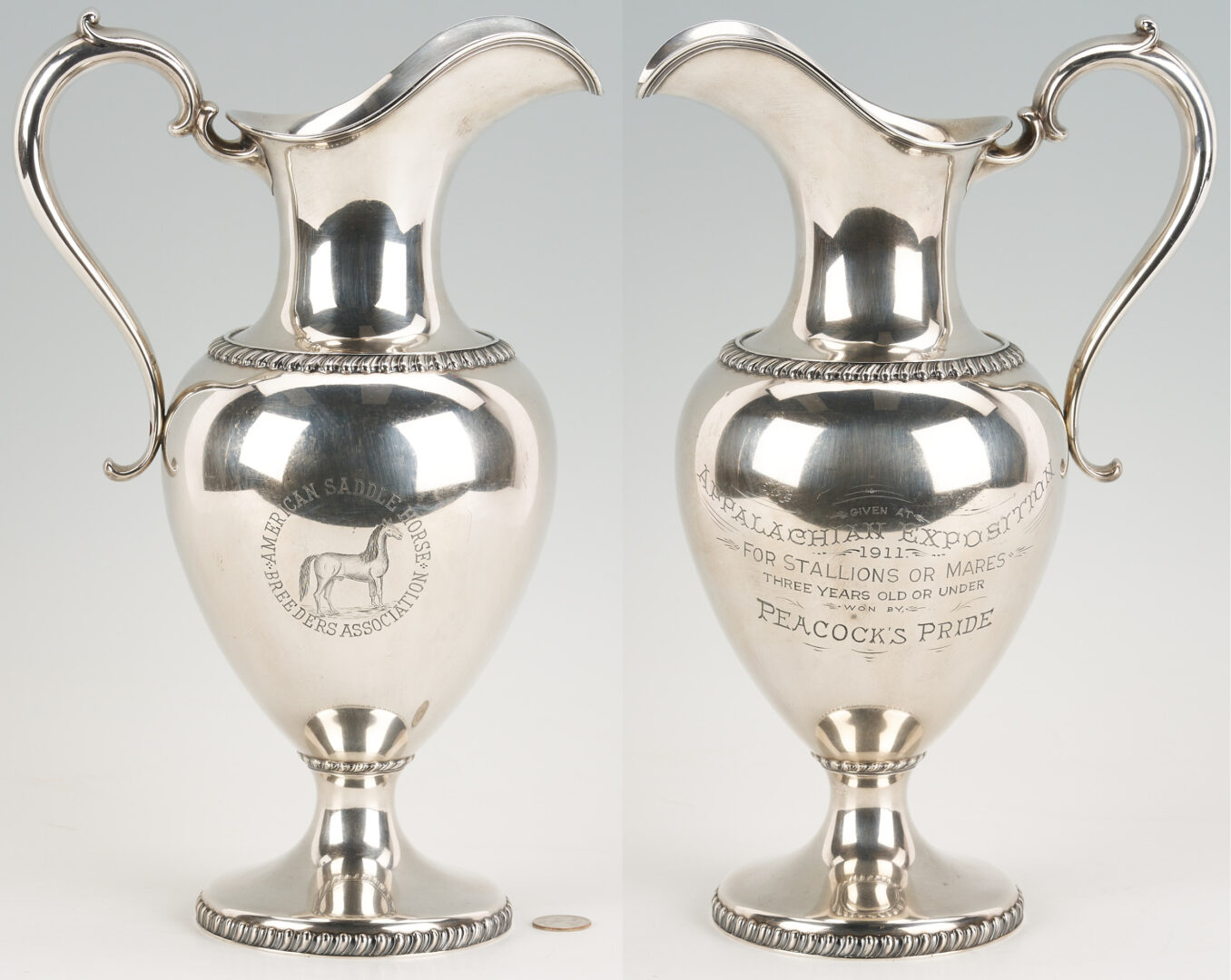
Important Tennessee Appalachian Exposition 1911 Sterling Silver Agricultural Premium Pitcher, awarded at the event to Peacock’s Pride for “Stallions or Mares Three Years Old or Under,” by the American Saddle Horse Breeders Association. The pitcher, of tall baluster form, features an engraved standing horse within the association’s logo to one side and award inscription verso, flaring reeded spout, C scroll handle, and gadroon banding at shoulder and foot. Marked to the underside for Whiting, Sterling, 2328, 6 pints. 14 5/8 in. H. 40.59 oz troy.
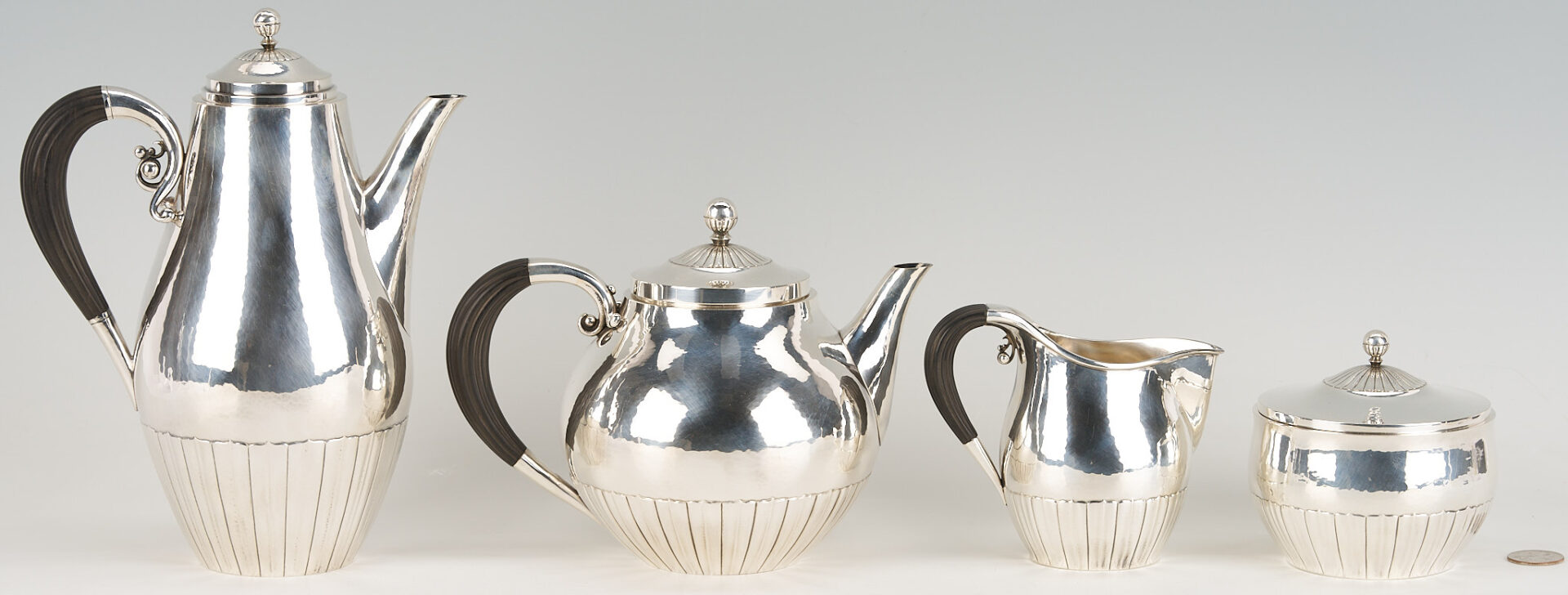
Art Deco era Cosmos Pattern Sterling Silver Tea and Coffee Service, designed by Johan Rohde for maker Georg Jensen, Denmark. Set includes coffee pot and teapot numbered 45A, and creamer and sugar numbered 45C, each with hand hammered surface and fluted lower section. The pots and creamer each feature a reeded ebony handle with blossom design at handle. Jensen hallmarks and Johan Rohde design marks to underside of each piece. Coffee pot 9 1/4 in. H. Total weight overall: 55.19 oz troy. Circa 1915-1925.
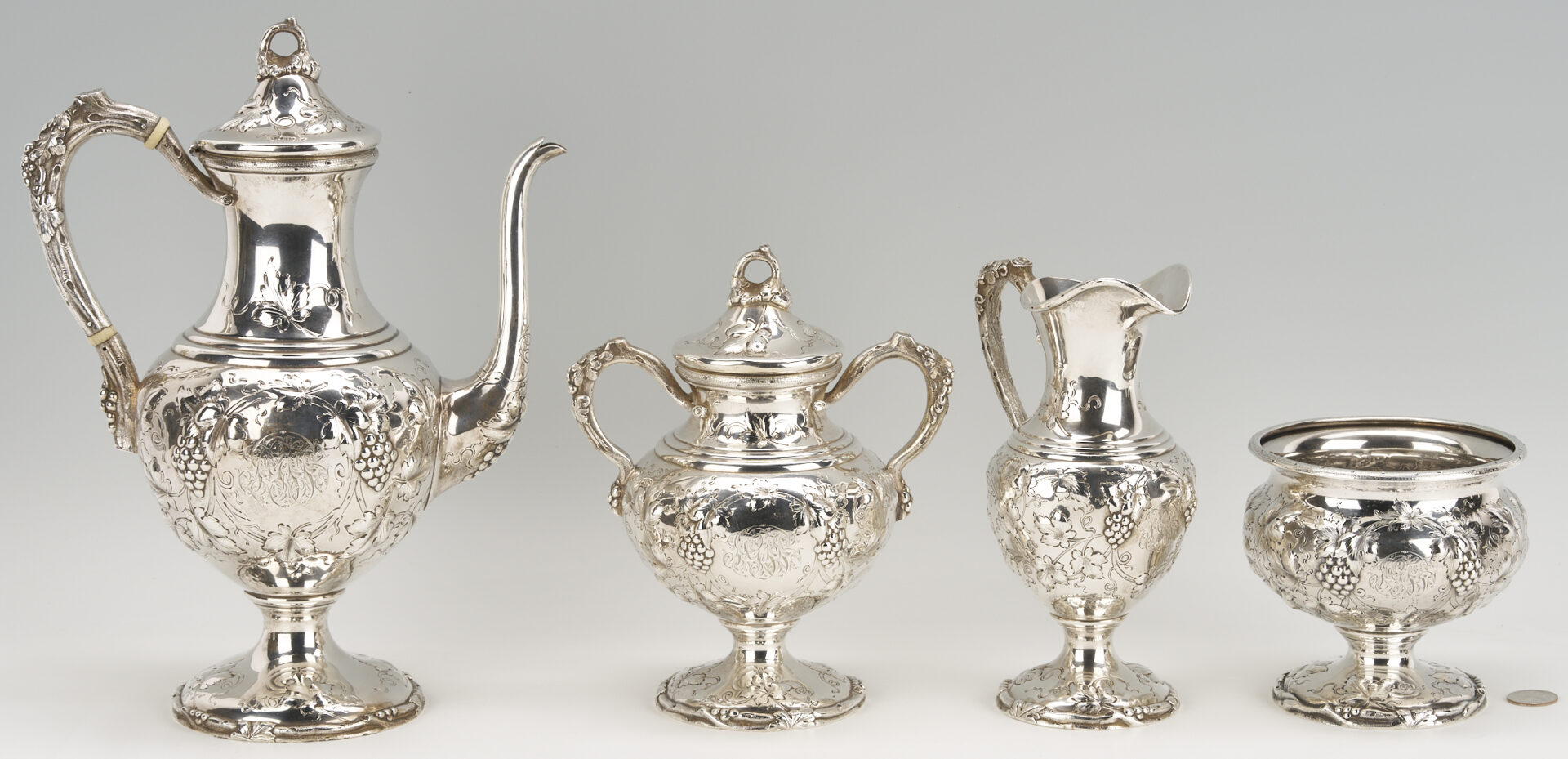
A.G. Schultz heavy and ornate sterling silver 4-piece tea service retailed by Sylvan Bros. Columbia, SC, circa 1900. The set includes a large teapot, sugar bowl, cream jug and waste bowl, all with repousse grapevine decoration to bodies and rounded feet, with naturalistic handles and finials. Stamped to underside “Sterling”, with the “hand made” logo of A.G. Schultz (Baltimore, 1899-1950) and retailer mark of Sylvan Bros. (1897-present). Elaborate 3 part letter monogram with leafy flourishes to one side; the teapot is engraved “Memphis” to the other side. Pot 13 inches H. Combined weight: 89.67 oz troy.
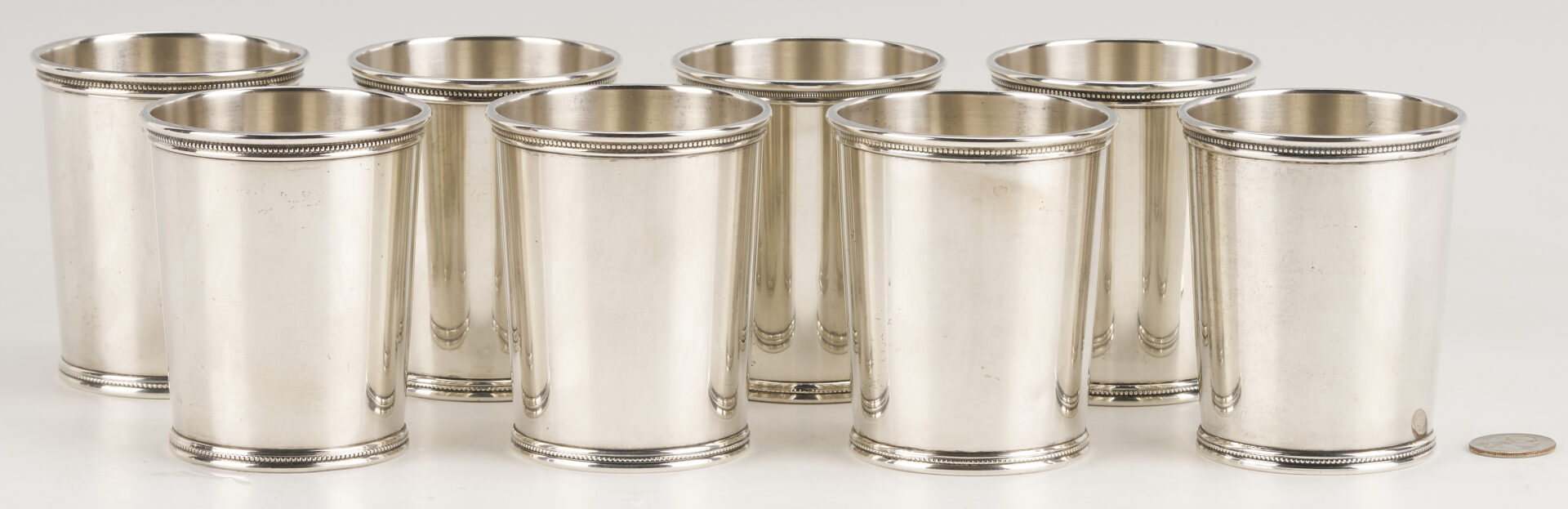
Eight (8) Mark Scearce sterling silver Kentucky mint julep cups or beakers with tapered body and beaded upper and lower rim. Marked on underside MARK J. SCEARCE SHELBYVILLE KENTUCKY / STERLING with eagle symbol and JFK initials commemorating the American president during the period in which it was made (John F. Kennedy, 1961-1963). 3 3/4″ H. 36.76 total troy ounces. (1st set of 2 offered in this auction).
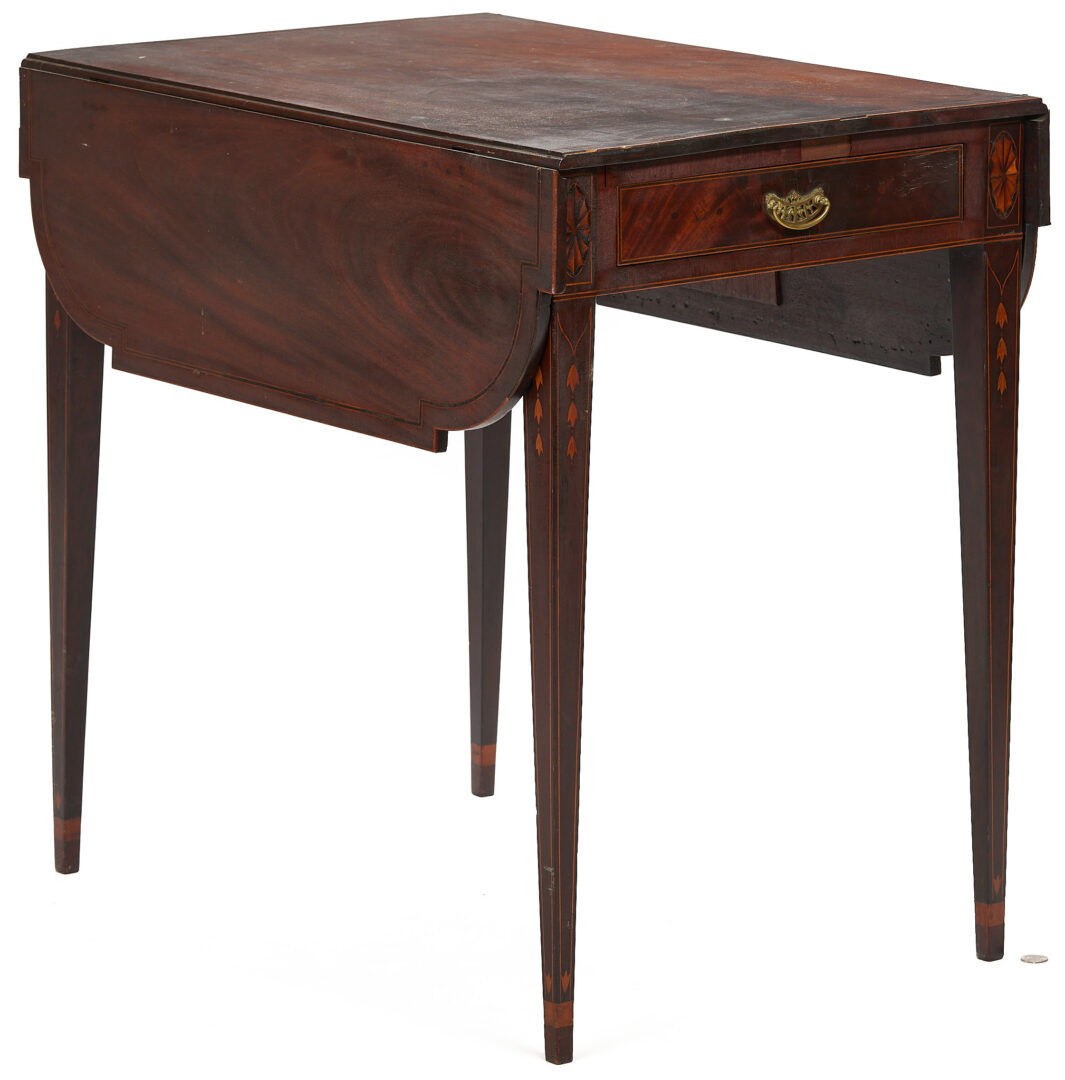
South Carolina Federal Inlaid Pembroke Table, possibly Charleston. Mahogany with cypress secondary. Blind dovetailed drawer. 29 3/4 in. H x 21 in. W (41 in. W with leaves extended) x 30 1/2 in. D. More information in the coming weeks.
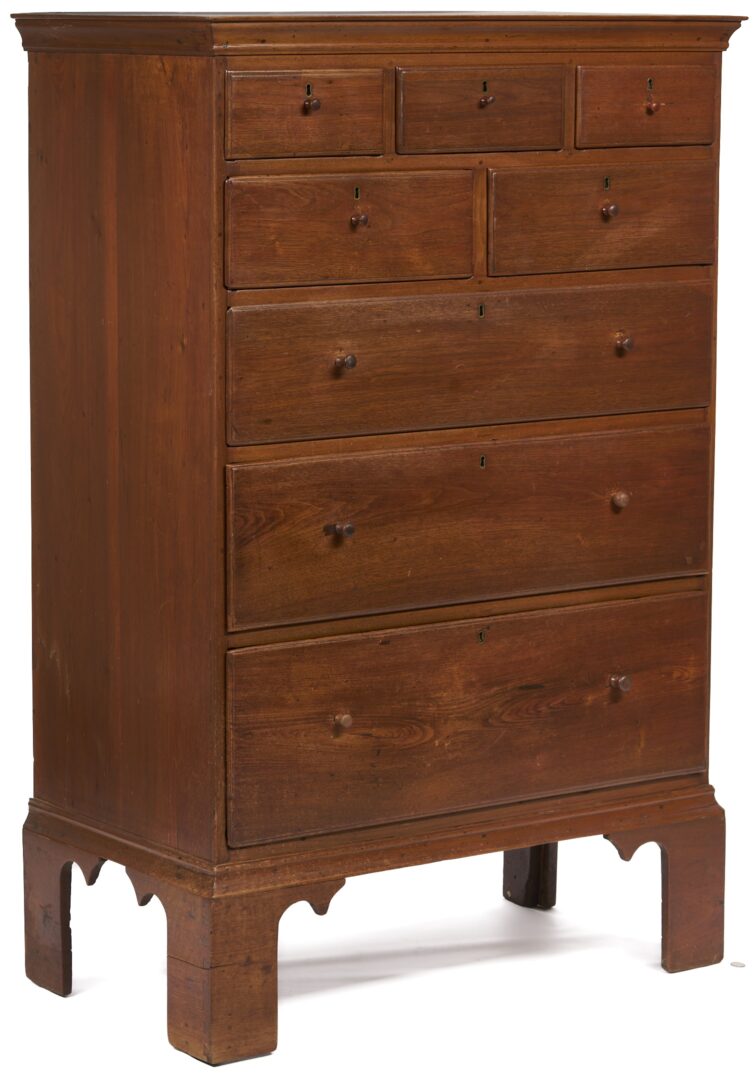
Greene Co., Tennessee walnut high chest with yellow pine secondary. Ogee cornice with three over two over three dovetailed drawers, tall bracket feet with spur returns. Three hidden dovetailed drawers behind the three dovetailed drawers at the top of the case, full length dustboards. 57 1/4 in. H x 37 3/8 in. x 21 1/2 in. Greene County, Tennessee, late 18th/early 19th century. Provenance: Acquired from the Widow Bales home in the Camp Creek area of Greene County; the estate of the Late Thomas W. (Jack) and Dr. Frances Bernard Overall, Greeneville, Tennessee and estate of Donna C. Rogers, Greeneville, Tennessee. Documented by MESDA, reference S-13002; illustrated in Williams and Harsh, [The Art and Mystery of Tennessee Furniture,] page 203.
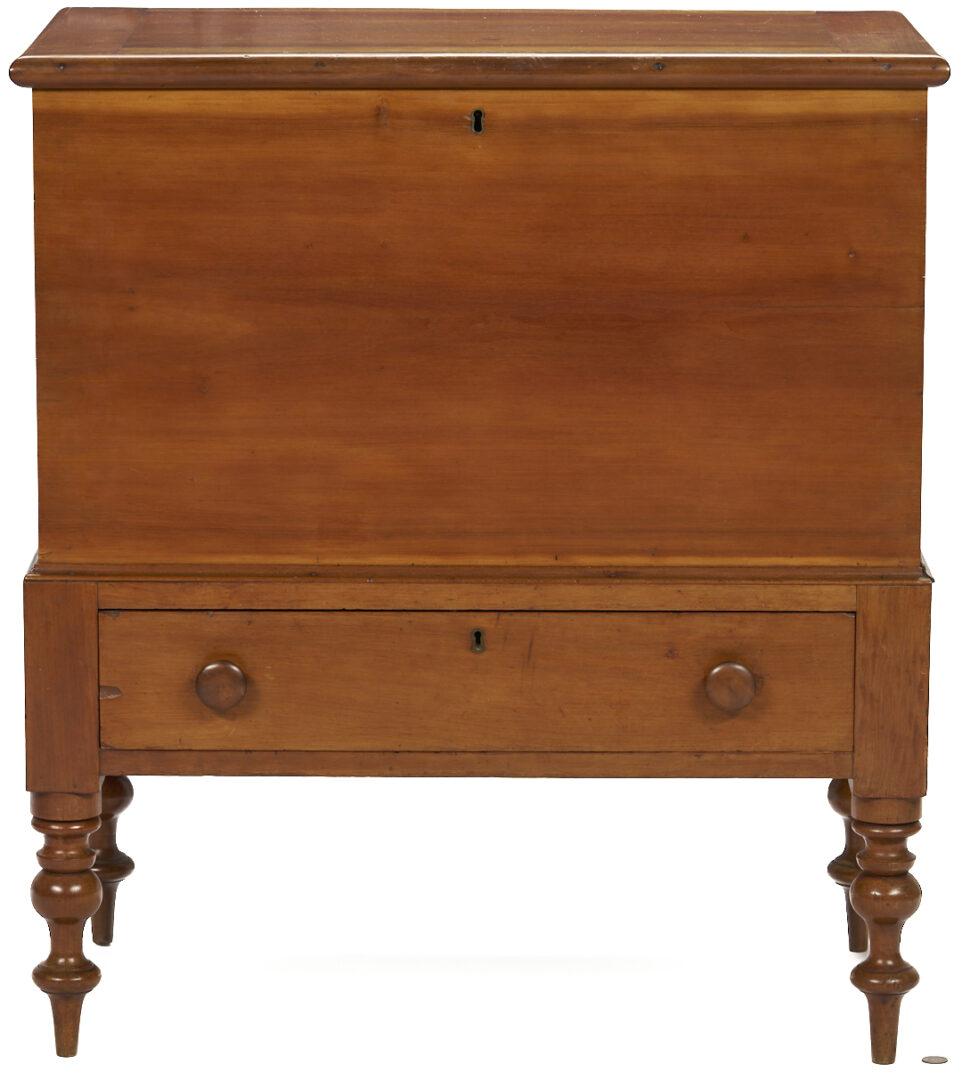
Williamson County, Tennessee cherry sugar chest, poplar secondary wood. Hinged top with breadboard ends having a half-round molded edge over a dovetailed case with a divided interior. Lower case with an ogee molding over a dovetailed drawer with a tri-divided interior and two wooden pulls. Case rests on bulbous ring-turned tapering legs. 32 1/4 in. W x 19 7/8 in. D x 36 in. H. Circa 1830.
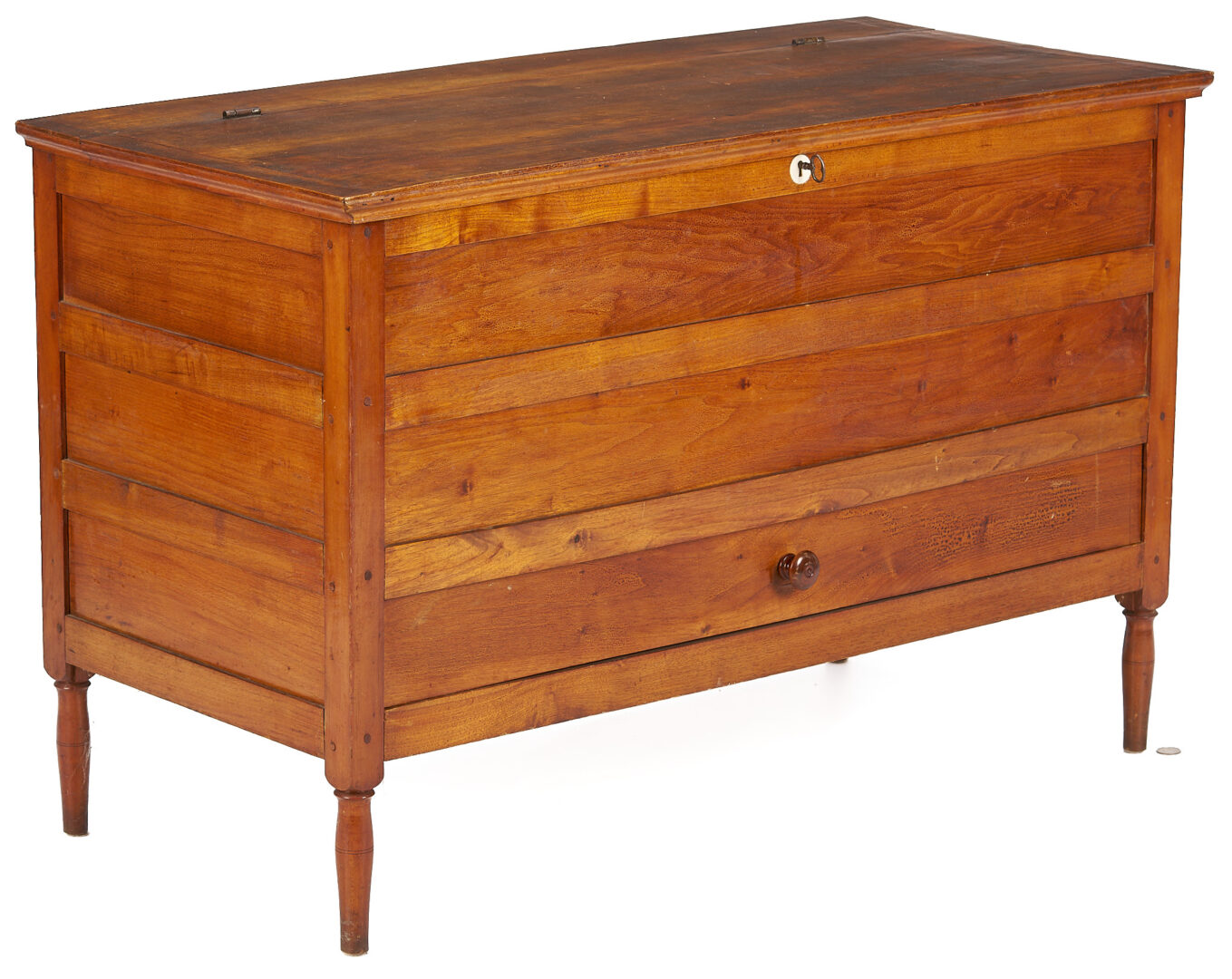
Canterbury Shaker butternut and cherry post-and-panel blanket chest, white pine secondary. Hinged lid with applied ogee molding above case and a stack of three fielded panels on the front, the lowest being a drawer with a turned knob, on tapering cylindrical legs. Bone escutcheon. 26 1/2 in H x 40 3/4 in. W. x 19 1/8 in. D. New Hampshire, mid 19th century.
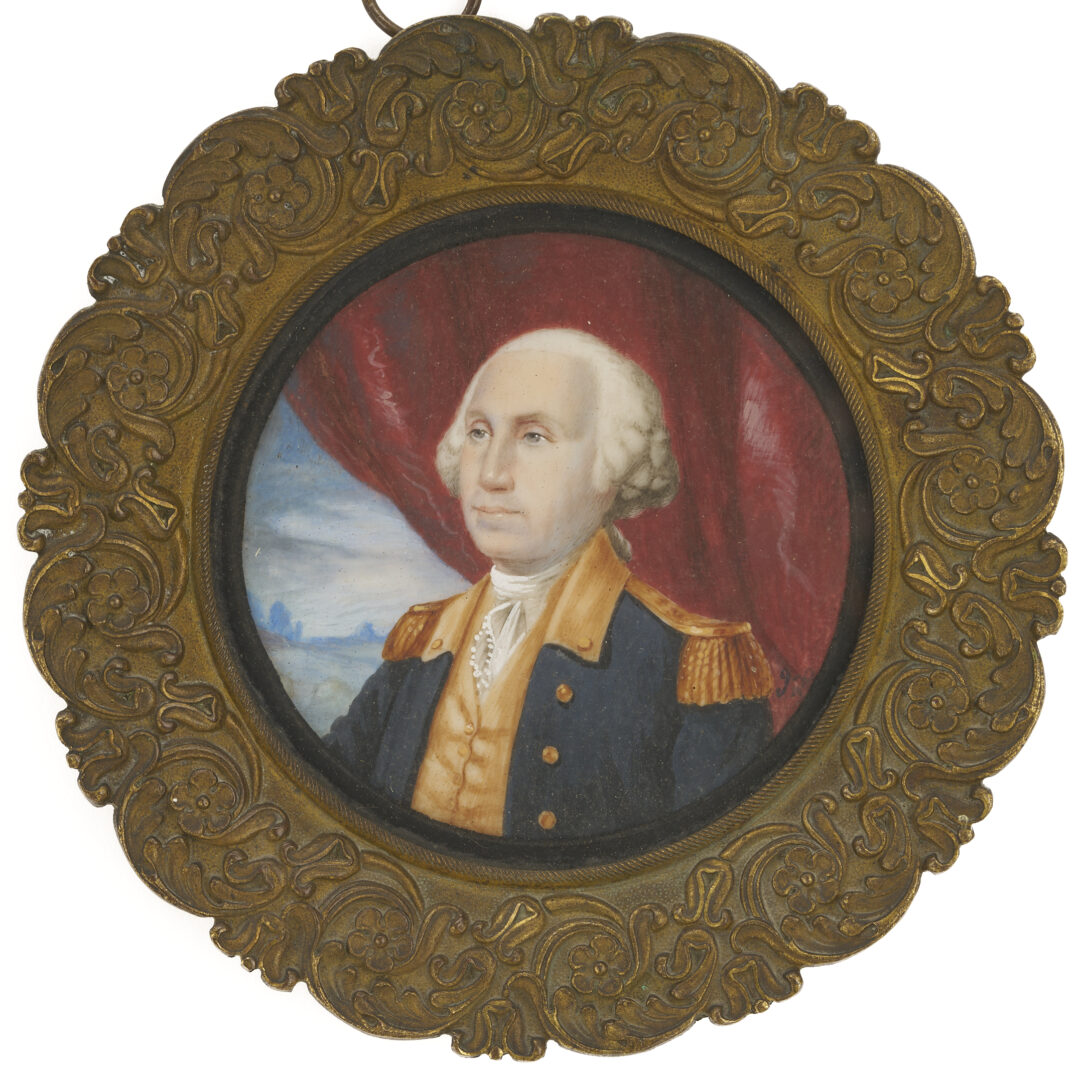
Miniature Portrait of George Washington, by descent in the family of U.S. President John Tyler. Signed JL lower right. Brass frame with floral/scroll decoration. The back is covered in old newspaper mentioning “Bonaparte.” Sight: 3 1/2 in. diameter. Frame: 6 in. diameter. Early 19th century. More information in the coming weeks.
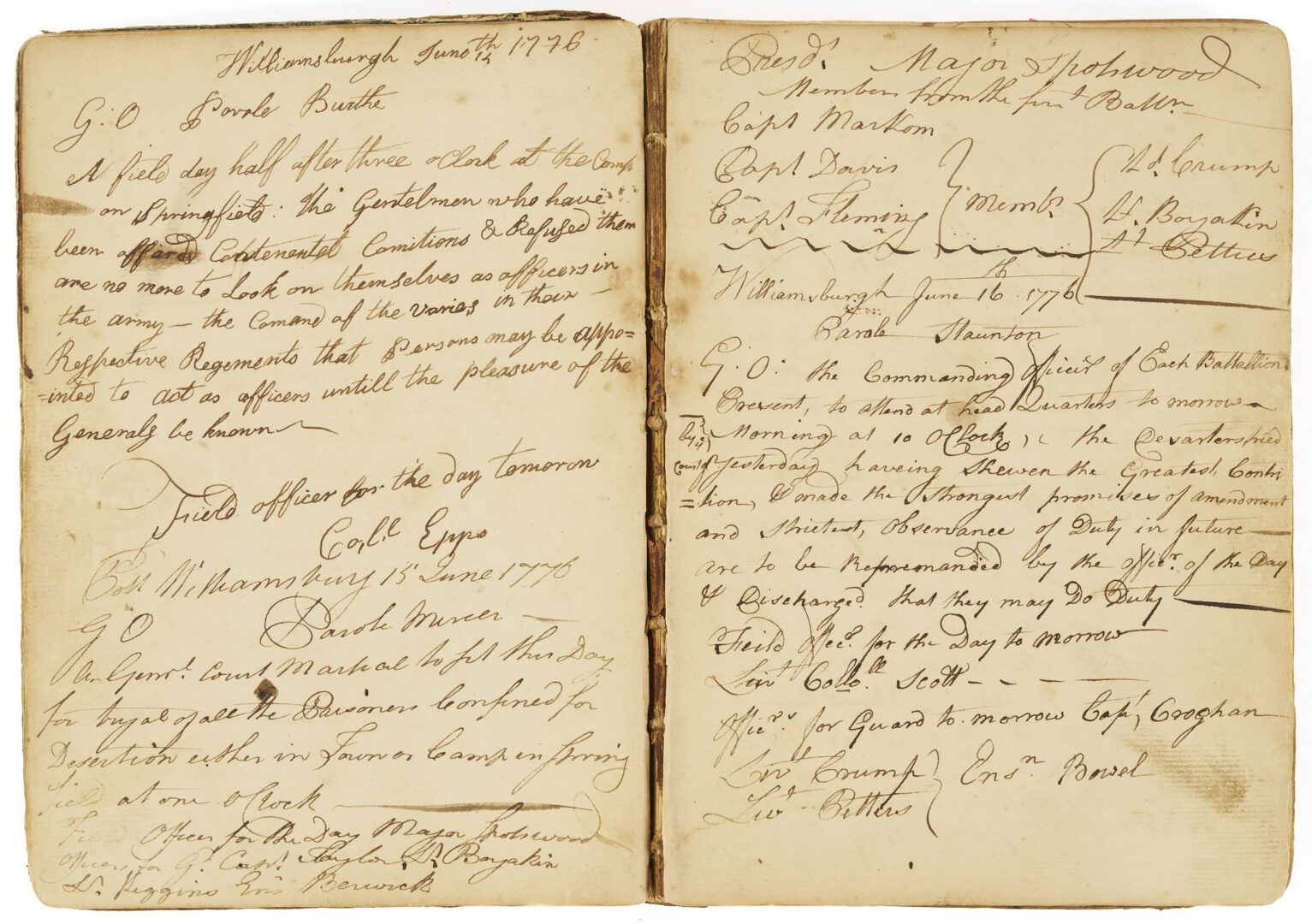
Manuscript orderly book detailing day to day activities of Virginia troops in the Continental Army during the Revolutionary War, beginning at Williamsburg, Virginia, June 12, 1776 and ending at George Washington’s headquarters at Wilmington, Delaware, August 26, 1777. Sites listed include Williamsburg, VA; College Camp, VA: Camp Crossroads, PA; Ramapo, NJ/NY; Roxboro, PA; “Stenton near Germantown,” PA; and Wilmington, Delaware. Of particular interest are events during June and July of 1776, as several newly formed units of the Virginia Line were being trained and transitioned into the Continental Army at the state’s then-capital, Williamsburg. Entries in the book skip from Williamsburg, July 8, 1776 to July 9, 1777, when this book was at George Washington’s headquarters at Morristown, New Jersey (no pages are lost in this transition). Also covered is the period of time in August, 1777 when the troops were with Washington at Camp Cross Roads at Warwick Township, Pennsylvania during a period known as The Neshaminy Encampment.
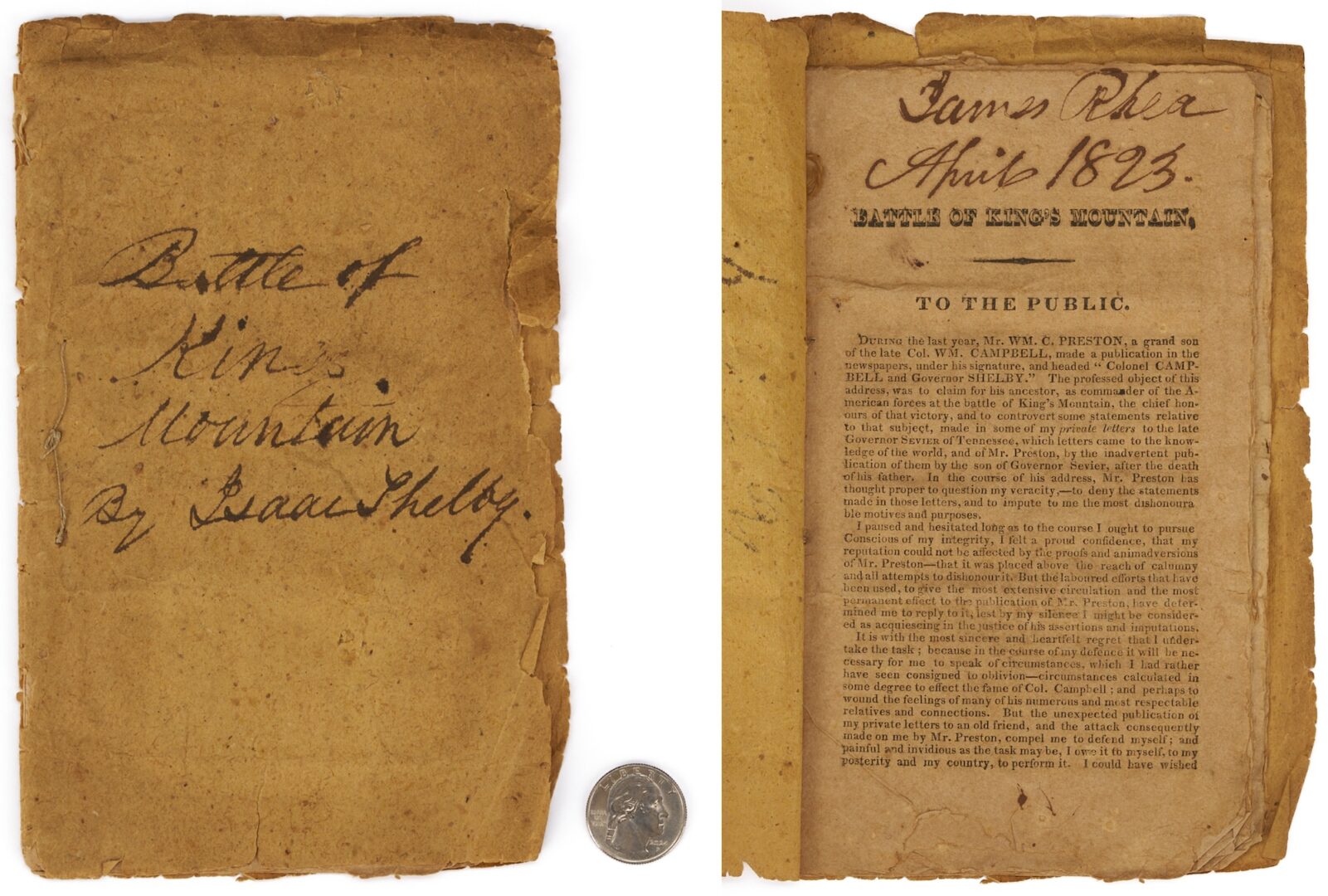
Signed pamphlet on the Battle of Kings Mountain controversy, addressed “To the Public” by Isaac Shelby (1750-1826), published in April 1823. A scarce and historically significant monograph by Isaac Shelby, Revolutionary War officer and first Governor of Kentucky, addressing the long-standing controversy over the leadership for the Overmountain Men’s victory at the Battle of Kings Mountain (1780). Handwritten cover has string binding. Addressed to “James Rhea, April 1823,” on page 1. Dated on page 13: “Isaac Shelby. April 1823.” Signed again by on page 24, below a printer’s ornament “Finis,” attributed to a Lexington, KY imprint of Thomas Smith, according to the Library of Congress. Approximate dimensions: 8 1/2 inches L x 5 1/4 W. 24 pages.
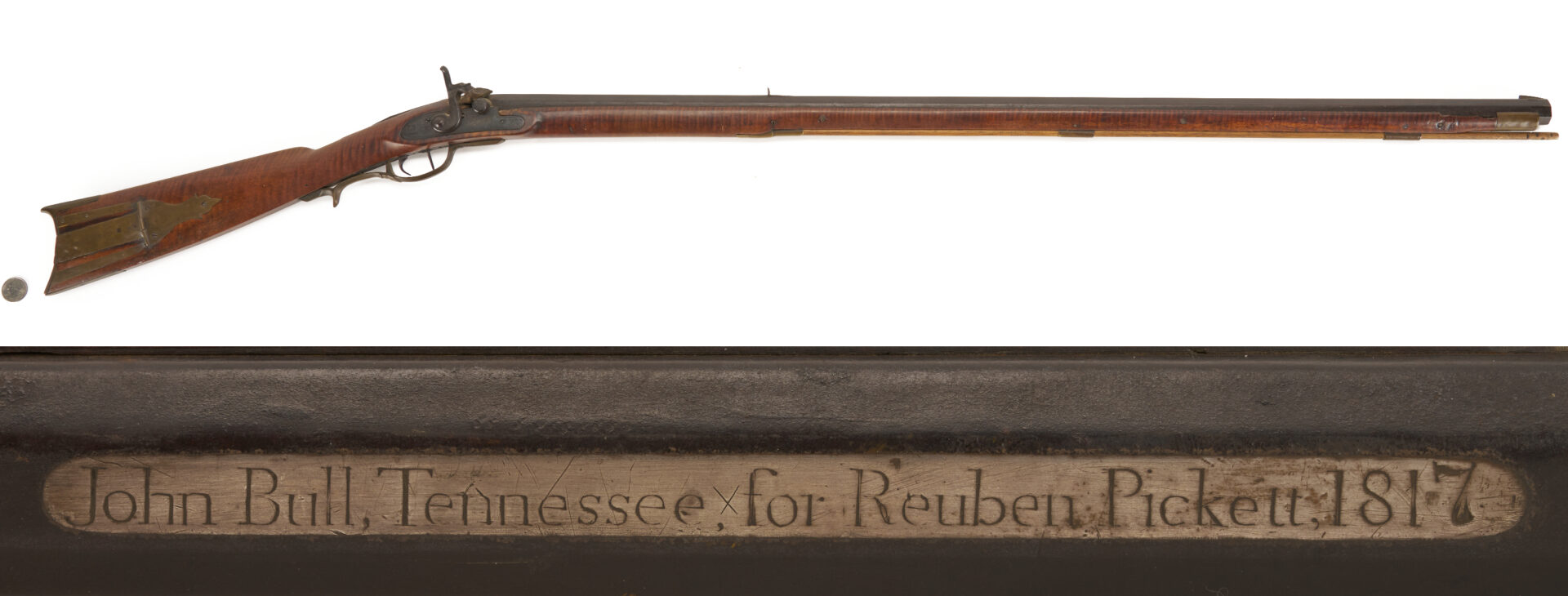
Early conversion of a 50 cal. percussion rifle with a 1817 John Valentine Bull (1777-1840) barrel. Marked on silver plate on top barrel flat “John Bull, Tennessee, for Reuben Pickett 1817”. Lock with mark of Joseph Golcher. Dovetailed brass blade front sight, V-notch rear sight. Overall 55 3/4 in. L; barrel 39 3/4 in. More information in the coming weeks.
Percussion long rifle owned by Obediah Wade Hill (1824-1893) of Williamson County, TN. Heavy, octagonal 44 1/4 in. barrel, 30 cal. Lockplate is marked “Kirkman & Ellis Nashville Tenn” with game bird design behind hammer; set trigger. Brass ramrod guides, buttplate, and trigger guard. Stock features several inlaid German silver pieces, including fish, fowl, fox, deer and skunk, as well as inlaid silver medallions along its full stock. Accompanied by framed reproduction photograph of Obediah Hill and handwritten biography. This gun is discussed and illustrated in the 2003 book ART OF TENNESSEE by the Frist Center for the Visual Arts, pgs. 38-39. Barrel 44 1/4 in. L; Overall 60 in. L. Note: 1848 records list a hardware manufacturing/storefront partnership between John Kirkman and James Ellis, located at 34 Public Square, Nashville.
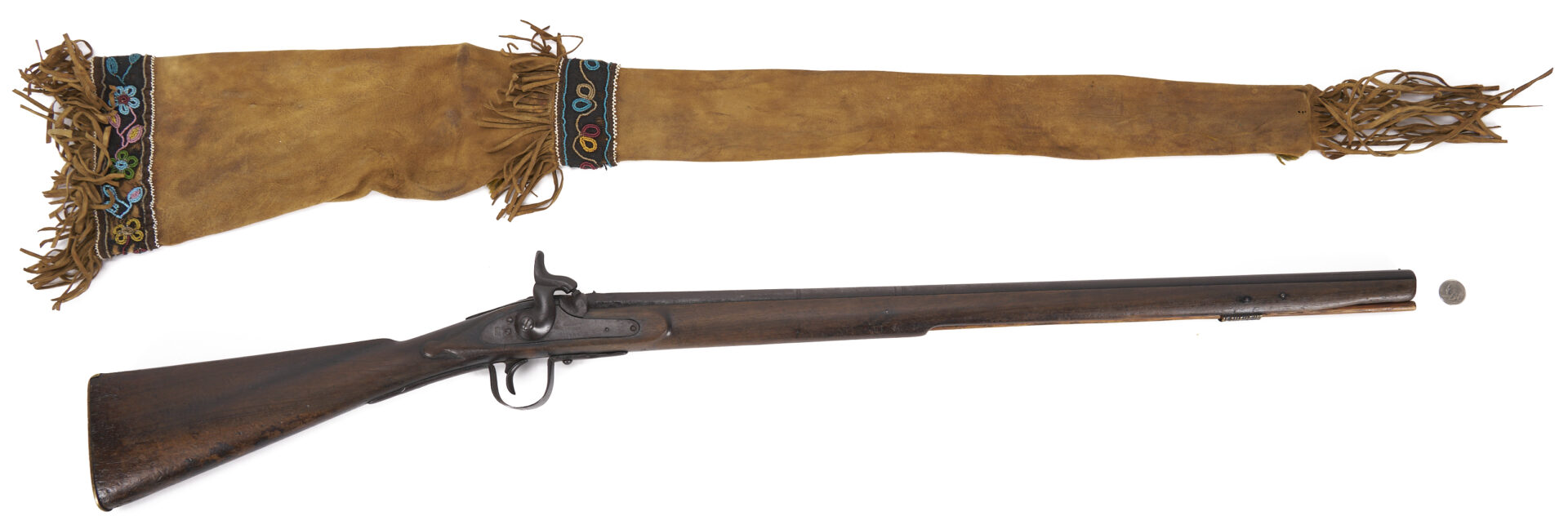
Plains Cree beaded rifle scabbard with a Barnett Trade musket. 1st item – Southern Canada Plains Cree tanned hide scabbard with band of wool cloth decorated with bead flowers and fringe. 47 in. L (plus end fringe). 2nd item – lightweight carbine-length percussion Barnett trade musket with the lockplate marked “Barnett London 1885” and an impressed proof depicting a “fox in a tombstone” with initials “EB”. 30 in. smoothbore barrel, approx. 62 cal., with obscured proof marks; oversized trigger guard (for gloved use), iron trigger guard with brass buttplate, notched rear sight and bead front sight. Side plate verso depicts a brass sea serpent. The lockplate markings indicate distribution by the Hudson Bay Company for the Northwest region. Overall 46 in. L. Late 19th century.
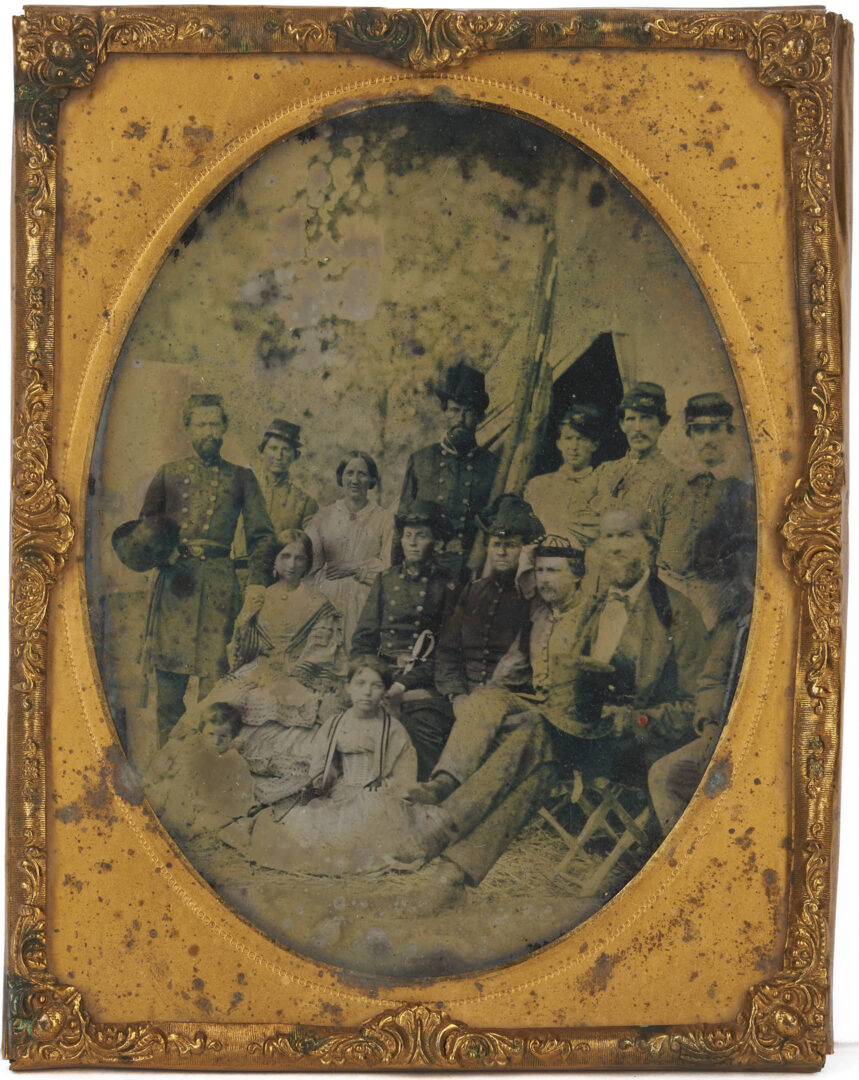
Rare large half plate Civil War ambrotype photograph depicting the Johnson Family of Cowetta County, Georgia, including nine Confederate soldiers. Pictured in the group are Lt. Col. Thomas Coke Johnson (b. 1835, 19th Ga. Infantry, KIA Mechanicsville, VA, 1862), who is believed to be pictured at far left next to his wife, Ella Wiggins (1840-1911), and their son Thomas Coke Johnson II. Also likely pictured are Lt. Col. Johnson’s brothers, Lt. William Henry Harrison “Adjutant” Johnson (b. 1840, 19th Ga. Infantry, KIA Oluste, FL, 1864) and John Andrew Johnson (b. 1837, d. 1900), along with their parents, John Hutchins Johnson (1807-1864) and Ann Francis Penn (1810-1845). The ambrotype measures 5 1/2 in. H x 4 1/4 in. W. and is housed in a gilt metal mat with oval opening (4 1/2 in. H x 3 1/2 in. W).
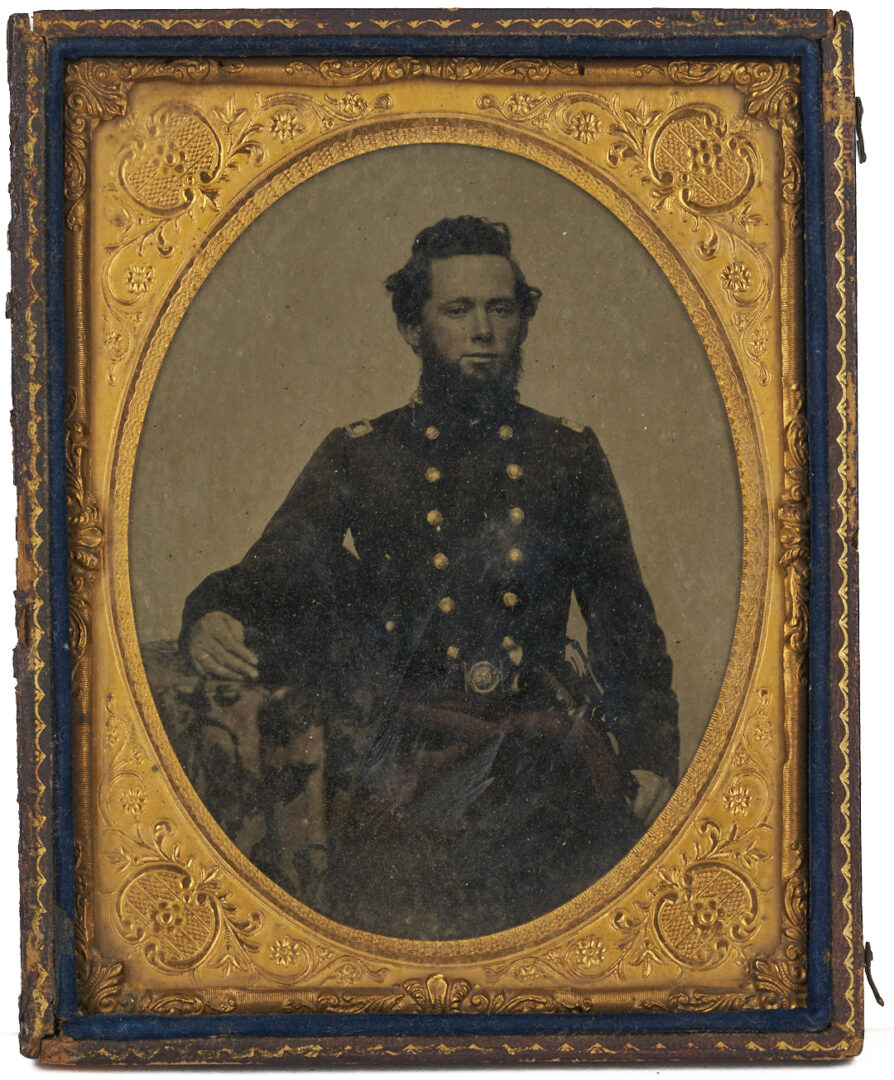
Half plate sized photograph tintype of Georgia Confederate Officer Lt. Col. Thomas Coke Johnson, 19th Ga. Infantry, killed in action at Mechanicsville, Virginia, 1862, together with his posthumous Southern Cross of Honor. Johnson is pictured three quarter length, standing, with one hand holding his hat atop a table, and gripping his sword in the other. Embossed gilt metal mat with oval opening, in an embossed leather partial union case. Sight: 4 1/2 in. H x 3 1/2 in. W. Frame: 6 in. H x 4 3/4 in. W. The Southern Cross is engraved with Johnson’s name and unit and measures 2 in. x 1 1/3 in. Also included with this lot is Johnson’s copy of the book “The Life of William Penn,” 1836, by M.L. Weems, in which Thomas Coke Johnson’s name, likely his signature, appears four times. (Note: Johnson’s mother was Ann Frances Penn, daughter of Francis Taliaferro Penn). Lt. Col. Thomas Coke Johnson was born 1835 in Oglethorpe County, GA and by the 1840 census was living with his father John Hutchins Johnson, mother, and four brothers in Coweta, GA (his mother died in 1845 after giving birth to his fifth brother). Thomas, or T.C. as he was known, attended the Emory and Georgia Military Institute. He married Ella J. Wiggins in 1856 in Griffin, GA and they had two sons (Thomas Coke Johnson Jr. and Lee Clifford Johnson) before Thomas enlisted in the Confederate Army. He is believed to have been killed in the Battle of Beaver Dam Creek at Mechanicsville, VA on the first day of the famed Seven Days War and this photograph descended in his family.
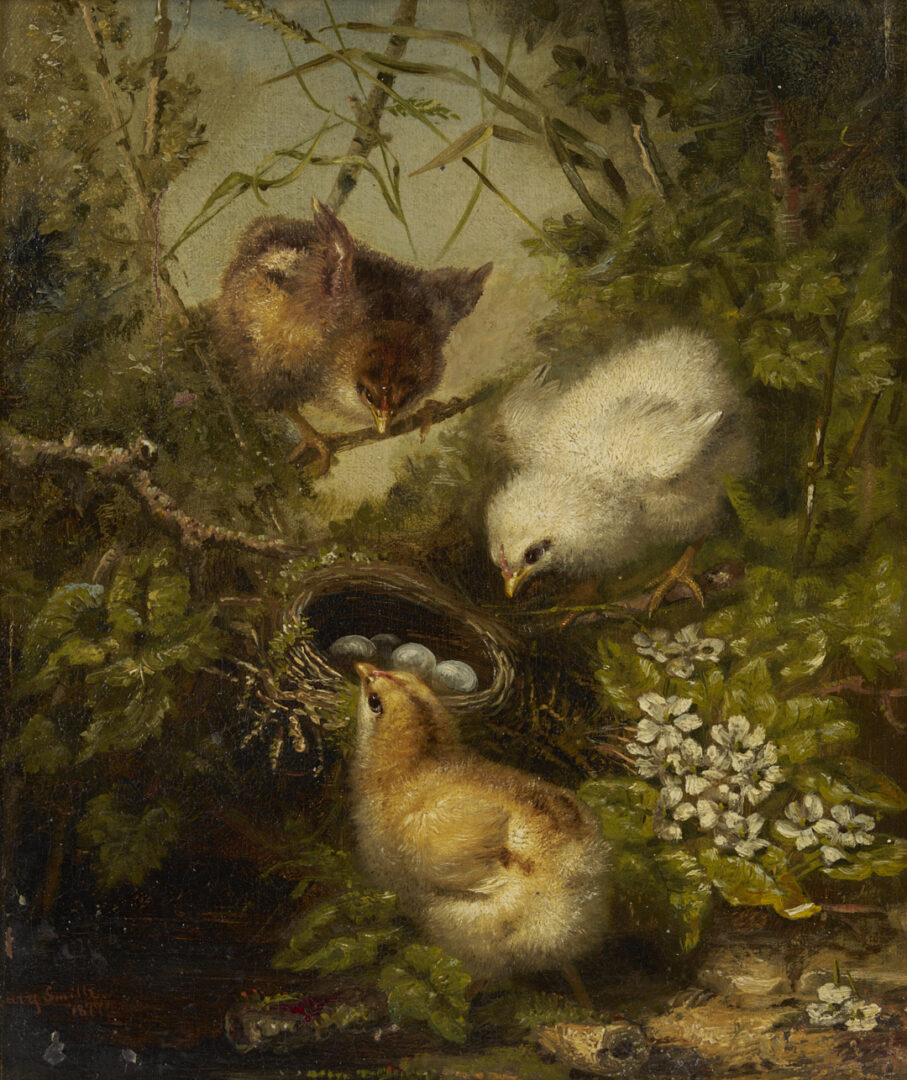
Mary Russell Smith (American, 1842 – 1878) oil on board painting depicting three fledgling chicks surrounding a nest with eggs in a forest floor setting. Signed and dated lower left in red “Mary Smith 1877” and housed in a modern gilt wood frame. Sight: 11 1/4 in. H x 9 1/2 in. W. Framed: 15 in. H x 13 1/4 in. W.
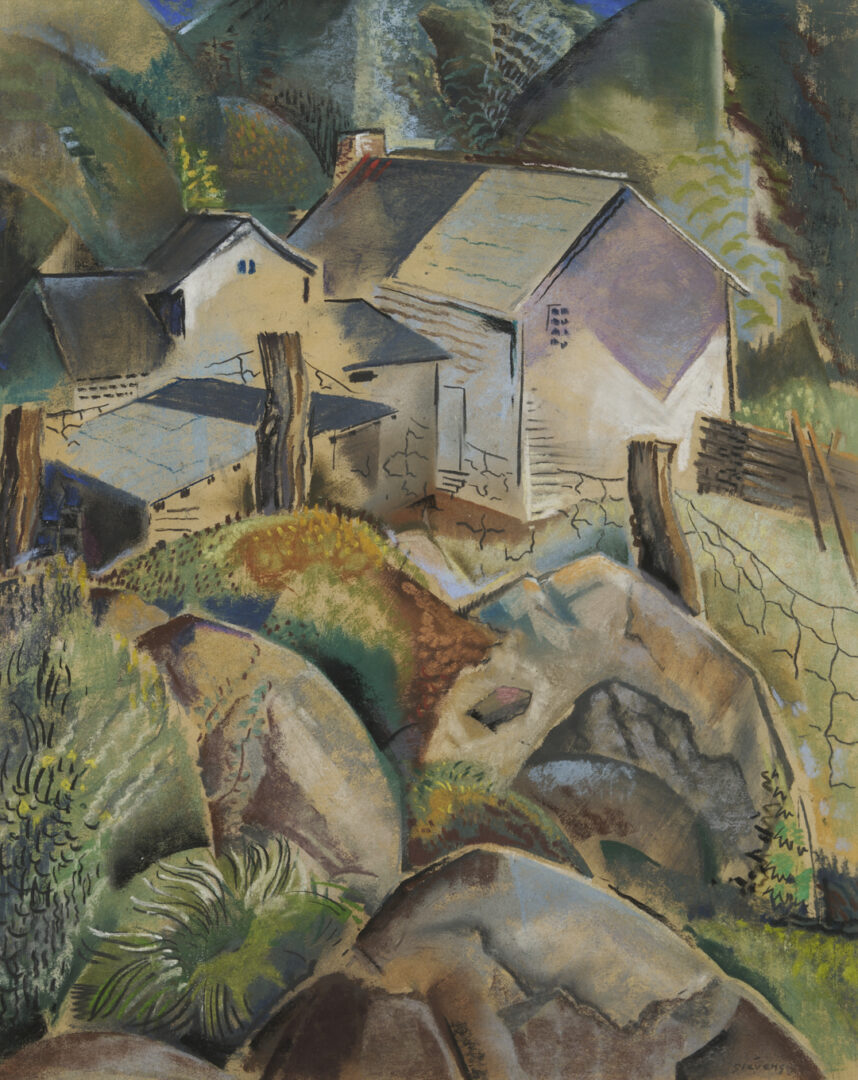
Will Henry Stevens (American, 1881-1949) pastel on paper painting depicting a cluster of buildings rising from amid mountains, likely the Appalachian or Blue Ridge Mountains, on a bright clear day. Signed “Stevens” lower right. Matted and framed under plexiglass in a narrow silvered wood frame. Old Asheville, NC framing label en verso. Sight: 19 /8 in. x 15 3/8 in. Frame: 27 in. H x 23 in. W.
Robert “Bob” Norman Ross (American, 1942-1995) oil on canvas Wet-on-Wet Technique oval landscape painting that depicts a body of water lined with tall evergreen trees and a distant, misty mountain range all beneath a yellow-and-blue sky. Impasto details describe shrubs and other plants that grow in the foreground. Signed lower left. Canvas: 18 in. H x 24 in. W. Circa 1993. A Certificate of Authenticity issued by Bob Ross Inc. accompanies this painting. Note: Unlike Ross’s artwork created for The Joy of Painting, that was typically produced in groups of three — one to use as a reference while taping, one painted on-camera, and a final, perfected version used for reproduction in instructional books — the present painting is likely a unique artwork.
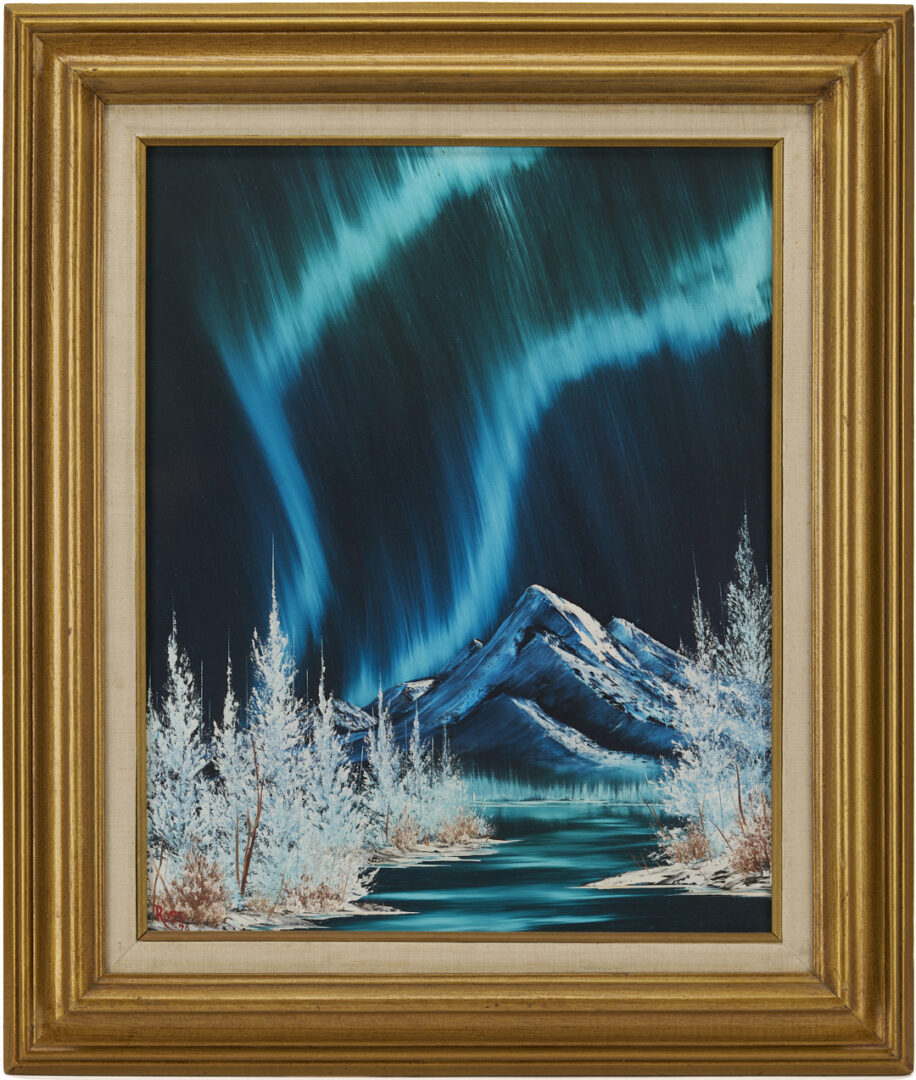
Robert “Bob” Norman Ross (American, 1942-1995) oil on canvas landscape painting depicting the Northern Lights illuminating the night sky over an Alaskan mountain, with snow-covered trees and lake in the foreground. Signed lower left “Ross” and dated 197_ (last digit partially concealed by frame). Stamps en verso for “Bob Ross Alaskan Oil Paintings,” Eielson Air Force Base, Alaska. Molded giltwood frame with linen mat. Sight: 19 1/2 in. H x 15 1/2 in. W. Frame 26 1/2 in. H x 23 in. W.
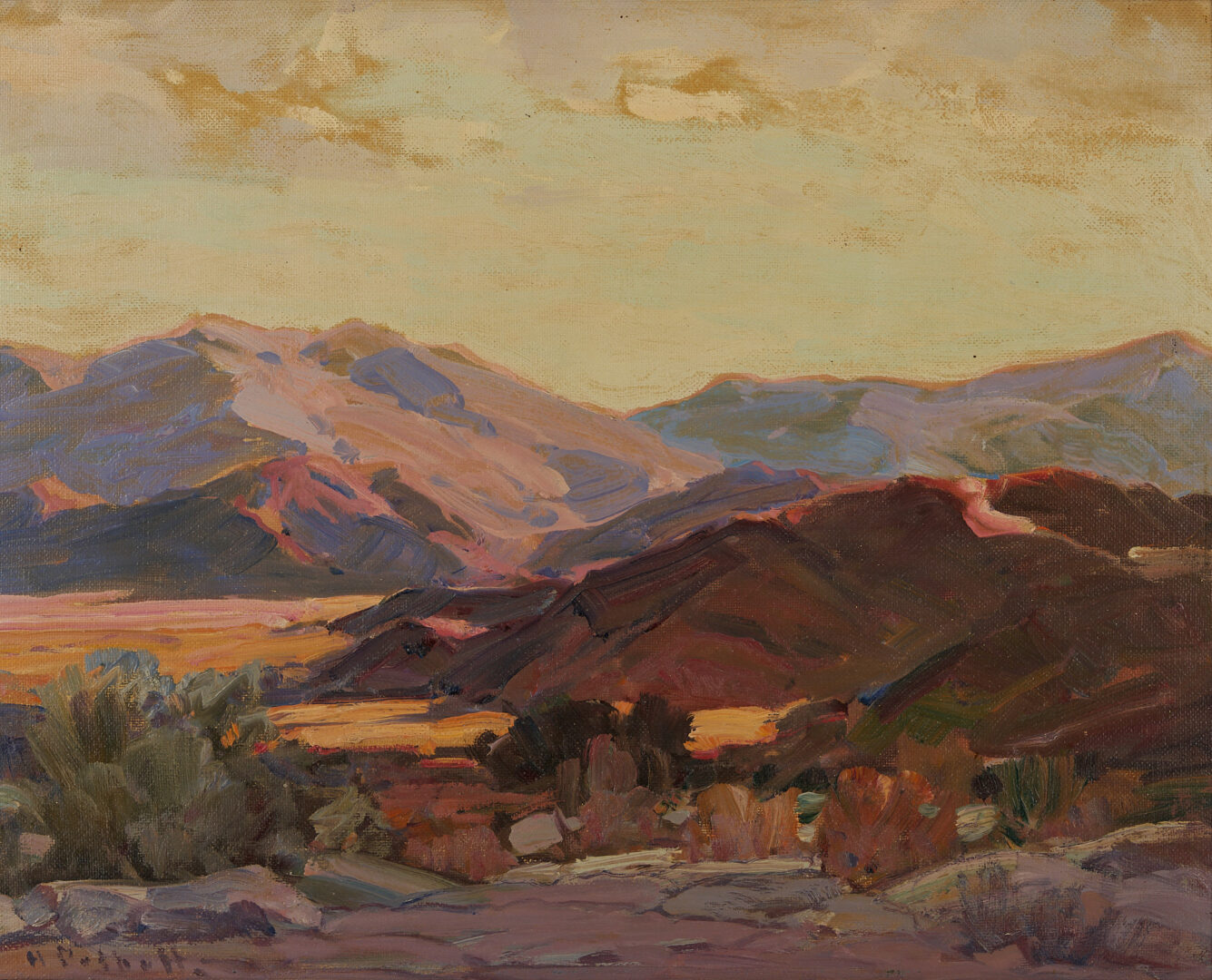
Hanson Duvall Puthuff (Missouri/California, 1875-1972) oil on board American Impressionist landscape painting, “Desert Gold.” Small plants grow before an expansive desert vista, with purple mountains that rise in the distance beneath a blue-green sky. Signed lower left. Additionally signed and titled to verso. With additional inscriptions to verso and old inventory label to back of frame. Housed in a painted wooden frame with textured liner and painted fillet. Sight: 15 1/2 in. H x 19 1/4 in. W. Board: 15 3/4 in. H x 19 1/2 in. W. Framed: 25 in. H x 29 in. W.
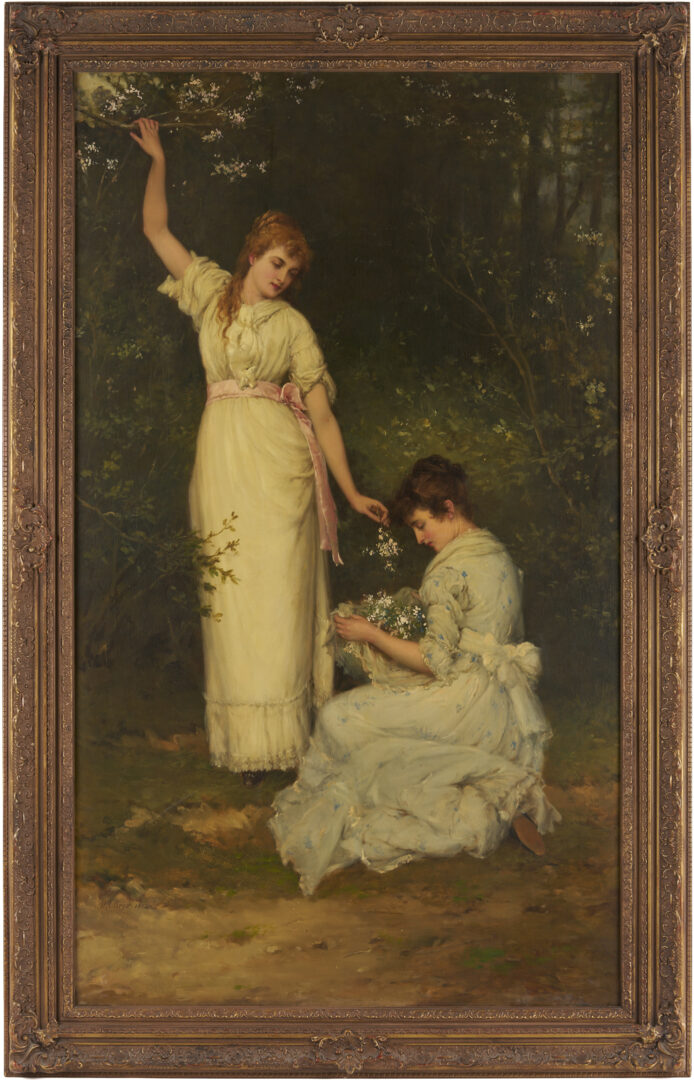
William Oliver (English, 1823-1901, sometimes referred to as “William Oliver the Younger”) large oil on canvas painting depicting two young women gathering blossoms from a tree. Signed lower left “W. Oliver” and dated 1884. Foliate and scroll molded frame with acanthus carved corner ornaments. Label en verso of frame for George Wilkinson & Co., Sheffield. Sight: 52 1/2 in. H x 30 1/2 in. W. Frame: 61 in. H x 39 in. W.
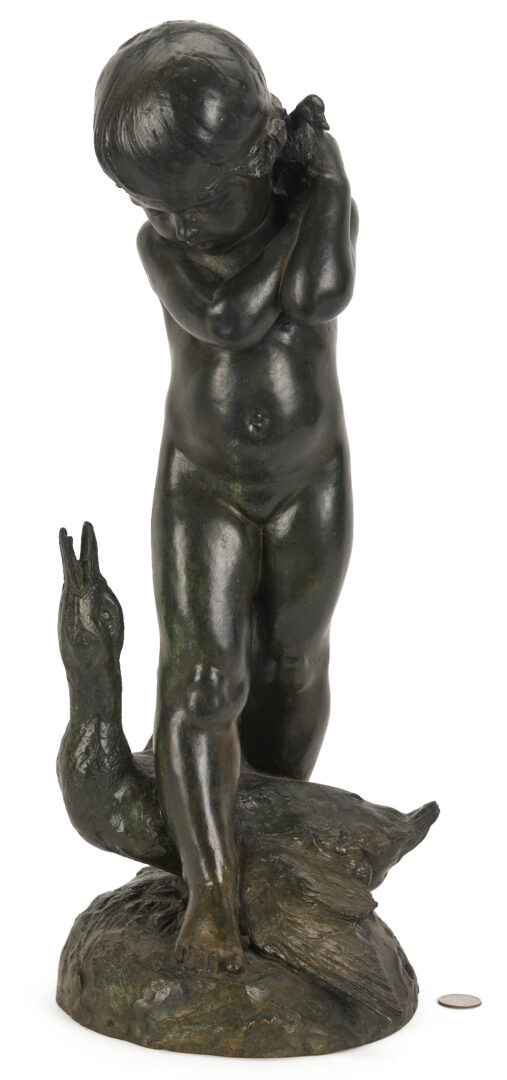
Edward Berge (American, 1876-1924) bronze titled “Duck Mother”, depicting a young child holding a duckling, standing above and gazing downward at a mother duck with outstretched wings and an open beak, who is gazing upward at the child. Impressed signature “E. Berge” on the rear of the base together with an impressed circular foundry stamp reading “Roman Bronze Works, N.Y., B20”. The sculpture is piped as a fountain. 21 1/2 in. H x 9 5/8 in. W.
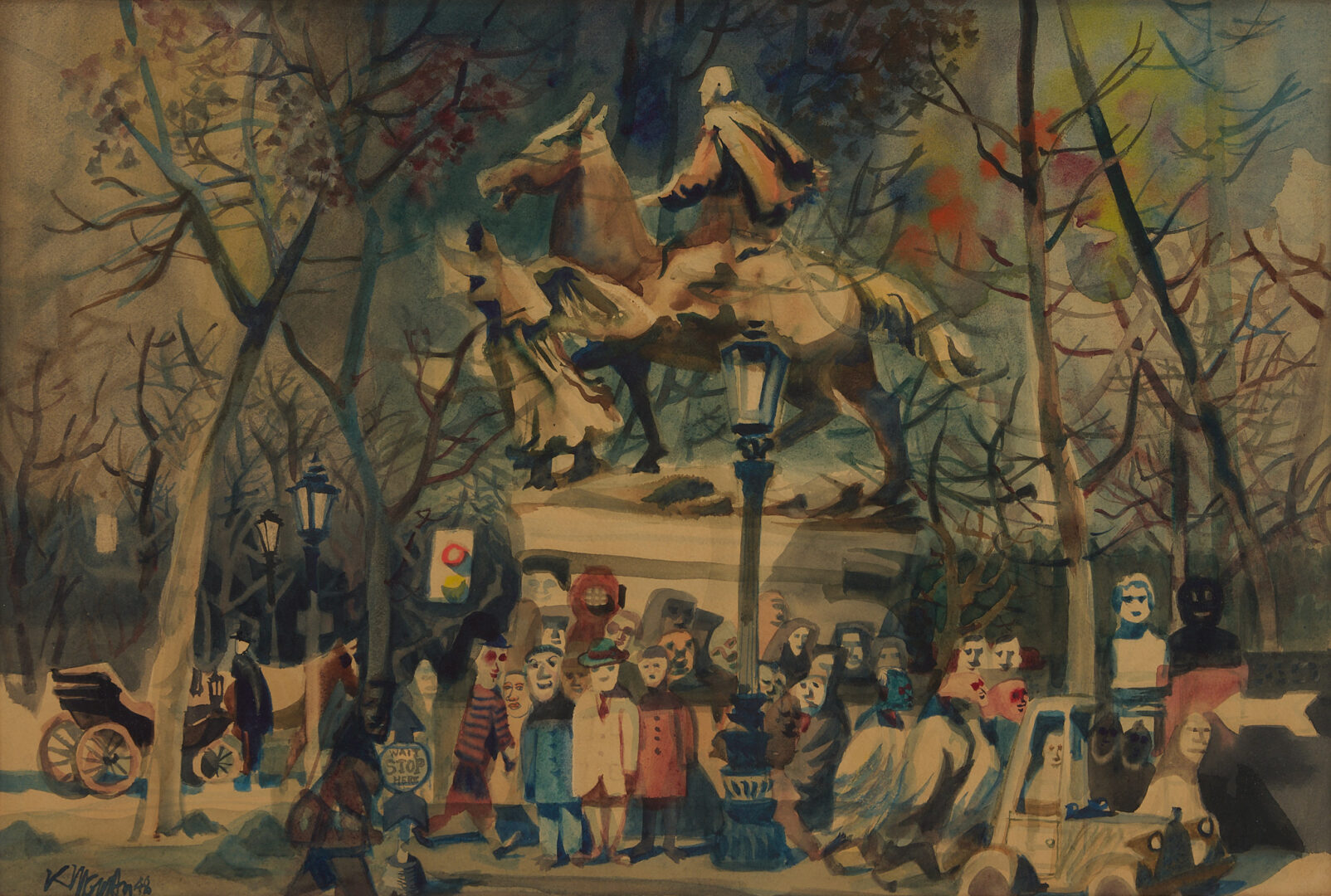
Dong Moy Chu Kingman (American, 1911-2000) watercolor painting, “Monument On Fifty Ninth St.” A group of people wait at a crosswalk before Augustus Saint-Gaudens’s William Tecumseh Sherman monument at Grand Army Plaza in Manhattan. Signed and dated to lower left. Titled and illegibly inscribed (possibly “J401” or “J49”) en verso. Housed under glass in a painted wood frame with cream mat. Sight: 14 1/4 in. H x 21 1/4 in. W. Sheet: 15 1/2 in. H x 22 1/4 in. W. Framed: 28 in. H x 34 in. W. 1948.
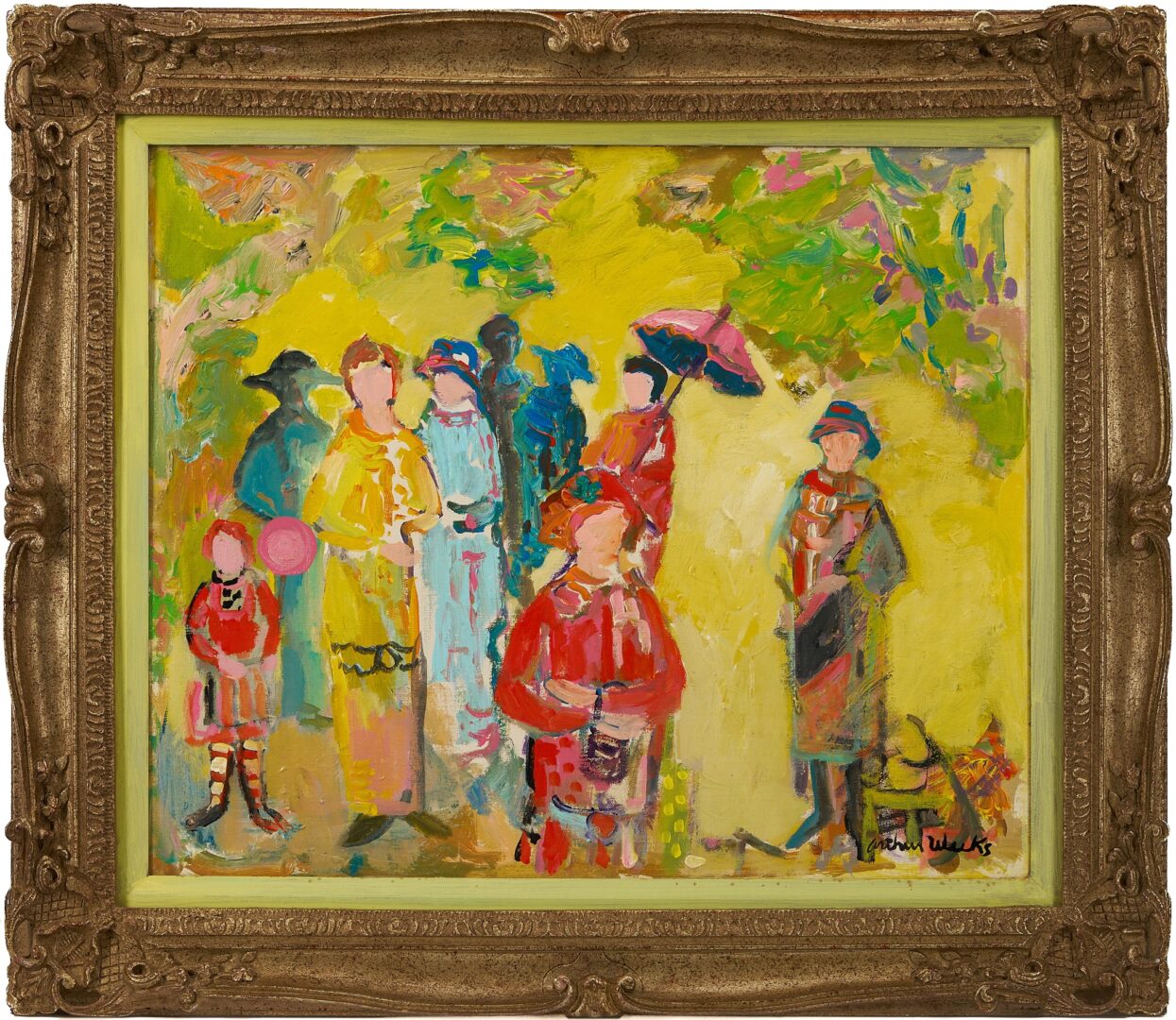
Arthur Weeks (American/Alabama, 1930-1988), oil on canvas impressionist painting depicting figures in a park, illuminated by golden sunlight. Signed “Arthur Weeks” lower right and additionally signed and titled (“Figures in a Park”) en verso. Rococo style giltwood and molded frame with pierced corner ornamentation and a green wood mat. Stretcher: 20 in. H x 24 in. W. Frame: 27 in. H x 31 in. W.
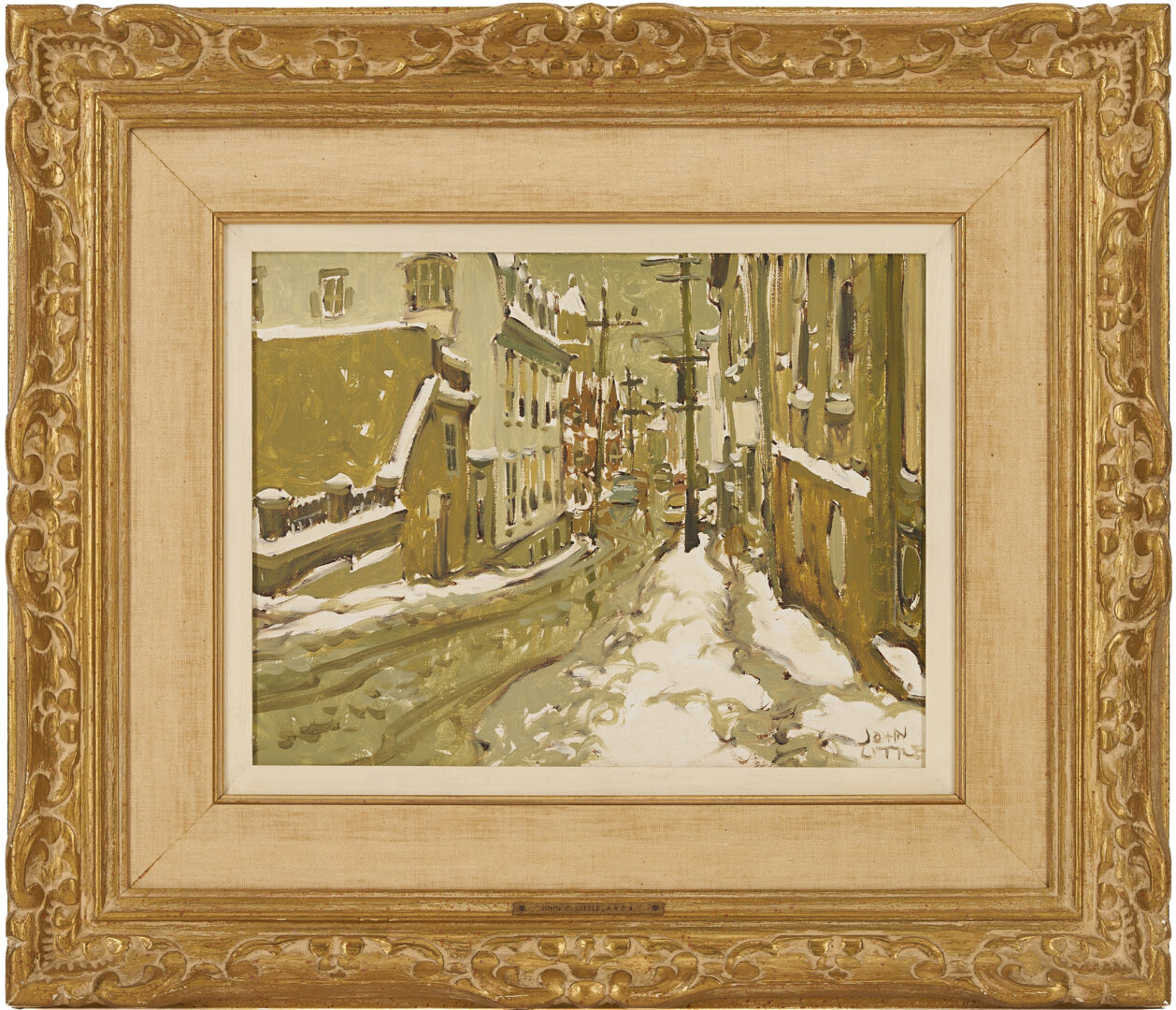
John Little (Canadian, 1928-2024), “Rue Laporte, Quebec,” oil on board Winter street scene painting. Signed “John Little” lower right. Additionally signed, titled and dated 1966 en verso. Housed in a carved giltwood frame with linen mat. Board – 13 in. W x 10 in. H. Frame – 21 1/2 in. W x 18 1/2 in H.
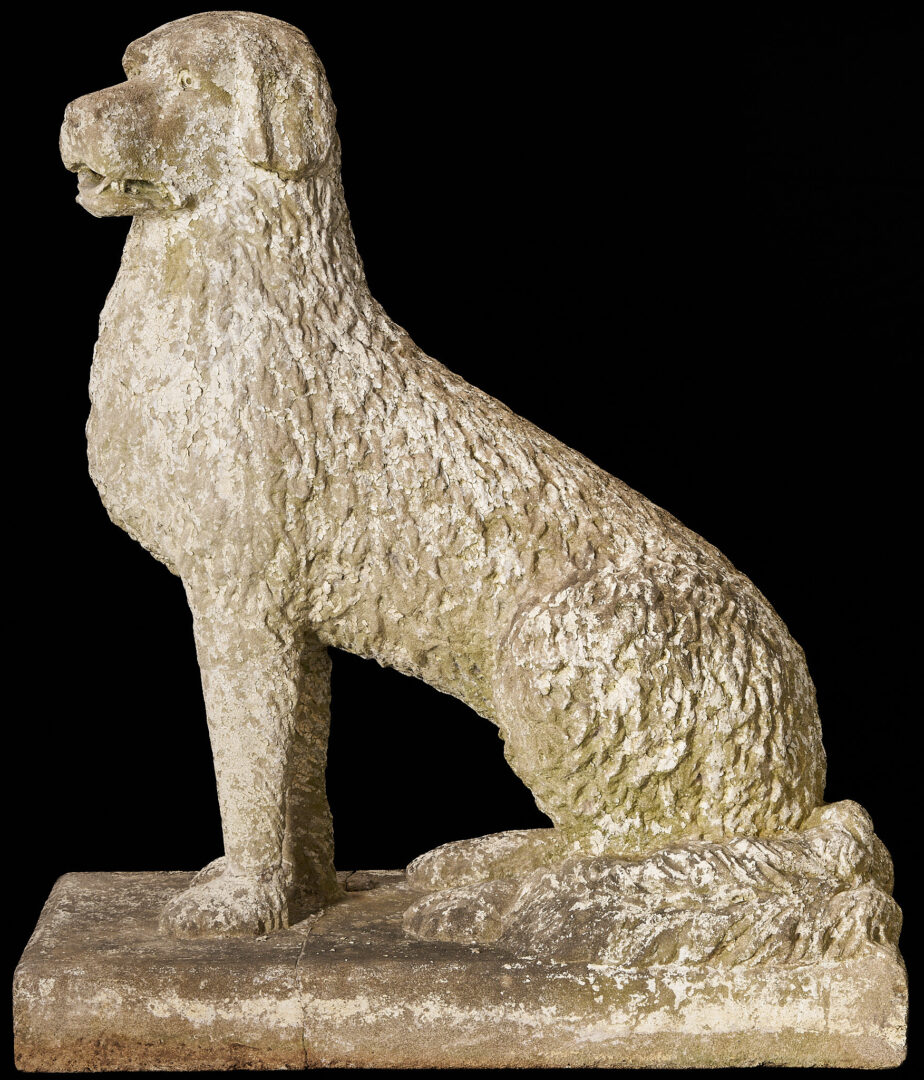
Large carved stone dog sculpture from the Knoxville, Tennessee estate of George Washington Callahan (1862–1927). From stone cutter apprentice to marble yard owner, then alderman, successful railroad builder, and gentleman farmer, Callahan was a prominent figure in Knoxville’s history and is still remembered today for the road and I-75 interstate exit that bears his name. The dog sculpture is pictured with the family in front of their home, Amberwood Hall, at their Valley View Farm estate. The dog was once the victim of a mischievous heist by a University of Tennessee fraternity in 1948, where his front paws and base were cracked and repaired. 38 in. H and 32 in. L. Late 19th/early 20th century. Provenance by descent of the Callahan family.
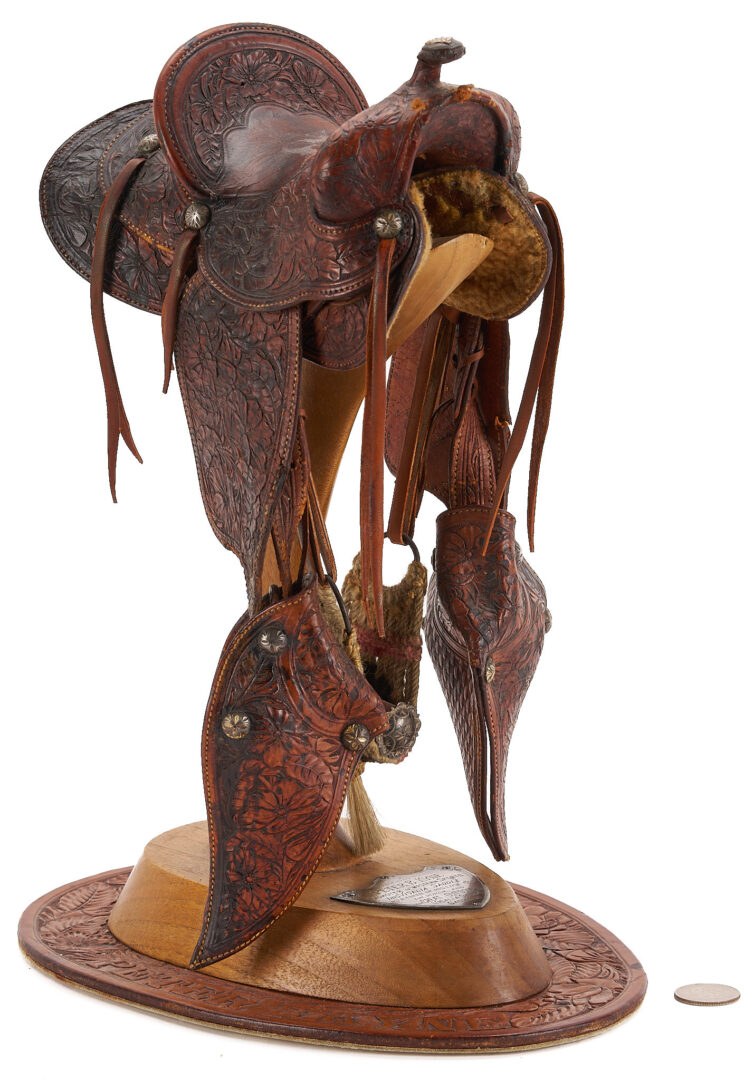
Miniature presentation saddle, made by the Visalia Stock Saddle Company, San Francisco, circa 1935. Miniature floral carved saddle with original fleece lining, and raised silver or gold horsehead on the sterling horn cap. Six engraved sterling silver spots mark each saddle string with three more adorning the elegant long monkey-nose tapaderos. Saddle is displayed on a custom-made solid California oak stand secured by a miniature braided natural black and white horsehair cinch. The stand sits atop a floral carved leather base with the original recipients name tooled into the leather and a Visalia Stock Saddle Co S.F. oval plaque inset in the leather seat. A sterling silver plaque is inscribed to Peter B. Kayne. 13 in height with a 4″ seat, 3 3/4″ high cantle.
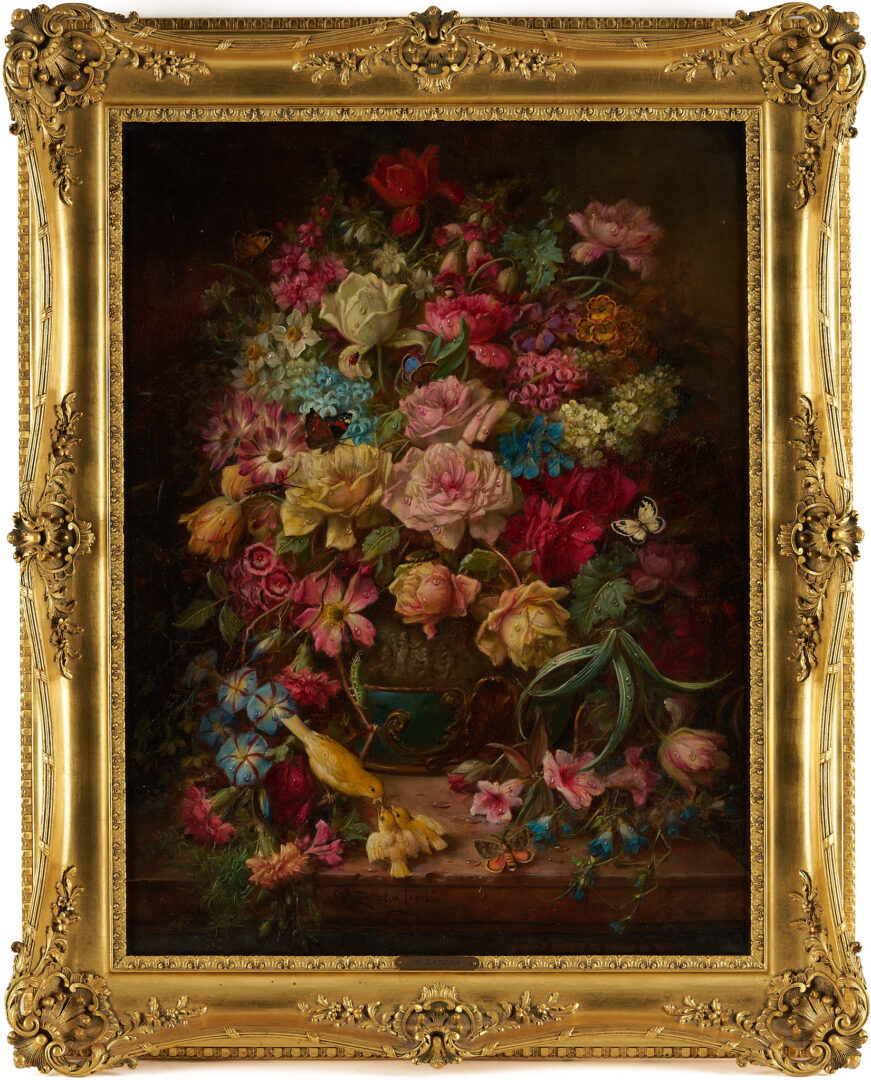
Hans (Ronsard) Zatzka (Austria, 1859-1945) oil on canvas floral still life painting that depicts an ornamental vase filled with a variety of dewy, multicolored flowers. Butterflies, a bee, ladybug, caterpillar, and other insects populate the scene along with a small yellow bird that feeds two fledglings. Signed ” H. Zatzka Fecit” to lower center. Additionally signed and inscribed “Jede art nachbildung vorbehalten” (All forms of reproduction reserved) en verso. With Leopold Hess, Berlin stamps to stretcher. Housed in an ornate giltwood frame with name plate. Sight: 29 1/4 in. H x x 21 7/8 in. W. Canvas: 30 3/4 in. H x 22 3/4 in. W. Framed: 37 in. H x 29 1/2 in. W.
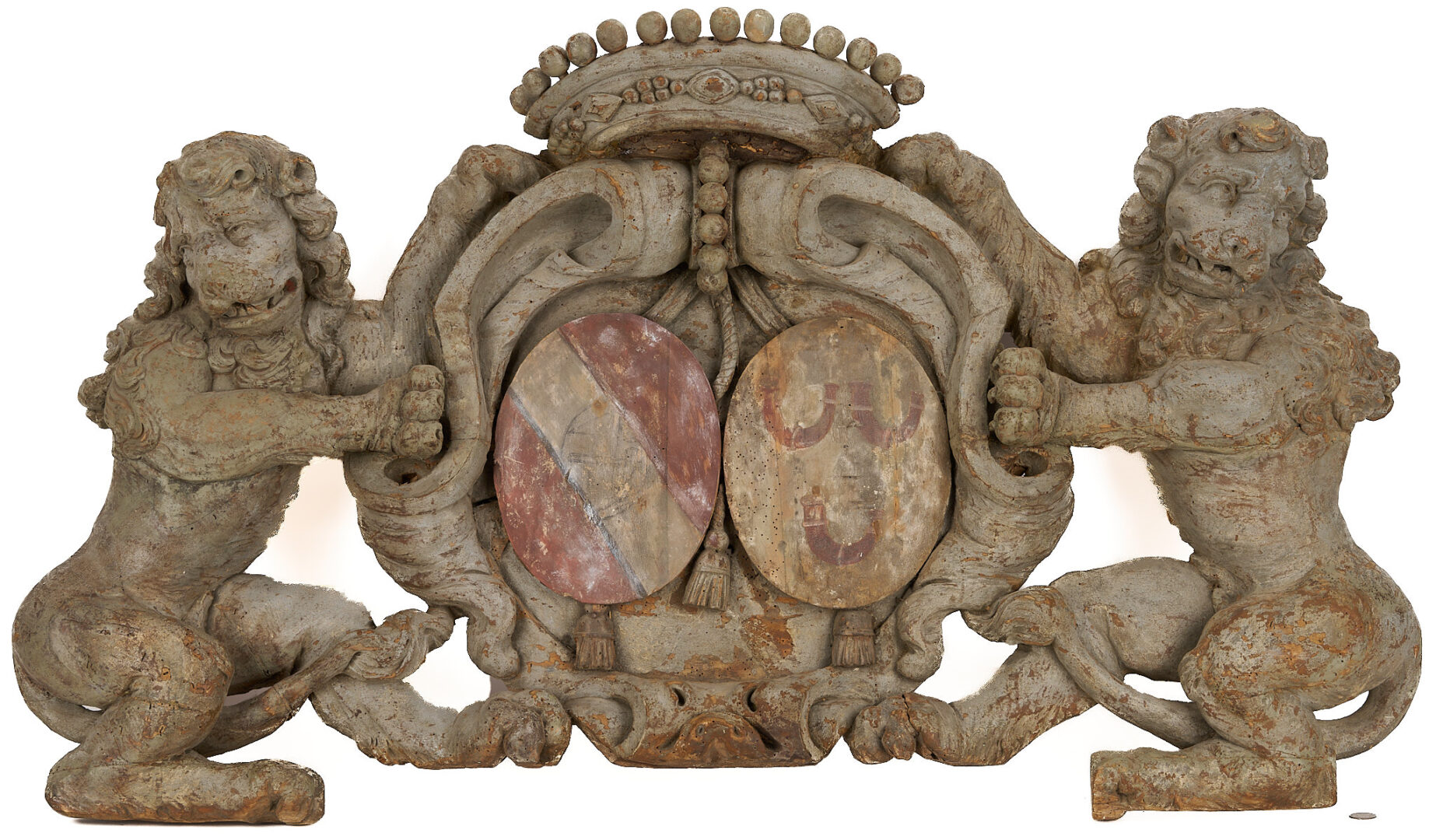
Continental, likely Dutch, polychrome carved wooden architectural coat of arms with conjoined crowned shields and tassels, flanked by two rampant lions. 50 in. W x 28 1/2 in. H x 7 in. D. Late 17th to early 18th century.
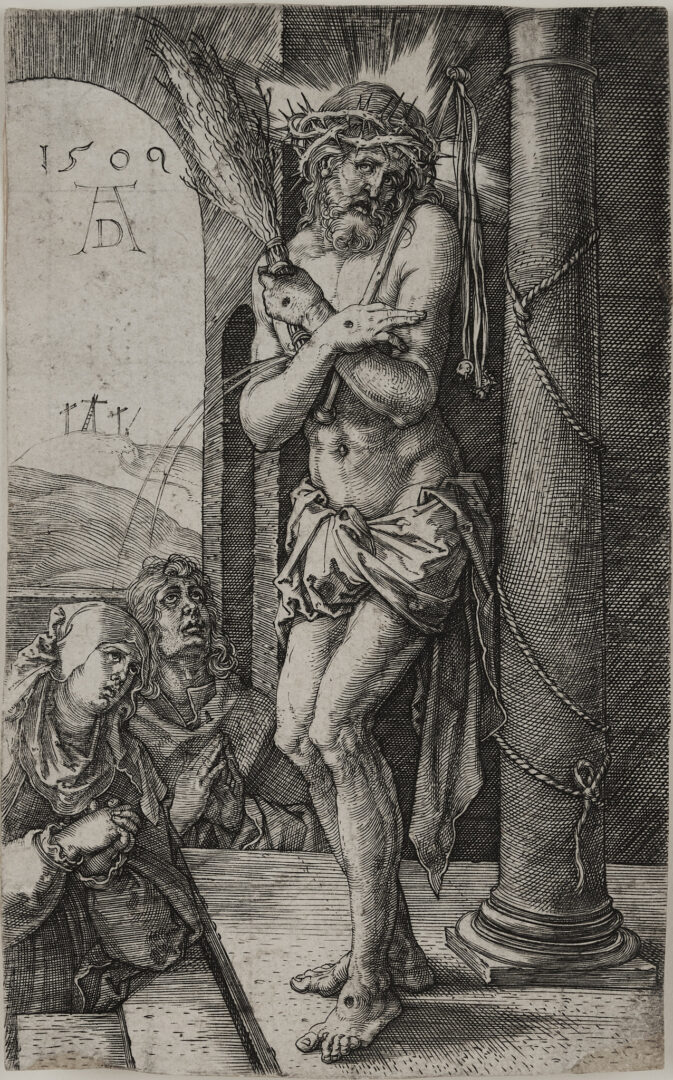
Albrecht Durer (German, 1471-1528) etching on laid paper, “Man of Sorrows by the Column,” from the Engraved Passion series. A Meder c-d (of e) impression, with very faint traces of the vertical wiping scratches to left of Christ’s feet and beneath monogram. With stamped collector’s marks of Albert W. Blum (1882-1952) (Lugt 79b & 3198) plus inscription in ink, possibly “I.N.” en verso. Ref.: Bartsch, Meder 3. Floated under glass in a giltwood frame with cream textile mat and gilt fillet. Sheet: 4 5/8 in. H x 2 7/8 in. W.
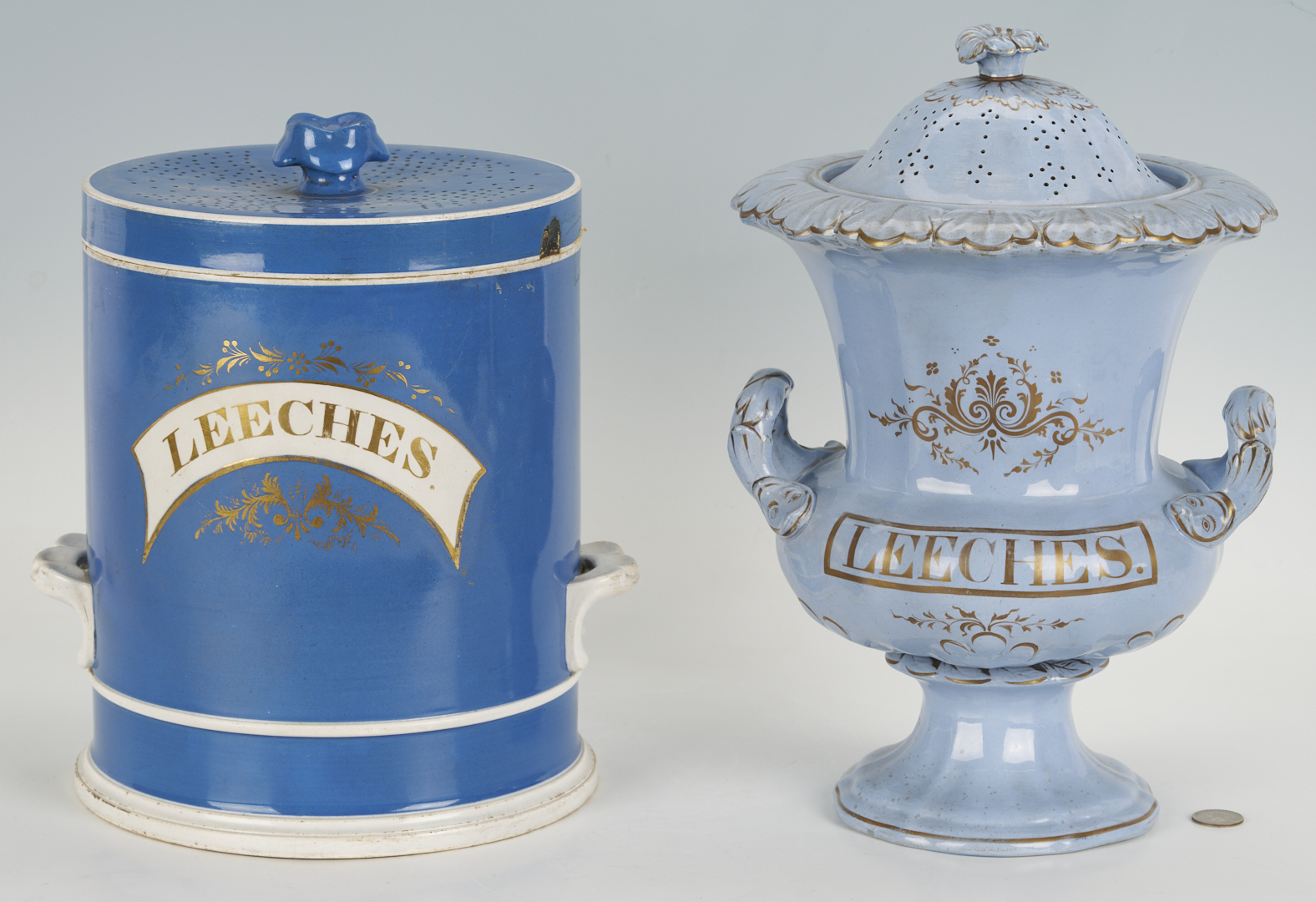
Two (2) Staffordshire Apothecary Jars, Leeches. 1st item: Blue English Staffordshire cylindrical apothecary jar with “LEECHES.” label in a white swag banner with gilt lettering. Exterior has two white handles and a perforated Maltese cross-designed lid with bud finial. Bottom has red-gummed label with E-18 inventory number, from the Max M. Warsaw Collection, Chicago. 13 in. (incl. lid finial) H x 10 in. D (incl. handles). 2nd item: English Staffordshire apothecary jar with perforated domed lid and pedestal base. Labeled “LEECHES.” in gilt lettering, with gilt accents. Exterior finial and two handles. Gilt faces painted on each side of handles. 10 in. with lid H x 4 1/2 in. D., Bottom has red-gummed label with E-19 inventory number, from the Max M. Warsaw Collection, Chicago. 15 in. (incl. lid finial) H x 8 in. D (incl. handles).
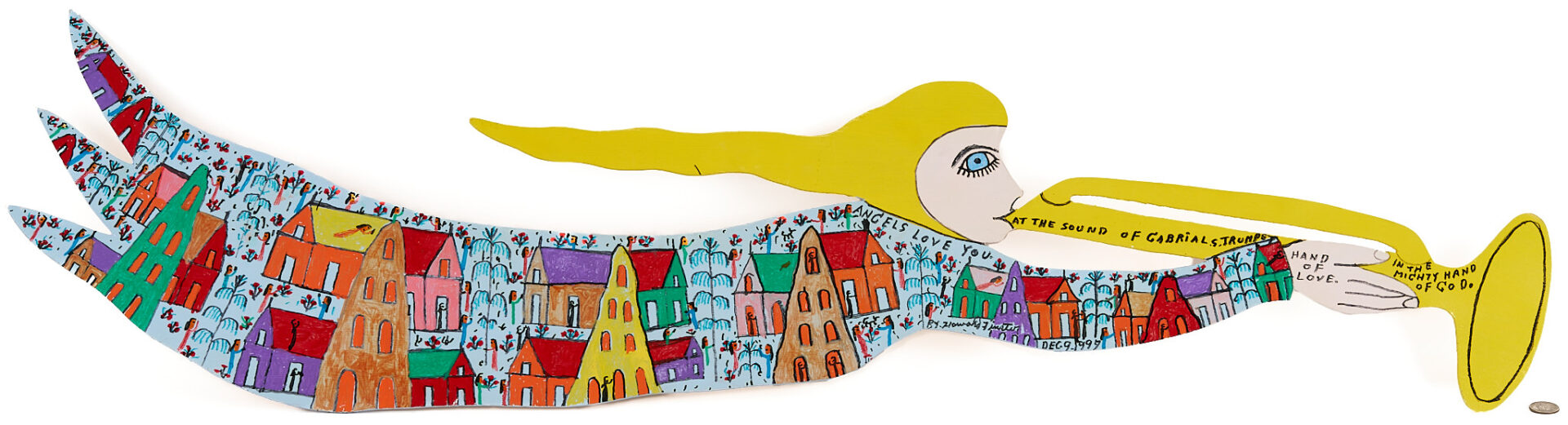
Howard Finster (Georgia/Alabama, 1916-2001) paint on cutout board of a trumpeting angel with blonde or yellow hair, unusual for Finster’s angels. Decorated with repeating colorful figures, botanical elements, architectural vignettes, and text including “Angels Love You,” signed and dated Dec-9-1997. Additional textual, scriptural, and numerical elements in marker en verso including date, artist’s name, and number 42,000.651. 48 in. L x 8 in. W x 1/4″ D. 1997.
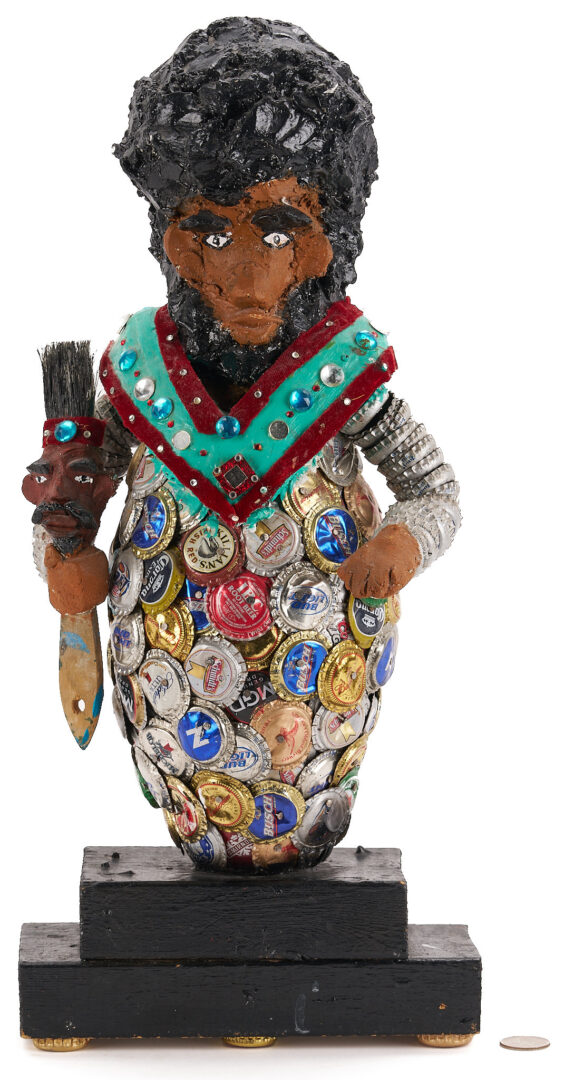
Gregory Warmack, aka Mr. Imagination (American, 1948-2012), “Self Portrait,” outsider art mixed media sculpture made of bottle caps, clay and paint on bowling pin and paint brush. Mounted to a painted black wood base, signed “Mr. I” and dated 2004. 19 in. h x 9 in. W x 7 in. D.
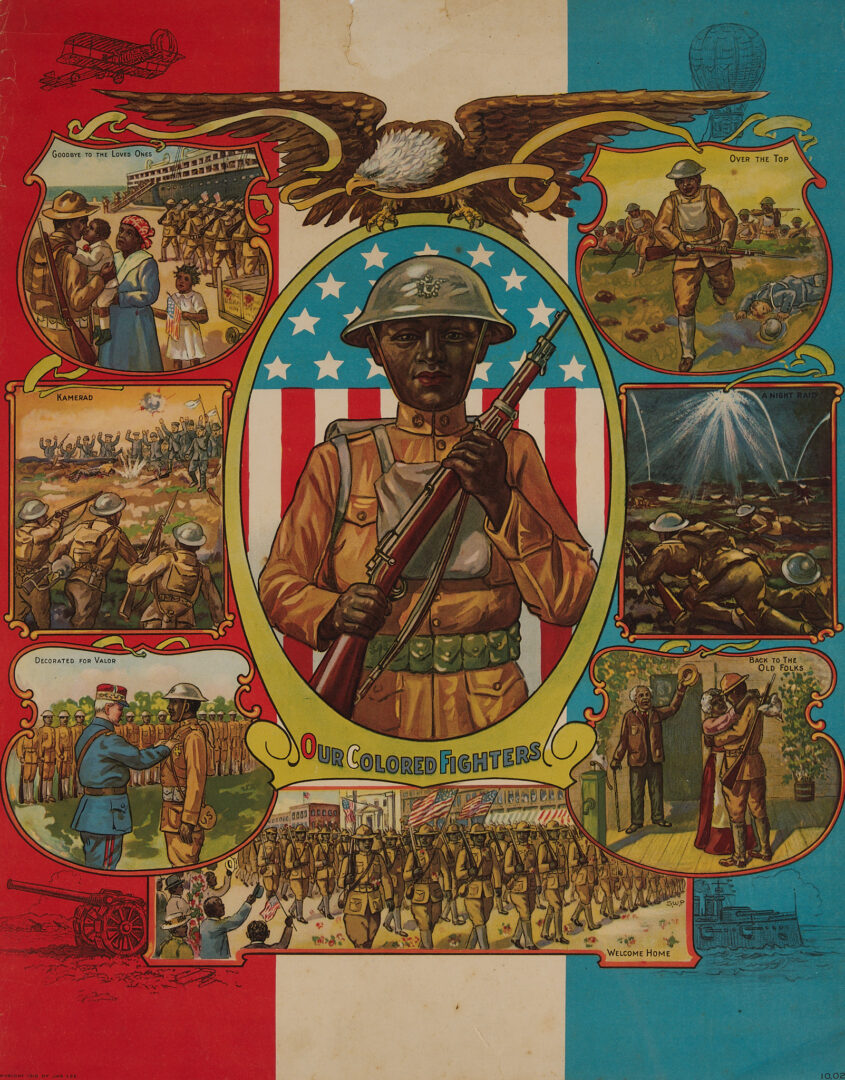
OUR COLORED FIGHTERS chromolithographic poster published by James Lee, 1918, featuring vignettes of Black soldiers including Goodbye to the Loved ones to Over the Top, Kamerad, a Night Raid, Decorate for Valor, to a glorious Welcome Home and Back to the Old Folks. 20 in. H x 16 in. W. Unframed. Note: this rare poster was produced in connection with a 24 minute film shown around the country by order of President Woodrow Wilson to promote recruitment.
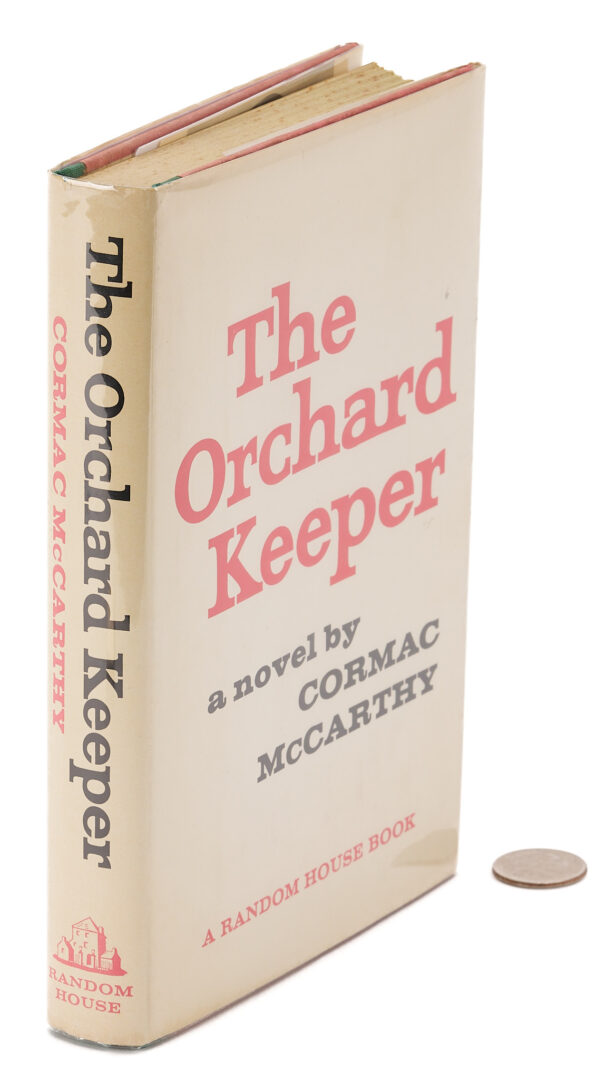
Author Signed, THE ORCHARD KEEPER, Cormac McCarthy, Random House, New York, 1965. First Edition, with stated “First Printing” on copyright page; inscribed and signed by McCarthy on the front free endpaper, “To Mr + Mrs Susano Cormac McCarthy”. 8vo, in publisher’s green and red boards with gilt stamping, with dust jacket in protective archival cover. McCarthy’s first book, with only 4,000 printed in the first run. 8 1/2″ L x 5 3/4″ W.
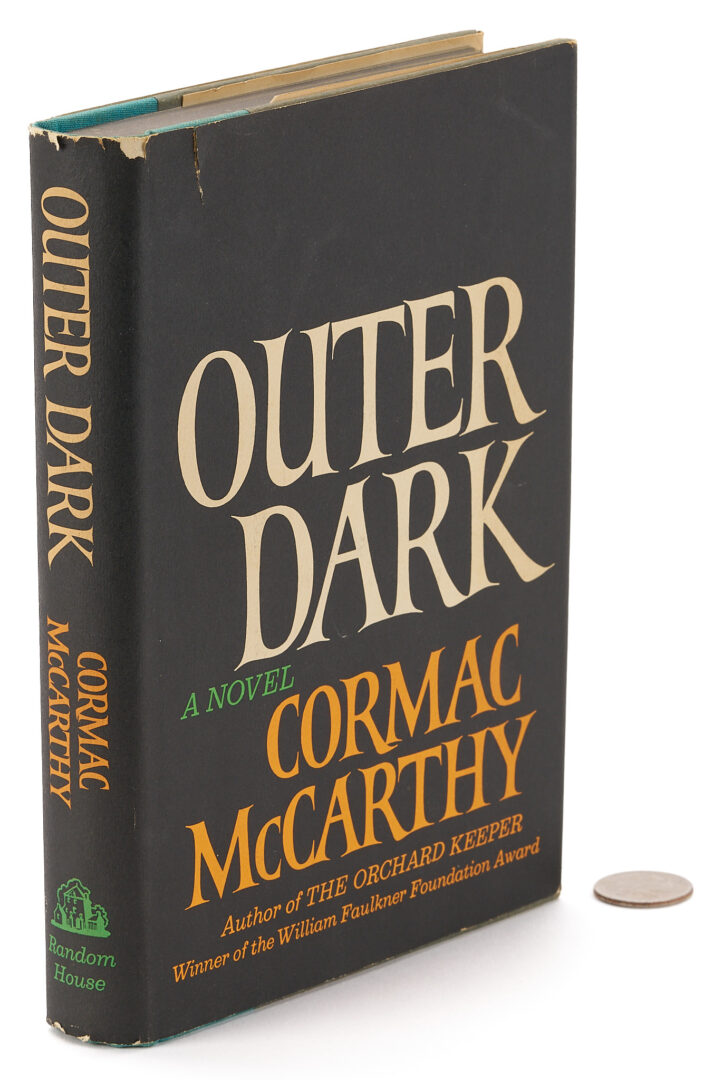
Author Signed, OUTER DARK, Cormac McCarthy, Random House, New York, 1968. First Edition. “First Printing” on copyright page; inscribed and signed by McCarthy on front free endpaper, “For Dr + Mrs Frank Rogers Cormac McCarthy”. Original light blue 1/4 cloth and gray paper boards; First state jacket with price of $4.95 and date of 9/68 intact. McCarthy’s second book, only 5,000 printed in the first run. 8 1/2 in. H x 5 3/4 in. W.
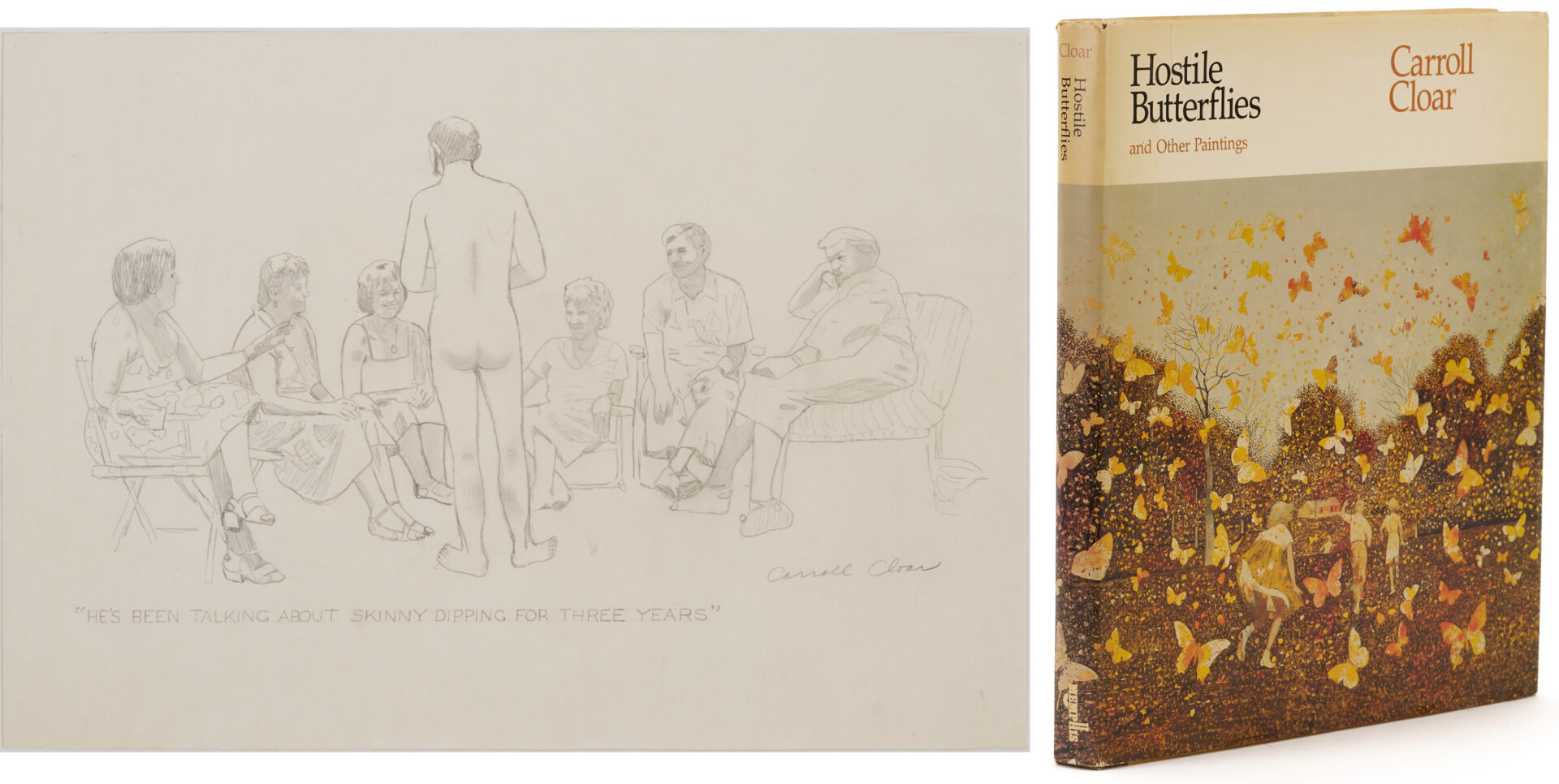
1st item: Carroll Cloar (American/Tennessee, 1913-1994) graphite on paper drawing. A nude man stands before a group of seated women with his back to the viewer. Inscribed or captioned “He’s been talking about skinny dipping for three years,” lower left, and signed “Carroll Cloar,” lower right. Unframed. Shipping tube included. Sheet: 10 3/8 in. H x 15 5/8 in. W. Tube: 36 in. L x 2 in. Dia. Note: The father of the consignor was the model for the standing figure in this drawing. 2nd item: Signed copy of Carroll Cloar’s book “Hostile Butterflies and Other Paintings: Carroll Cloar” published in 1977 by Memphis State University Press. Inscribed “To Paul and Lulu / affectionately, / Carroll Cloar / Nov. 21, 1977.” 10 3/4 in. H x 9 3/4 W x in. 1 in. D.
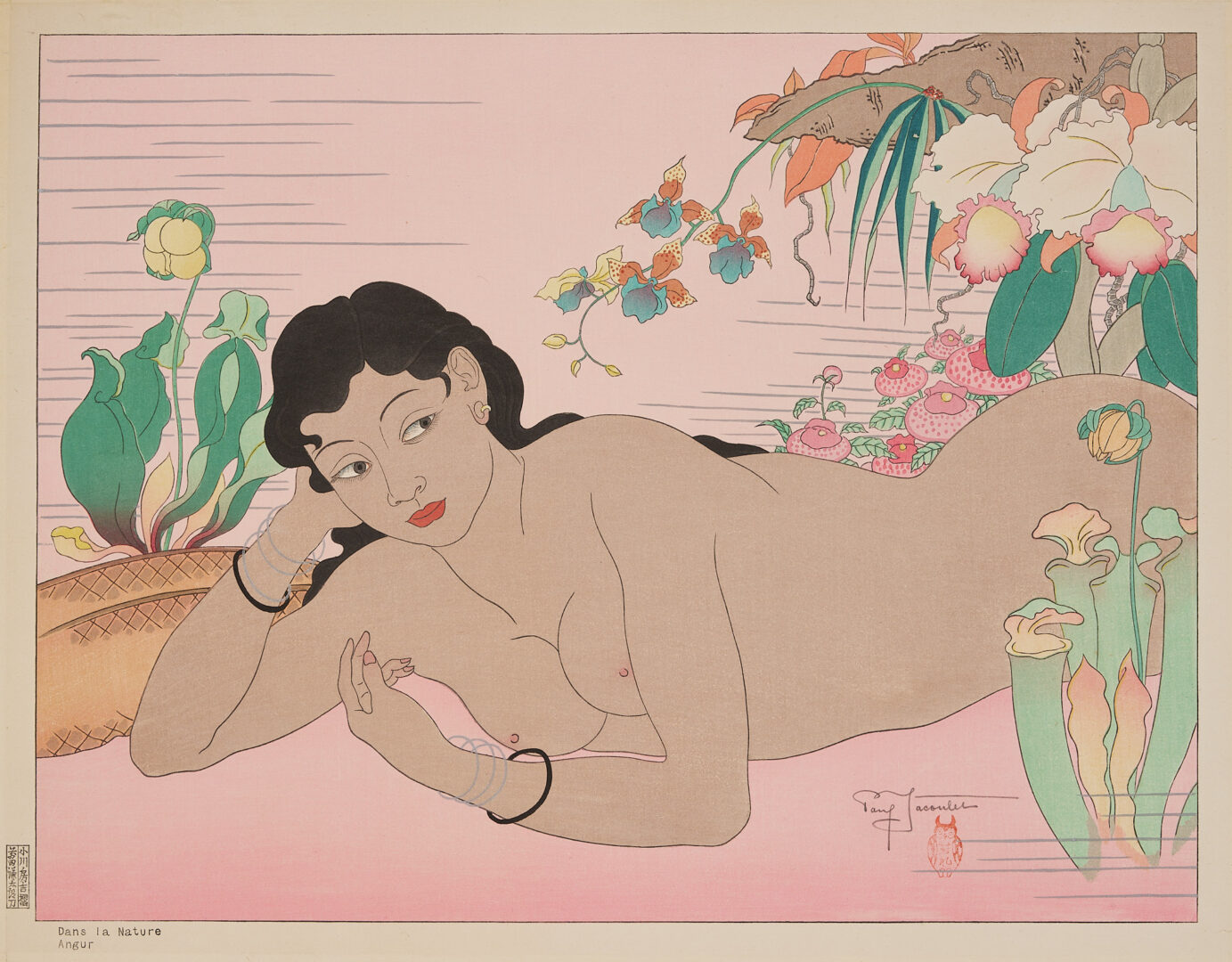
Paul Jacoulet (France/Japan, 1902-1960) Japanese woodblock print on wove paper, “Dans La Nature, Angur “(According to Nature, Angaur). A nude woman lies on her stomach while surrounded by blooming flowers. From the edition of 350. Pencil signed above owl hop mark, lower right. With printed title to lower margin, seals of carver and printer to left margin. Artist’s watermark (his initials and name in kanji) at upper left. Red stamp numbered 255/350 en verso. Sheet: 14 5/16 in. H x 18 3/4 in. W.
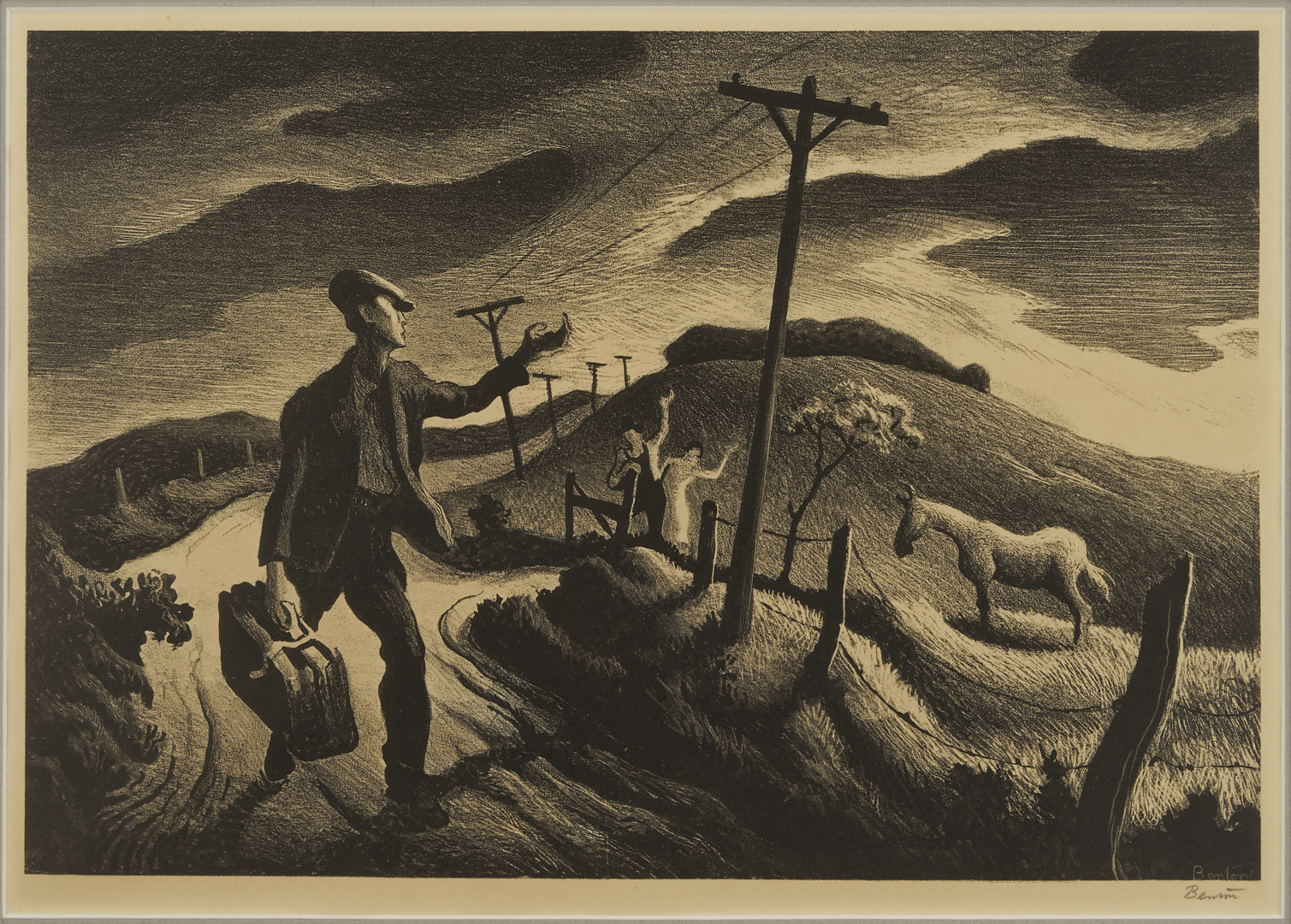
Thomas Hart Benton (American, 1889-1975), regionalist lithograph titled “The Boy.” A young man holds a suitcase and gestures toward his mother and father as he walks down a country road and toward the viewer. From the edition of 250 published by Associated American Artists, New York. Signed in pencil, lower right margin, and in the stone. Ref.: Fath 72. Housed under acrylic in a silvered wood frame with cream mat and silver reveal. Sight: 10 1/4 in. H x 14 1/4 in. W. Framed: 19 1/4 in. H x 23 in. W. 1948.
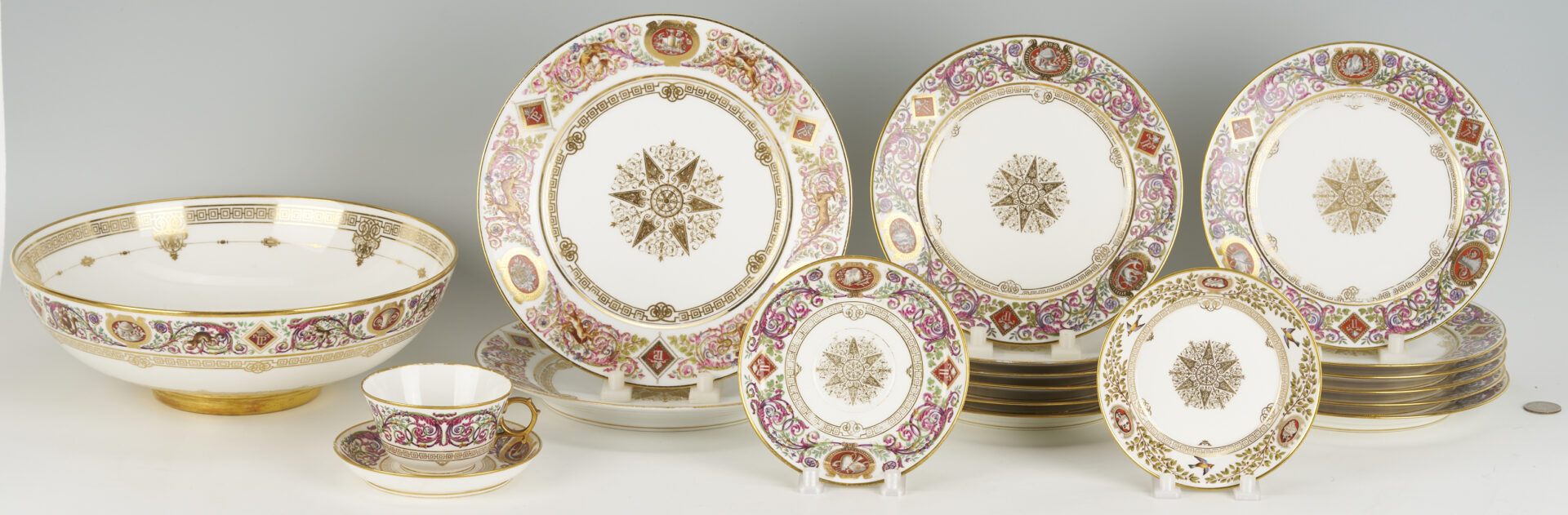
Nineteen (19) pieces of Sevres porcelain from the Chateau De Fontainebleau hunting service, commissioned by King Louis Philippe. Circa 1845. Includes one (1) large serving bowl, 11 in. dia. x 3 5/8 in. H; twelve (12) salad plates, 7 3/4 in. dia.; two (2) dinner plates, 9 1/2 in. dia.; one (1) teacup and matching saucer; one (1) shallow bowl, 5 3/8 in. dia.; and one (1) bread and butter plate, 5 1/2 in. dia. Undersides with royal and factory marks used 1845-1848. Note: A devoted patron of the Sevres Factories, King Louis Phillipe of France commissioned large porcelain dinner services for each of his official residences. The de Fontainebleau service order was initiated in 1836 and deliveries continued through the early 1840s. The service was augmented by additional orders made through 1847. The marks on these pieces indicate they were from this final order. The service was designed with two different though complementary borders. The design on the present dishes is the less complex of the two. It features a foliate arabesque border entwined with birds and animals, and oval reserves containing various emblems and ornaments, and diamond shaped reserves enclosing the royal cipher. According to the Metropolitan Museum of Art, which owns a soup plate from this collection, “Louis-Philippe’s initial order for the service had specified that it ‘would bear a bas-relief in the Renaissance style,’ a direct reference to the chateau’s Renaissance origins and distinctive character. The service as finally designed did not specifically reflect the king’s request, but the leafy borders recall the nearby extensive forest, and the animals entwined in the foliage allude to the hunting for which the Chateau was famous.” https://www.metmuseum.org/art/collection/search/198016
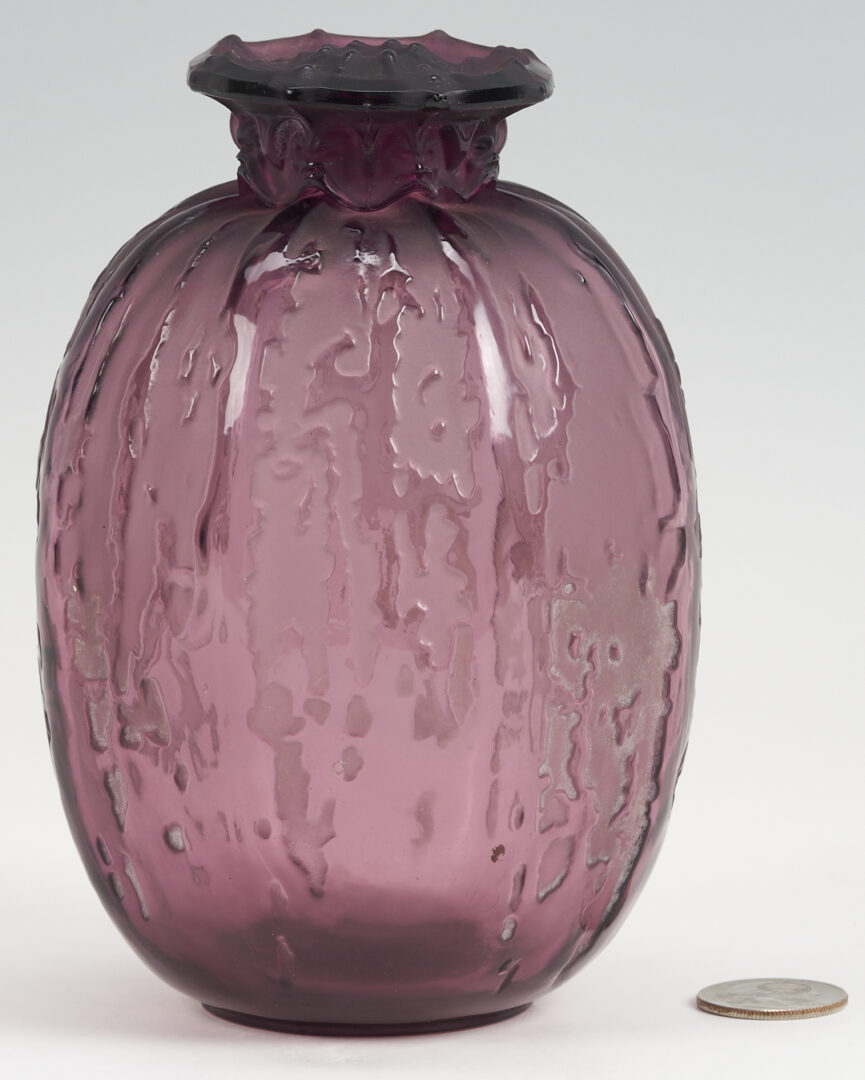
Rare Rene Lalique Fontaines (Fountains) Amethyst Glass Vase and Cover, with textured design simulating falling water emanating from the cover. Signed R. Lalique to bottom edge, side. Height 6 inches. French, circa 1912.